Trees

Out of the window of my boyhood bedroom there was a line of huge Elms. So much did they dominate the landscape that what was beyond was thrown into the shadows. They were more part of the skyscape as they raised their branches to touch the clouds.

I wondered at the massive trunks of these trees. They were the Californian Redwoods of my childhood Somerset. Tall and straight, their bark was grey and smooth. These towering Elms stood bolt upright against any weather. Season after season they were the predominant landmark. Sadly, it’s a disease that brought an end to these tall living monoliths. Now, they exist only in a few black and white pictures and the memories of people like me.

Trees play a bigger part in our lives than we ever acknowledge. It’s often when they have gone that we miss them the most. As the words of the song goes: “you don’t know what you’ve got ’til it’s gone.” Capturing the melancholy remorse of loss, words can’t replace the impact of these living leviathans. Visually stunning their image is lost but not forgotten.

Today, on the same country road where these Elms grew directions are often given to “turn right at the bendy tree”. In this case referring to an out of place Fir tree on a marshy riverbank. What’s common is its success in shooting towards the sun. Looking dishevelled and leaning one way, this lone Fir tree is a perfect navigation aid.

This week’s story about the Sycamore Gap[1] has resonance for me. I’m not alone in that feeling. One tree has captured the national news. The words I have for those who brought a chainsaw to this beauty are not repeatable[2]. More mildly I’d say: moronic vandals who must have brains the size of tiny walnuts, if they have any brains at all.

Sane people can’t for one single moment understand why a prat, or prats did this cruel act. Sadly, vandalism is all around us, but this takes the biscuit. Surely even amongst complete and utter idiots there remains some sense of what’s beyond the pale[3].

Village stocks were made of wood[4]. They still are, where they still stand. A good punishment for the perpetrators of this crime would be that stocks are erected on the site. The villains must spend a winter in the gap. I’ll be kind and suggest that they not be held there for 300-years. Naturally, the stocks should be made of sycamore wood.


[1] https://news.sky.com/story/sycamore-gap-tree-second-person-arrested-in-connection-with-felling-of-iconic-landmark-12972772

[2] https://www.chroniclelive.co.uk/news/north-east-news/sycamore-gap-tree-northumberland-live-27801497

[3] https://dictionary.cambridge.org/dictionary/english/beyond-the-pale

[4] https://www.propfactory.co.uk/listing/item/GGG009.html

Adaptation

There was a time when AI was an esoteric subject that filled the minds of high-minded professors. They had real trouble trying to translate what they were doing into langauage that most of us would understand. Research in the subject area was the purview of national institutes and military facilities. Results flowed into academic journals and little read folders in the corners of university libraries.

That has changed. What was expensive to build and test because everything was unique or bespoke is no longer. Enough is known about algorithms that work, and the ones that don’t, to make practical experimentation much more viable. AI tools are turning up on our desktops, tablets, and phones without us even asking. Opting-in is often assumed.

A massive number of applications are nothing more than fizz. They can be useful, but they are not game changers, and our lives carry on much as before. What is new, or at least pushing at the door, is applications that control things in our everyday environment.

If traffic lights start guessing what my age is before allocating a maximum time to cross the road, we are going to start to see a good amount of pavement rage when they get it wrong. When AI algorithms drive my car for me it’s going to be a bad day when accidents start to accumulate[1] (even if the total system of systems is far safer than us mere humans). Anyway, it’s easy to write scary stuff about AI. In this case I’d like to highlight some positive gains that might be realised.

A lot of what is designed, produced, and sold is pretty much fixed the day it leaves the shop or showroom. Yes, for example, cars are recalled for fixing known deficiencies but the threshold for taking such action is extremely high. Even in a safe industry like civil aviation dealing with an unsafe condition that has been discovered takes time and a great deal of resources.

AI has the potential to be adaptive[2]. So, that thing that you buy, car, washing machine, or whatever, will have the inbuild ability to learn. To adapt to its situation. To be like others of its type but, over time, to customise itself to the needs of its user.

Just image a domestic appliance that can adapt to its pattern of use. Always staying with safe boundaries, producing maximum energy efficiency, and doing its job to the best of its specification. Let’s imagine a car that gets to know common routes and all the hazards on those routes and even takes the weather and time of day into account when driving those routes.

In all that adaptive potential there’s great benefit. Unlike buying gloves that are made to specific standard sizes and don’t quite fit you, the adaptive glove would be that malleable leather that slowly gets a better and better fit with use. AI will be able to do that if it gathers the right kind of data.

Now naturally, this gets complicated if the adaptive element is also safety related. The control system in a car, truck, tram, train, or aircraft must get it right day after day in a wide range of conditions. Nevertheless, if systems are constrained within known safe boundaries there’s much to be gained by adaptation. This is not taking control away from the human in the loop but making it easier to do what humans do best. Just a thought.


[1] https://www.washingtonpost.com/technology/2023/09/28/tesla-trial-autopilot-crash/

[2] https://luffy.ai/pages/IS-DR.html

Showboating

Thinking that the pressure of global migration will go away if we build a high enough wall, physically or legally, is foolish and doesn’t work.

We have a Minister called Braveman in the UK. Currently the Home Secretary. She has a particular set of views which can accurately be described as of the right of politics. Given recent speeches it may be more accurate to say that she holds views that are of those of far-right political parties.

At a time when the UK Home Office is performing badly, she chooses to spend her time in ways that contribute little to solving problems. Her diagnosis is flawed. At the same time her desire to parade in front of cameras is insatiable. Upstaging her colleagues and showboating are roles that she plays with apparent ease. All this while the Home Office flounders.

In part Braveman’s flawed thinking comes from an overly legalistic grandstanding[1]. Yes, UK Members of Parliament are legislators, but Government Ministers should be leaders and administrators too. The UK Home Office’s challenges can not be addressed by law making alone, or even grandstanding about law making. Fine, policy can be important. In the current predicament timely action and implementation are far more important.

Building walls, forging barriers, imprisoning immigrants are appealing options to hard core isolationism, nationalists, and xenophobes. A long history of experience shows that their impacts are temporary, at best, and the worst extremes are soon entertained. North Korea has policies of that nature. History records the devastation caused by aggressive nationalists’ policies in the 1930s.

Saying that words written in the 1950s are no more relevant is a puny argument. She does not say that the Magna Carta is irrelevant or that the US Constitution is out of date. Braveman picks and chooses likes and dislikes to fit her nasty narrative[2].

At home, the cartoon of the ostrich with its head in the sand applies. Thinking that the pressure of global migration will go away if we build a high enough wall, physically or legally, is foolish and doesn’t work. Demonising those who are in peril is downright criminal.

Yes, immigration must be regulated. National borders must be controlled. A nations administration must be well managed. All of these are vital areas where immediate focus is needed. All of these seem to be ignored by Braveman.

Posturing in front of media hungry think tanks is futile. It’s for show. It’s a Trump like approach to the UK’s challenges and will bring only continued failure. Braveman has ambitions to be a party leader. That frightening prospect hangs in the air like a bad smell. Now, her unfortunate colleagues struggle and fidget when trying to defend her showboating. Let’s hope her time in office is short. 


[1] https://www.bbc.co.uk/news/uk-politics-66930930

[2] https://news.sky.com/story/suella-braverman-hits-back-at-sir-elton-john-criticism-of-speech-as-she-brushes-off-claims-she-is-aiming-for-tory-leadership-12971087

HS2 – again

Travelled on the Elizabeth Line yesterday. It was an expensive project to build. Tunnelling under London and erecting new stations was a costly business. It was called “Crossrail”. Approval was given in 2007 and construction started in 2009[1]. In 2022, one-sixth of the UK’s total rail journeys took place on the Elizabeth Line. The billions spent were a major investment in the future. Over £18 billion in fact. It was a national demonstration that huge civil engineering projects can be undertaken and mastered[2].

As a passenger the Elizabeth Line is a pleasure to use. It’s clean, speedy, and simple to use. Comparing it to the older London Tube lines is like comparing a Tesla with a Ford Anglia[3]. Sadly, a great deal of our national rail infrastructure is trapped in the Ford Anglia era.

So, what of HS2[4]? The wibbling and wobbling that has plagued the project is sucking the energy out of the resolve needed to see through an even bigger undertaking than Crossrail. Some people argue that the billions needed for HS2 could be better spent on other projects. However, the portfolio of transport projects that are suggested as alternatives never seem to materialise.

Talk of cancellations feed the political turbulence over infrastructure investments. The impression this presents goes way beyond the shores of this country. There’s no Global Britain on show here. It’s more signals of dither and lack of determination that are publicly on display. Instability and the short-term outlook is the motif of the current generation of politicians.

If there are superior and smarter alternatives to HS2 they should have come up during the planning phase of the project. What we know about vast engineering projects is that chopping and changing them midstream adds massively to costs. It also diminishes the usefulness of the outcome.

Britain needs a backbone. A rail backbone and a political backbone. The spending on HS2 is large but that spending is in country. It’s jobs and investment onshore for the benefit of the whole country, not just the Southeast of England.

The last few years have seen that banner “levelling up” heralded by Conservative politicians. This slogan will be as nothing if HS2 is wound down or constricted. The signal will be loudly heard that all that talk of levelling up the regions of Britain was shadow boxing.

In the long-term improved connectivity across the country will be a great asset. The Victorians knew a thing or two about engineering great projects. Their legacy should give us resolve.

POST: Still it is good to see the rest of the world getting on with High Speed Rail High-speed Archives – International Railway Journal (railjournal.com)


[1] https://www.timeout.com/london/news/the-new-elizabeth-line-your-crossrail-questions-answered-052322

[2] https://www.theguardian.com/uk-news/2022/mar/13/elizabeth-line-crossrail-opening-london

[3] https://www.autoexpress.co.uk/ford/104979/ford-anglia-105e-and-123e-buying-guide-and-review-1959-1968

[4] https://www.hs2.org.uk/

Get Back

The big picture story is that Europe needs unity more and more to face the future.

Today, a National Rejoin March takes place in London. This march takes place when it’s all to evident that Brexit has been an abject failure. Having the bravery to admit that Brexit is a failure remains challenging. UK political leaders are shying away from admitting the reality of our common situation.

Thousands of those who support the UK being a European Union (EU) member are gathering in the capital. It’s time to ensure a message gets sent that re-joining the EU is a popular and gaining momentum. Members of Parliament (MPs) may not be in Parliament on the weekend, but the message sent by those on the city’s streets is strong and clear.

It’s true that this is a frustrating experience. I’ve been on many organised London marches. They are characterised by their camaraderie, positivity, and great spirit. Marching makes a difference to the people who march and it’s also makes a wider impact. Media coverage may be sparce. What they do see and hear is a sense of solidarity and unity.

Sadly, there are no apparent results flowing from this national campaign, so far. The UK’s out of touch political parties are trying to look the other way. Today, the fearful nature of the bland mixture of our political leaders is immensely disappointing. They scurry around like little brown rats. Looking busy but terrified of stepping outside their comfort zone.

Tinkering with the Trade and Cooperation Agreement signed by former Prime Minister Boris Johnson will deliver only more disappointment. Papering over that public disappointment, we can rely on a part of the tabloid media spinning threatening stories. The artificial culture wars raging between the political right and left have little to do with reality. This noisy nonsense plunders the opportunity to make life better for the vast majority. It’s a side show.

The big picture story is that Europe needs unity more and more to face the future. If it’s climate change, war, immigration, or economic troubles sustainable solutions cannot be found in isolation. Our region of the world is so interconnected and interdependent that events in one part of Europe inevitably affect others. Brexit does not work.

Future generations will look back on this era as being a regressive one. Opportunities lost and difficulties increased by a lack of political bravery. A lack of direction. A lack of leadership. This will be overcome in time, but that change will not come soon enough.

POST: Reporting on the event Pro-EU supporters march for Britain to rejoin the European Union (france24.com)

Views

Journalists do a vital job. See, I’ve said it. It’s true. Now, I get on to the “but”. Afterall, what’s the point in writing unless there’s a point to make. I’m talking about the factual reporting rather than the more fanciful material.

I notice this frequently. It’s on the radio, its in the newspapers, it’s on TV. Basically, we have more and more journalists talking to journalists, particularly in the political domain. My purely subjective impression is not science, even if I’m sure it could be backed up by numbers.

Commentary is good and good commentary is even better. Understanding the complexities of our mixed-up multifaceted society needs some help. There’s always the difficulty of having so much information that none of us can see the wood for the trees. Careful and thoughtful analysis helps.

So, I’m not having a downer on journalists. It’s just, I get annoyed when there’s a parade of interviews that are nothing more than journalists asking other journalists questions. There’s that image of a snake eating its tail. The more that News comes from one place, to be analysed by one group of people and then to be scrutinised by the same, the more the mouth and the tail met.

When I’m in the car, soaking up time in a traffic jam on the M25, I listen to LBC[1]. Although this radio station has its interminable monologues from its presenters, at least the phone in format means that some of the public get aired. However, cranky, and unfathomable their views it’s always good to hear what people have to say.

I’ve been doing some doorstepping. Canvasing people. It’s a great way to get to know what people are thinking. Not everyone wants to talk. That aside, there’s always plenty that do. From that experience a fascinating range of opinions comes to the fore. A swirling range of views.

Don’t get the wrong impression. Not everyone is seething with anger about the state of the world. A few are that’s for sure. There’s still plenty of hopeful folk who are engaged in their communities constantly trying to make the best of things. Knowing a little of the good and bad of a community’s experiences is a great insight. It’s far more interesting than pitching one media columnist against another.

Perhaps the format of the BBC’s Question Time[2] ought to be completely changed. Have an audience full of journalists and politicians and a panel made up of the public. There could be a postcode lottery to pick members of the public to sit on the panel.

It’s might not be easy to put together. It’s said public speaking is a top fear of most people. Finding people who would take up the offer who would genuinely embrace it and not go too much off the wall, would be challenging. I’m not calling for a revival of what Jerry Springer was famed for.


[1] https://www.lbc.co.uk/

[2] https://www.bbc.co.uk/programmes/m001qxgz

Get Back

It’s painful to watch. Frightening. Seeing them take over London. Yes, I did hide behind the sofa when the Cybermen[1] came on. But then again, I was only around 6 or 7-years old. They converted humans to their kind by removing emotions and personalities. Scary stuff. The sort of evil creatures that nightmares are made of. With bodies made of cybernetic parts they seemed undefeatable but like so many great science fiction stories they had weaknesses, and the Doctor knew them. My early Dr Who knew exactly what to do.

In this case it’s not fiction that I’m writing about. Just the same it was painful to watch. Frightening. Seeing them take over London and the whole country. We had years of this scary drama. In fact, its still going on around us now. Laura Kuenssberg’s State of Chaos[2] has been a true horror story. This week I caught the Part 2. I don’t think I can take another Part.

History is being penned quickly in our media age. Watching the story of how our political system was smashed-up by a bunch of marauding, well, I don’t know what to call them. Is there a collective term for careless, egotistic, idiotic, manic, obsessive, power-hungry politicians? A term one can use in polite company, that is.

Since 2016, and to a lesser degree just before, the march of Conservative politicians has been to the tune with a dangerous beat. Smash-up the norms, disregard sound advice and steam ahead with blind arrogance. Much of this is epitomised by the character of Boris Johnson, but there are so many other in the cast strange and obsessive people.

Kuenssberg must tread a fine line because getting caught up in the finger pointing polarisation of the politicians is perilous. In her time as BBC Political Editor, it must have been like walking across Niagara on a tightrope every day.

The State of Chaos is giving us a new perspective on the Conservative Party’s on-going civil war. It seems the situation was even worse than we had been led to believe. This documentary is a treasure-trove of extraordinary material that is only a sample of what happened.

I’d say we all agree. It doesn’t matter which side of the Brexit argument that you stand or stood. Utter chaos has transpired in the reign of the last 5 Conservative Prime Ministers. Interviewees can point fingers at each other, all the same the word chaos applies.

In the coming months the lessons from this fearful period need to be learned. A new normal need to be established. We need to get back[3] what we have lost. Get back a sense of responsibility. Get back a reputation for competence. Get back ambition for the future.


[1] Dr Who. The Cybermen first appear in the serial The Tenth Planet in 1966, set in 1986.

[2] https://www.bbc.co.uk/iplayer/episodes/m001qgww/laura-kuenssberg-state-of-chaos

[3] I must be channelling The Beatles.

Upfront

Years of looking at the reliability of aircraft components and structure have given engineers a good understanding of the natural decay of mechanical workings. To that extent even electronic components are mechanical. Materials oxidise (rust), random shocks and vibration take their toll, temperatures cycles from cold to hot and back again a whole range of impacts are relentless. You can say – nothing lasts forever.

Occasionally a discovery adds to the knowledge of how materials behave under high stress. Sadly, that’s what hit the early years of civil jet aviation. The de Havilland DH106 “Comet” was the world’s first passenger carrying jet airliner. It first took to the air in 1949, which I find remarkable.

Catastrophic metal fatigue failure of the aircraft fuselage put paid to this British aviation project but only after several tragic fatal accidents. In 1954, the Comet aircraft were all grounded during an extensive accident investigation. The jets were redesigned and re-entered commercial service in 1958. However, by then the aircraft had a damaged reputation and others were doing far better. Now, those Comet aircraft that remain are museum exhibits[1].

Last week, I walked through the fuselage of a Comet 1A built in 1953 at Hatfield for Air France. It’s fascinating to see what advanced aviation technology was 70-years ago. What was surprising to me was the read across from that first version of a jet aircraft and what we have in-service now.

Automation has removed the place of the navigator and the flight engineer, but the stations of the pilot and co-pilot are familiar. The fuselage is cramped but the seating is generous and spacious. This aircraft must have been a dramatic revolution in flying at the time.

As we look to advance aviation in the coming years, with new ways of flying and new ways of powering flight so the warning of the Comet project should be heeded. We are at a time of extraordinary changes in the aviation industry. Advanced technology can deliver great benefits to society. It’s up to us to make sure we cover all the possible disbenefits as far upfront as we can. If we don’t, they will come back to bite us.


[1] https://www.dehavillandmuseum.co.uk/aircraft/de-havilland-dh106-comet-1a/

The Week

Conversations can go in a strange direction. It’s well and good to be sceptical. I mean, questioning newspaper headlines, social media hot shots and politician’s pontifications. Lies are common enough, but everything is not a lie. My experience is that most people are honest, straightforward, and reasonable. So, yes, be sceptical but don’t think everything is a conspiracy. The evidence simply doesn’t point that way.

How did this chat kick-off? Surprise, surprise, a conversation about COVID-19. There’s no doubt that a lot of big mistakes were made in the last few years. Balance that fact with the dedication and hard work people put in to mitigating the pandemic and the suffering of those who lost loved ones. It was a crisis that most of us had never experienced. The pains and shocks were real.

When I hear someone say – it wasn’t a real pandemic, you know. Following up with – do you know who was funding the chaos? That question left me with a blank expression. Then an answer, as if this confident speaker had discovered something no one else knew – it was Bill Gates. Although I’d heard this conspiracy theory before it still left me doing a shocked double-take. How can someone be so convinced of such utter nonsense?

I’m a liberal, so I question those who follow a crowd for the sake of following the crowd. On top of that way of thinking, free speech is to be cherished. If my judgment is that the world of conspiracy theories is not new and is just part a colourful world, am I ignoring the harm that untrue utter nonsense can do? It’s a difficult dilemma. When someone gets sucked into conspiracy thinking they become chained to lies but they freely take-up those chains. Is it harmful for people to buy crystals or silver foil hats to protect themselves from the evils of 5G[1]? It certainly is nutty. Maybe, they have a right to be nutty.

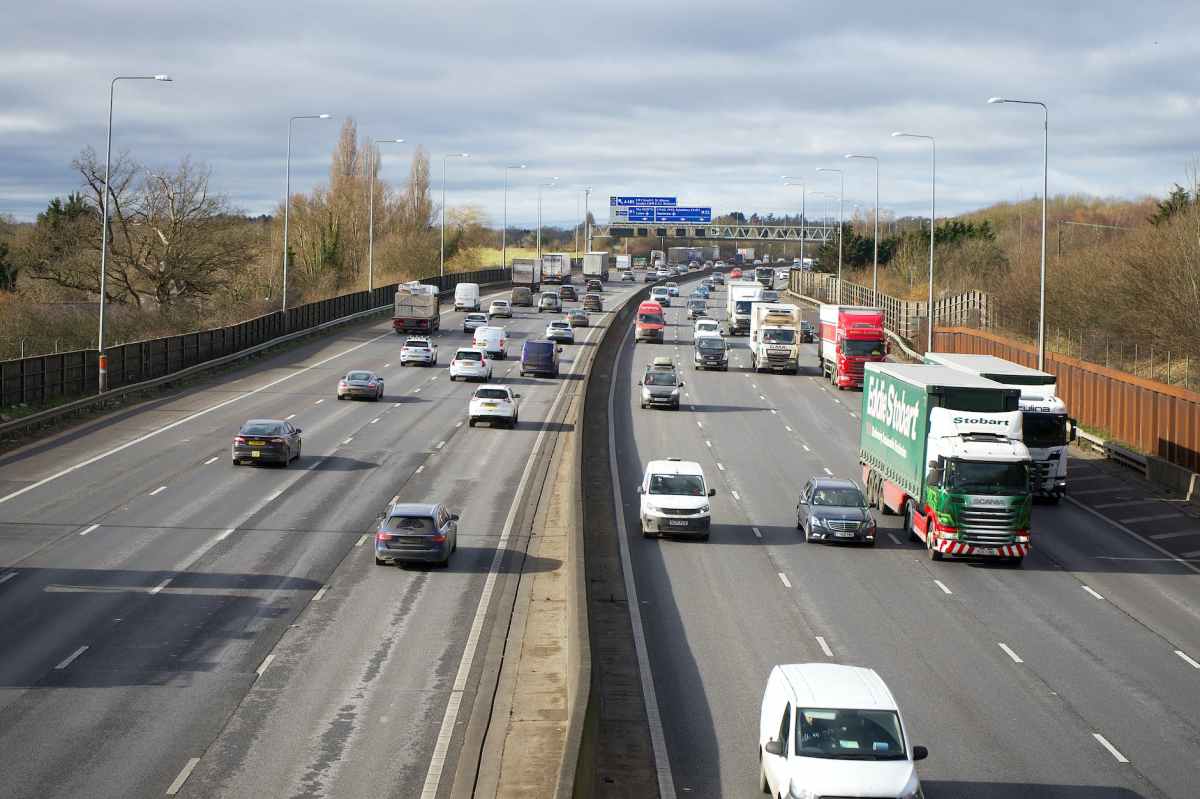
Switching subjects. Thundery skies, dusty, a sweaty 25 degrees C and bright shafts of intense sunlight. Lanes full of cars, bikes, buses, trucks, and vans. The writhing unpleasantness that is the M25 motorway. That’s too mild a word. As the song by Chris Rea goes – The Road to Hell[2]. A song made for the M25 that never grows old.

Yesterday, hell was a bad place to be (Not what AC/DC wrote). Stop and go. Stop and go. It was a self-imposed torture sitting in lines of traffic on the country’s longest moving car park. Moving only as an afterthought. I did the 60 miles between the towns of Reigate and Hatfield. That’s almost 180 degrees around London’s circular motorway. From South to North. If it’s not the noisy concrete sections, then it’s the countless number of congested lanes under the Heathrow flight path that are top of my worst list. Grinding slow, mind numbing and an indictment of our failure to take the environment seriously. Transport policy is in a mess.

What’s crazy is our country’s response to this everyday transport pain. Make it bigger and wider. Carve out more of the countryside and cover it with concrete, steel and tarmac. I’m talking about the current work on the A3/M25 interchange at Wisley[3]. Heavy machinery has dug out trees and shifted massive amounts of soil to shape the land to the demands of the internal combustion engine. Add a lane. Fill up a lane. Add another lane. Fill another lane. Build a bridge but never bridge the gap. That been the way of the last 30-years and more. A monster that just keeps eating up more land.


[1] https://www.cancerresearchuk.org/about-cancer/causes-of-cancer/cancer-myths/do-mobile-phones-cause-cancer

[2] https://youtu.be/OcW-BSEB3ng

[3] https://nationalhighways.co.uk/our-roads/south-east/m25-junction-10/

Newspeak

Listening to the drivel coming from The Rt Hon Kemi Badenoch MP[1] this morning on the radio reminds me that we have a long way to go. The road travelled is a long one.

The tendency to either speak like a badly typed up press release or repeatedly call apples – pears is astonishing. It must be that there’s a switch that has been thrown in the brains of Ministers that is hit to engage illogical nonsense. From that moment a droning sound emanates. Jumbled up words are contrived to say Brexit = good – not Brexit = bad. You would imagine that such Ministers think they are talking to naughty 5-year-olds. It doesn’t mater what the facts are this behaviour continues.

Even good news, like BMW’s continued investment in the UK, is flipped into an EU bashing session. The fact is that the UK had to demonstrate its willingness to support the car industry to retain that much needed investment.

Brexit has been, and is, a complete catastrophe, and everyone knows it. That is everyone who isn’t a Conservative Minister, or a Labour would be Minister. Badenoch plays childish games to paint a picture of great success when the reality is one of significant pressure.

The Foreign Direct Investment Statistics are not good[2]. To quote a recent report to Parliament: “Net investment from the EU was -£24.1 billion, compared to £28.0 billion in 2020, while net investment from Europe as a whole was -£27.6 billion “. Note the “-“, in other words negative.

To quote further:” The UK’s share of inward investment projects has stabilised after “falling sharply following the 2016 vote for Brexit”, with the 21% of projects attracted in 2015 “representing the high-water mark.” In other words, the UK was doing exceptionally well until Brexit came along.

And so much for so called – levelling up. London retained its status as the UK’s largest destination for inward investment projects. London continues to attract the world’s attention.

What’s further idiocy is the random pick and mix approach that this Conservative Government has adopted. There appears to be no strategy. No direction. Just an opportunism. Jump in a wholly reactive manner and then announce success, as if it was planned.

Looking at investment going the other way. The UK’s outward investment flows to the US reached their highest level since 2017. So, post-Brexit, British investors see opportunity in the US. Could it be because they are investing? The US Infrastructure Law targets a range of spending from repaving roads and water system upgrades.

With the News, such as it is, surely, we need a UK Infrastructure Law. Would British investors not want to support that idea?

POST 1: Badenoch would not face the reality. On Sky News she skirted around the subject but let slip that cars will be more expensive in the UK because of Brexit. Rules of origin impact the British car industry.

POST 2: For the sake of balance. At least Badenoch is taking a practical approach to China. The Conservative back benchers who push for a hard line are not thinking about the need for dialogue on climate change and trade. Intelligence and Security Committee of Parliament China (independent.gov.uk)


[1] https://www.gov.uk/government/people/kemi-badenoch

[2] https://researchbriefings.files.parliament.uk/documents/CBP-8534/CBP-8534.pdf