HS2 – again

Travelled on the Elizabeth Line yesterday. It was an expensive project to build. Tunnelling under London and erecting new stations was a costly business. It was called “Crossrail”. Approval was given in 2007 and construction started in 2009[1]. In 2022, one-sixth of the UK’s total rail journeys took place on the Elizabeth Line. The billions spent were a major investment in the future. Over £18 billion in fact. It was a national demonstration that huge civil engineering projects can be undertaken and mastered[2].

As a passenger the Elizabeth Line is a pleasure to use. It’s clean, speedy, and simple to use. Comparing it to the older London Tube lines is like comparing a Tesla with a Ford Anglia[3]. Sadly, a great deal of our national rail infrastructure is trapped in the Ford Anglia era.

So, what of HS2[4]? The wibbling and wobbling that has plagued the project is sucking the energy out of the resolve needed to see through an even bigger undertaking than Crossrail. Some people argue that the billions needed for HS2 could be better spent on other projects. However, the portfolio of transport projects that are suggested as alternatives never seem to materialise.

Talk of cancellations feed the political turbulence over infrastructure investments. The impression this presents goes way beyond the shores of this country. There’s no Global Britain on show here. It’s more signals of dither and lack of determination that are publicly on display. Instability and the short-term outlook is the motif of the current generation of politicians.

If there are superior and smarter alternatives to HS2 they should have come up during the planning phase of the project. What we know about vast engineering projects is that chopping and changing them midstream adds massively to costs. It also diminishes the usefulness of the outcome.

Britain needs a backbone. A rail backbone and a political backbone. The spending on HS2 is large but that spending is in country. It’s jobs and investment onshore for the benefit of the whole country, not just the Southeast of England.

The last few years have seen that banner “levelling up” heralded by Conservative politicians. This slogan will be as nothing if HS2 is wound down or constricted. The signal will be loudly heard that all that talk of levelling up the regions of Britain was shadow boxing.

In the long-term improved connectivity across the country will be a great asset. The Victorians knew a thing or two about engineering great projects. Their legacy should give us resolve.

POST: Still it is good to see the rest of the world getting on with High Speed Rail High-speed Archives – International Railway Journal (railjournal.com)


[1] https://www.timeout.com/london/news/the-new-elizabeth-line-your-crossrail-questions-answered-052322

[2] https://www.theguardian.com/uk-news/2022/mar/13/elizabeth-line-crossrail-opening-london

[3] https://www.autoexpress.co.uk/ford/104979/ford-anglia-105e-and-123e-buying-guide-and-review-1959-1968


[4] https://www.hs2.org.uk/

Get Back

The big picture story is that Europe needs unity more and more to face the future.

Today, a National Rejoin March takes place in London. This march takes place when it’s all to evident that Brexit has been an abject failure. Having the bravery to admit that Brexit is a failure remains challenging. UK political leaders are shying away from admitting the reality of our common situation.

Thousands of those who support the UK being a European Union (EU) member are gathering in the capital. It’s time to ensure a message gets sent that re-joining the EU is a popular and gaining momentum. Members of Parliament (MPs) may not be in Parliament on the weekend, but the message sent by those on the city’s streets is strong and clear.

It’s true that this is a frustrating experience. I’ve been on many organised London marches. They are characterised by their camaraderie, positivity, and great spirit. Marching makes a difference to the people who march and it’s also makes a wider impact. Media coverage may be sparce. What they do see and hear is a sense of solidarity and unity.

Sadly, there are no apparent results flowing from this national campaign, so far. The UK’s out of touch political parties are trying to look the other way. Today, the fearful nature of the bland mixture of our political leaders is immensely disappointing. They scurry around like little brown rats. Looking busy but terrified of stepping outside their comfort zone.

Tinkering with the Trade and Cooperation Agreement signed by former Prime Minister Boris Johnson will deliver only more disappointment. Papering over that public disappointment, we can rely on a part of the tabloid media spinning threatening stories. The artificial culture wars raging between the political right and left have little to do with reality. This noisy nonsense plunders the opportunity to make life better for the vast majority. It’s a side show.

The big picture story is that Europe needs unity more and more to face the future. If it’s climate change, war, immigration, or economic troubles sustainable solutions cannot be found in isolation. Our region of the world is so interconnected and interdependent that events in one part of Europe inevitably affect others. Brexit does not work.

Future generations will look back on this era as being a regressive one. Opportunities lost and difficulties increased by a lack of political bravery. A lack of direction. A lack of leadership. This will be overcome in time, but that change will not come soon enough.

POST: Reporting on the event Pro-EU supporters march for Britain to rejoin the European Union (france24.com)

Views

Journalists do a vital job. See, I’ve said it. It’s true. Now, I get on to the “but”. Afterall, what’s the point in writing unless there’s a point to make. I’m talking about the factual reporting rather than the more fanciful material.

I notice this frequently. It’s on the radio, its in the newspapers, it’s on TV. Basically, we have more and more journalists talking to journalists, particularly in the political domain. My purely subjective impression is not science, even if I’m sure it could be backed up by numbers.

Commentary is good and good commentary is even better. Understanding the complexities of our mixed-up multifaceted society needs some help. There’s always the difficulty of having so much information that none of us can see the wood for the trees. Careful and thoughtful analysis helps.

So, I’m not having a downer on journalists. It’s just, I get annoyed when there’s a parade of interviews that are nothing more than journalists asking other journalists questions. There’s that image of a snake eating its tail. The more that News comes from one place, to be analysed by one group of people and then to be scrutinised by the same, the more the mouth and the tail met.

When I’m in the car, soaking up time in a traffic jam on the M25, I listen to LBC[1]. Although this radio station has its interminable monologues from its presenters, at least the phone in format means that some of the public get aired. However, cranky, and unfathomable their views it’s always good to hear what people have to say.

I’ve been doing some doorstepping. Canvasing people. It’s a great way to get to know what people are thinking. Not everyone wants to talk. That aside, there’s always plenty that do. From that experience a fascinating range of opinions comes to the fore. A swirling range of views.

Don’t get the wrong impression. Not everyone is seething with anger about the state of the world. A few are that’s for sure. There’s still plenty of hopeful folk who are engaged in their communities constantly trying to make the best of things. Knowing a little of the good and bad of a community’s experiences is a great insight. It’s far more interesting than pitching one media columnist against another.

Perhaps the format of the BBC’s Question Time[2] ought to be completely changed. Have an audience full of journalists and politicians and a panel made up of the public. There could be a postcode lottery to pick members of the public to sit on the panel.

It’s might not be easy to put together. It’s said public speaking is a top fear of most people. Finding people who would take up the offer who would genuinely embrace it and not go too much off the wall, would be challenging. I’m not calling for a revival of what Jerry Springer was famed for.


[1] https://www.lbc.co.uk/

[2] https://www.bbc.co.uk/programmes/m001qxgz

Get Back

It’s painful to watch. Frightening. Seeing them take over London. Yes, I did hide behind the sofa when the Cybermen[1] came on. But then again, I was only around 6 or 7-years old. They converted humans to their kind by removing emotions and personalities. Scary stuff. The sort of evil creatures that nightmares are made of. With bodies made of cybernetic parts they seemed undefeatable but like so many great science fiction stories they had weaknesses, and the Doctor knew them. My early Dr Who knew exactly what to do.

In this case it’s not fiction that I’m writing about. Just the same it was painful to watch. Frightening. Seeing them take over London and the whole country. We had years of this scary drama. In fact, its still going on around us now. Laura Kuenssberg’s State of Chaos[2] has been a true horror story. This week I caught the Part 2. I don’t think I can take another Part.

History is being penned quickly in our media age. Watching the story of how our political system was smashed-up by a bunch of marauding, well, I don’t know what to call them. Is there a collective term for careless, egotistic, idiotic, manic, obsessive, power-hungry politicians? A term one can use in polite company, that is.

Since 2016, and to a lesser degree just before, the march of Conservative politicians has been to the tune with a dangerous beat. Smash-up the norms, disregard sound advice and steam ahead with blind arrogance. Much of this is epitomised by the character of Boris Johnson, but there are so many other in the cast strange and obsessive people.

Kuenssberg must tread a fine line because getting caught up in the finger pointing polarisation of the politicians is perilous. In her time as BBC Political Editor, it must have been like walking across Niagara on a tightrope every day.

The State of Chaos is giving us a new perspective on the Conservative Party’s on-going civil war. It seems the situation was even worse than we had been led to believe. This documentary is a treasure-trove of extraordinary material that is only a sample of what happened.

I’d say we all agree. It doesn’t matter which side of the Brexit argument that you stand or stood. Utter chaos has transpired in the reign of the last 5 Conservative Prime Ministers. Interviewees can point fingers at each other, all the same the word chaos applies.

In the coming months the lessons from this fearful period need to be learned. A new normal need to be established. We need to get back[3] what we have lost. Get back a sense of responsibility. Get back a reputation for competence. Get back ambition for the future.


[1] Dr Who. The Cybermen first appear in the serial The Tenth Planet in 1966, set in 1986.

[2] https://www.bbc.co.uk/iplayer/episodes/m001qgww/laura-kuenssberg-state-of-chaos

[3] I must be channelling The Beatles.

Upfront

Years of looking at the reliability of aircraft components and structure have given engineers a good understanding of the natural decay of mechanical workings. To that extent even electronic components are mechanical. Materials oxidise (rust), random shocks and vibration take their toll, temperatures cycles from cold to hot and back again a whole range of impacts are relentless. You can say – nothing lasts forever.

Occasionally a discovery adds to the knowledge of how materials behave under high stress. Sadly, that’s what hit the early years of civil jet aviation. The de Havilland DH106 “Comet” was the world’s first passenger carrying jet airliner. It first took to the air in 1949, which I find remarkable.

Catastrophic metal fatigue failure of the aircraft fuselage put paid to this British aviation project but only after several tragic fatal accidents. In 1954, the Comet aircraft were all grounded during an extensive accident investigation. The jets were redesigned and re-entered commercial service in 1958. However, by then the aircraft had a damaged reputation and others were doing far better. Now, those Comet aircraft that remain are museum exhibits[1].

Last week, I walked through the fuselage of a Comet 1A built in 1953 at Hatfield for Air France. It’s fascinating to see what advanced aviation technology was 70-years ago. What was surprising to me was the read across from that first version of a jet aircraft and what we have in-service now.

Automation has removed the place of the navigator and the flight engineer, but the stations of the pilot and co-pilot are familiar. The fuselage is cramped but the seating is generous and spacious. This aircraft must have been a dramatic revolution in flying at the time.

As we look to advance aviation in the coming years, with new ways of flying and new ways of powering flight so the warning of the Comet project should be heeded. We are at a time of extraordinary changes in the aviation industry. Advanced technology can deliver great benefits to society. It’s up to us to make sure we cover all the possible disbenefits as far upfront as we can. If we don’t, they will come back to bite us.


[1] https://www.dehavillandmuseum.co.uk/aircraft/de-havilland-dh106-comet-1a/

The Week

Conversations can go in a strange direction. It’s well and good to be sceptical. I mean, questioning newspaper headlines, social media hot shots and politician’s pontifications. Lies are common enough, but everything is not a lie. My experience is that most people are honest, straightforward, and reasonable. So, yes, be sceptical but don’t think everything is a conspiracy. The evidence simply doesn’t point that way.

How did this chat kick-off? Surprise, surprise, a conversation about COVID-19. There’s no doubt that a lot of big mistakes were made in the last few years. Balance that fact with the dedication and hard work people put in to mitigating the pandemic and the suffering of those who lost loved ones. It was a crisis that most of us had never experienced. The pains and shocks were real.

When I hear someone say – it wasn’t a real pandemic, you know. Following up with – do you know who was funding the chaos? That question left me with a blank expression. Then an answer, as if this confident speaker had discovered something no one else knew – it was Bill Gates. Although I’d heard this conspiracy theory before it still left me doing a shocked double-take. How can someone be so convinced of such utter nonsense?

I’m a liberal, so I question those who follow a crowd for the sake of following the crowd. On top of that way of thinking, free speech is to be cherished. If my judgment is that the world of conspiracy theories is not new and is just part a colourful world, am I ignoring the harm that untrue utter nonsense can do? It’s a difficult dilemma. When someone gets sucked into conspiracy thinking they become chained to lies but they freely take-up those chains. Is it harmful for people to buy crystals or silver foil hats to protect themselves from the evils of 5G[1]? It certainly is nutty. Maybe, they have a right to be nutty.

Switching subjects. Thundery skies, dusty, a sweaty 25 degrees C and bright shafts of intense sunlight. Lanes full of cars, bikes, buses, trucks, and vans. The writhing unpleasantness that is the M25 motorway. That’s too mild a word. As the song by Chris Rea goes – The Road to Hell[2]. A song made for the M25 that never grows old.

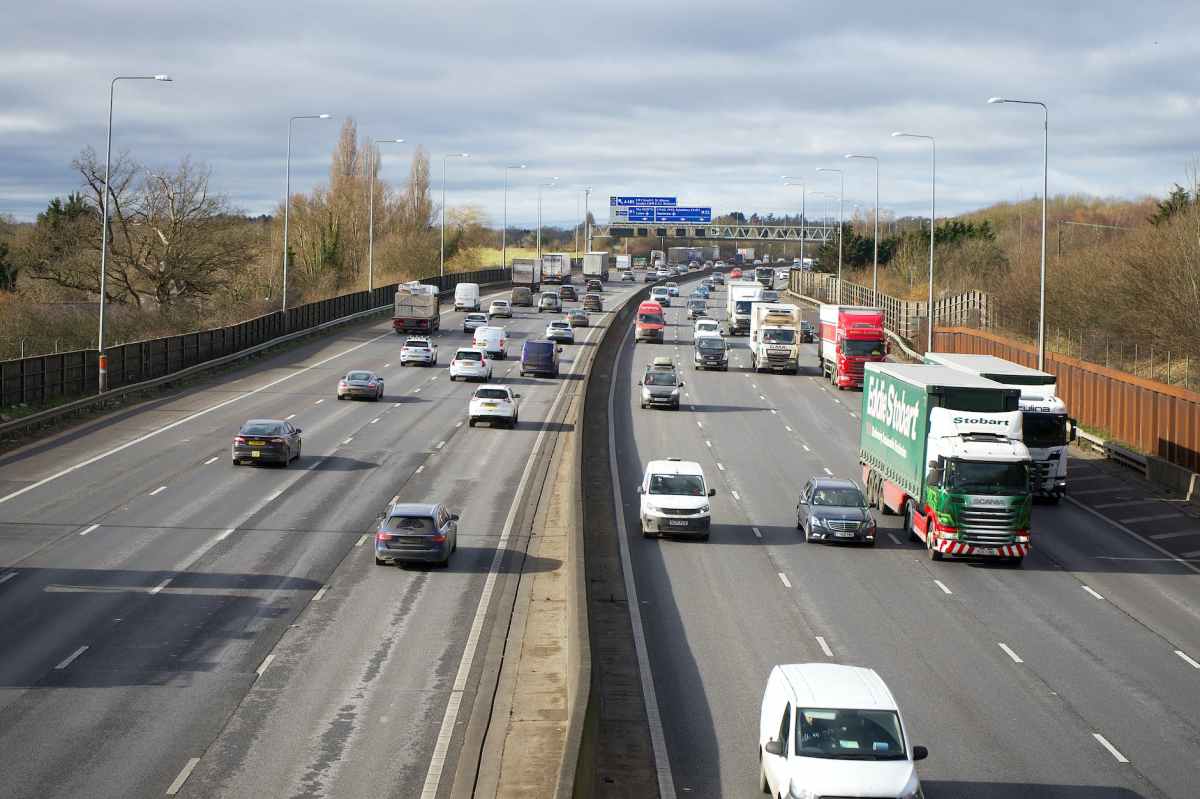
Yesterday, hell was a bad place to be (Not what AC/DC wrote). Stop and go. Stop and go. It was a self-imposed torture sitting in lines of traffic on the country’s longest moving car park. Moving only as an afterthought. I did the 60 miles between the towns of Reigate and Hatfield. That’s almost 180 degrees around London’s circular motorway. From South to North. If it’s not the noisy concrete sections, then it’s the countless number of congested lanes under the Heathrow flight path that are top of my worst list. Grinding slow, mind numbing and an indictment of our failure to take the environment seriously. Transport policy is in a mess.

What’s crazy is our country’s response to this everyday transport pain. Make it bigger and wider. Carve out more of the countryside and cover it with concrete, steel and tarmac. I’m talking about the current work on the A3/M25 interchange at Wisley[3]. Heavy machinery has dug out trees and shifted massive amounts of soil to shape the land to the demands of the internal combustion engine. Add a lane. Fill up a lane. Add another lane. Fill another lane. Build a bridge but never bridge the gap. That been the way of the last 30-years and more. A monster that just keeps eating up more land.


[1] https://www.cancerresearchuk.org/about-cancer/causes-of-cancer/cancer-myths/do-mobile-phones-cause-cancer

[2] https://youtu.be/OcW-BSEB3ng

[3] https://nationalhighways.co.uk/our-roads/south-east/m25-junction-10/

Newspeak

Listening to the drivel coming from The Rt Hon Kemi Badenoch MP[1] this morning on the radio reminds me that we have a long way to go. The road travelled is a long one.

The tendency to either speak like a badly typed up press release or repeatedly call apples – pears is astonishing. It must be that there’s a switch that has been thrown in the brains of Ministers that is hit to engage illogical nonsense. From that moment a droning sound emanates. Jumbled up words are contrived to say Brexit = good – not Brexit = bad. You would imagine that such Ministers think they are talking to naughty 5-year-olds. It doesn’t mater what the facts are this behaviour continues.

Even good news, like BMW’s continued investment in the UK, is flipped into an EU bashing session. The fact is that the UK had to demonstrate its willingness to support the car industry to retain that much needed investment.

Brexit has been, and is, a complete catastrophe, and everyone knows it. That is everyone who isn’t a Conservative Minister, or a Labour would be Minister. Badenoch plays childish games to paint a picture of great success when the reality is one of significant pressure.

The Foreign Direct Investment Statistics are not good[2]. To quote a recent report to Parliament: “Net investment from the EU was -£24.1 billion, compared to £28.0 billion in 2020, while net investment from Europe as a whole was -£27.6 billion “. Note the “-“, in other words negative.

To quote further:” The UK’s share of inward investment projects has stabilised after “falling sharply following the 2016 vote for Brexit”, with the 21% of projects attracted in 2015 “representing the high-water mark.” In other words, the UK was doing exceptionally well until Brexit came along.

And so much for so called – levelling up. London retained its status as the UK’s largest destination for inward investment projects. London continues to attract the world’s attention.

What’s further idiocy is the random pick and mix approach that this Conservative Government has adopted. There appears to be no strategy. No direction. Just an opportunism. Jump in a wholly reactive manner and then announce success, as if it was planned.

Looking at investment going the other way. The UK’s outward investment flows to the US reached their highest level since 2017. So, post-Brexit, British investors see opportunity in the US. Could it be because they are investing? The US Infrastructure Law targets a range of spending from repaving roads and water system upgrades.

With the News, such as it is, surely, we need a UK Infrastructure Law. Would British investors not want to support that idea?

POST 1: Badenoch would not face the reality. On Sky News she skirted around the subject but let slip that cars will be more expensive in the UK because of Brexit. Rules of origin impact the British car industry.

POST 2: For the sake of balance. At least Badenoch is taking a practical approach to China. The Conservative back benchers who push for a hard line are not thinking about the need for dialogue on climate change and trade. Intelligence and Security Committee of Parliament China (independent.gov.uk)


[1] https://www.gov.uk/government/people/kemi-badenoch

[2] https://researchbriefings.files.parliament.uk/documents/CBP-8534/CBP-8534.pdf

Society & Innovation

Yesterday, I drove up the main A303[1] in the stifling last summer heat. It was a windless sticky 30C. I drove past the road sign that says Micheldever Station[2]. By the way, “up” meaning heading towards London. Going “up” to London isn’t an unusual West County way of expressing that trip.

On that busy highway there are few, if any noticeable road signs that point towards a railway station. I’ve often wondered why that one was deemed so necessary. It’s not a tourist attraction, like the Watercress line[3] is in that part of the world. It’s an ordinary everyday railway station.

The small English hamlet known as Micheldever Station is a bit of an oddity. It’s the sort of place that could have been the location for The Avengers or The Saint, the popular British TV series of the 1960s. It’s in the green and pleasant countryside of Hampshire and about 10 miles north of Winchester city. An area that’s as conservative as can be.

Micheldever Station has a curious technological history. In 1895, it was the starting point for the first automobile journey in Britain. At that time a British Act of Parliament required that all self-propelled vehicles on public roads must travel at no more than 4 miles per hour and to be preceded by a man waving a red flag. In 1805, highly sensible. There’s no way that those infernal new machines should be allowed to scare the horses.

Not everyone thinks such thoughts while thundering along the A303 at 70 miles per hour. However, to me, ever since I got my first driving license at the age of 16, it’s been my most familiar of arterial roads. So, much traffic passes that way there’s never a time when it can’t be heard.

Well, we have come a long way in 138 years. Now, we are getting nervous about the safety of driverless cars, and no one even questions having a self-propelled vehicle on public owned roads. If they do, the likelihood of transforming that formula into something else is astronomically small. I can’t think of a bad time to write on the subject of: “Innovation and Its Enemies[4].” In fact, what may have graced a Victorian bookshelf can have some resonance today.

Next year, we will see commercial flights taken in electrically powered air-taxies. Without a shadow of a doubt these flights will arouse some vocal public resistance. We can take that from the history of technology. The airborne version of the man waving a red flag could raise its ugly head. I don’t say throw caution to the wind, but we need to be mindful of the natural propensity to object.

Striking a societal balance will not be easy. It would be a fool who says it will be. Slowly but surely, we will need to become accustomed to advanced new forms of mobility. Sticking a fair balance between the utility of these new machines and any burden they may place upon us will be a mighty tricky job.

I wake-up to the noise of the residential road outside. People commuting to work. The local trains send a rumble through the air. I don’t want to wake-up to the sound of an air-taxi hovering outside my window. Given the research[5] and technology under development, none of us should have to tolerate an increase in noise. Mobility and quality of life shouldn’t always be in conflict.


[1] https://youtu.be/C0sL3_NKPao

[2] https://www.southwesternrailway.com/travelling-with-us/at-the-station/micheldever

[3] https://watercressline.co.uk/

[4] https://global.oup.com/academic/product/innovation-and-its-enemies-9780190467036?cc=us&lang=en&

[5] https://ntrs.nasa.gov/citations/20210014173

Reform

The words: “A long time ago in a galaxy far, far away….” – who doesn’t know those words? They come to mind in my thoughts of the last few years.

I caught a “Have I Got a Bit More News for You” on TV[1] last night. I think it was only from May last year but the world it described was miles from the situation of today. By the way, I must be of a certain age given that I’m still watching TV. I put the iPhone and iPad down for ten minutes. The box in the living room still has a place even if the day they pension-off Ian Hislop and Paul Merton can’t be far off.

Fine, there was some enduring themes that just keep giving and giving. Personalities pop-up with new roles even if reputations were long since trashed. What’s moving on is that feeling of being in a post-COVID world and the good bits of the Elizabethan era. The signs saying keep a distance from the next person are fading. Discussion about QEII is now about memorials and statues.

In less than a decade, the global reputation of the UK has seen some remarkable turbulence. I’m not being romantic about some time when everything worked smoothly. It never did. Governance is a difficult business. Turbulence is a permanent feature even if it doesn’t always star in the everyday News.

What should be enduring is a frankness and ability to acknowledge when mistakes have been made. To reflect and learn from experience is a wonderful human ability. It likely that if this didn’t exist then neither would we. Every step forward that’s made is often on the backs of many failures.

The pre-2016 era, what we could call a time relative civility, fraternity, and sanity, was not immune from turbulence. What was better was the mechanisms available to address that turbulence. The space available for dialogue was much bigger.

Brexit, for our country has been the biggest blunder we have has made in a lifetime. As predicted, Brexit’s reality has made the UK a paradise for speculators, spivs, and smugglers. Brexit has imposed extra costs and border restrictions on goods. It’s wrecked freedom of movement. It’s encouraged petty finger pointing on every major difficult subject.

Brexit pledges are now broken with such regularity that it’s impossible to count them all. Whether it’s a downgrading of the environment or attacks on employment rules or fake political storms they are too numerous to mention.  

This blog started in a long time ago in a country far, far away, or at least it feels that way. My view remains that we need to be at the heart of Europe to succeed in the future. To do that we need to make some big changes at home. I’m no great fan of Rory Stewart[2] but he’s right to engage with populism and take on the need for constitutional change.


[1] https://www.bbc.co.uk/iplayer/episodes/b00877q4/have-i-got-a-bit-more-news-for-you

[2] https://www.barbican.org.uk/whats-on/2023/event/an-evening-with-rory-stewart

RAAC

Reinforced autoclaved aerated concrete (RAAC) is making the News in the UK. An unknown number of buildings are deemed dangerous because of the aging of this material[1]. RAAC has a limited lifespan. It’s inferior to standard concrete but lightweight and low-cost at the start of its life. It was typically used in precast panels in walls, roofs and sometimes floors.

The UK Government says it has been aware of RAAC in public sector buildings, including schools, since 1994. Warnings from the Health and Safety Executive (HSE) says that RAAC could – collapse with little or no notice. This “bubbly” form of concrete can creep and deflect over time, and this can be aggravated by water penetration. So, regular inspection and maintenance are vital to keep this material safe. Especially in a country known for its inclement weather.

It’s reasonable to say there lies a problem. The public estate has been through a period of austerity. One of the first tasks to get cut back, when funds are short is regular maintenance. Now, I am making some assumptions in this respect, but they are reasonable. Public sector spending has been under significant pressure for a long time.

The other dogmatic notion that has hindered a solution to this building problem is centralisation. There was a time when local authorities managed schools. They still do but in smaller numbers. Centralised funding has decreased the power of local people to address problems with the school estate.

Aging buildings have something in common with aging structures in aviation. There’s always a demand to keep going for as long as possible. There’s always the difficulty of determining the safety margin that is acceptable. There’s always a pressure on maintenance costs.

Believe it or not aircraft structures do fail[2]. There’s a tendency to forget this source of incidents and accidents but they never go away[3]. What happens in industries where safety is a priority is investigation, feedback and learning from incidents and accidents. The aim being to ensure that there’s no repeat of known failures. Rules and regulations change to address known problems.

The vulnerability to moisture and the limited lifespan of RAAC should have been a loud wake-up call. No doubt it was for some well-managed, well-resourced enlightened organisations. Central Government has bulked at the cost of fixing this known building safety problem. A culture of delaying the fixing of difficult problems has won.

In civil aviation there’s a powerful tool called an Airworthiness Directive (AD). It’s not something that an aircraft operator can ignore or put on the back burner. The AD can mandate inspections and changes to an aircraft when an unsafe condition exists.

In the schools cases in the News, the impression is given that Government Ministers have dragged their heels and only acted at the last possible moment. Maybe the construction industry and public estate needs a strong regulator that can issue mandatory directives. Known unsafe conditions should not be left unaddressed or significantly delayed.


[1] https://www.local.gov.uk/topics/housing-and-planning/information-reinforced-autoclaved-aerated-concrete-raac

[2] https://www.faa.gov/lessons_learned/transport_airplane/accidents/N73711

[3] https://www.faa.gov/lessons_learned/transport_airplane/accidents/TC-JAV