ID

Photo ID is essential, or your ballot will be denied to you in the UK. You can’t vote in elections. That was the case for service veterans, last Thursday. The armed forces veteran card was not deemed acceptable ID[1]. This card was heralded as a great step forward by Conservative Ministers. It seems they had not thought through the implications of the new ID card.

The Electoral Reform Society pointed out that the arbitrary nature of voter ID rules is a problem.

No doubt to get milk the publicity, Boris Johnson, former PM, praised the officials who turned him away from the polling station where he attempted to vote in the South Oxfordshire police commissioner vote[2]. That inspired one or two cartoons. As you would expect featuring clowns. The legacy of Boris Johnson’s chaotic time in the premiership continues to echo.

News is not all negative on the voting front. The 15-year time limit on the eligibility of British people living overseas has been lifted. They will now be permitted to vote in UK elections[3]. Most interestingly, around 3.5 million additional people will have the right to vote in the forthcoming UK General Election. I wonder how those living in the European Union (EU) will vote.

Anyway, if we look at the results from last Thursday, the Conservative attempt at what could be called voter suppression seem to have backfired. Big time. My view is that we should be making it easier for citizens to vote and not harder to vote. As one joker pointed out, in this Parliament, there have been more cases of MP’s misdemeanours than there have been of voter fraud.

I agree that many of the heartfelt arguments of 25-years ago about ID cards are now somewhat moot. The way we use mobile phones has put paid to those arguments. Big Brother is here to stay. It’s astonishing how much personal information we give away freely, not to the Government, but to commercial entities committed to extracting profits from our data.

Formally proving ID is an anarchic process in the UK. There are multiple means, and they are all confusing or mixtures of one another. What is becoming a fixed point is one’s mobile phone number. So many computer systems send a text message that requires acknowledgement to prove who you are who you say you are. The assumption being that the person with the mobile phone is the person who owns the phone, and its number.

Maybe it is time for one unified and recognised official UK ID system.


[1] https://www.telegraph.co.uk/politics/2024/05/02/minister-apologises-veteran-turned-away-refused-voter-id/

[2] https://www.theguardian.com/politics/article/2024/may/04/boris-johnson-pays-tribute-to-polling-staff-who-refused-to-let-him-vote-without-id

[3] https://www.gov.uk/voting-when-abroad

Culture

Yet again, Boeing is in the news. The events of recent times, I feel are immensely sad. Now, it is reported that the FAA has opened an investigation into a possible manufacturing quality lapse on the Boeing 787 aircraft[1]. Concern is that inspection records may have been falsified.

A company that once had a massive professional engineering reputation has sunk to a place where expectations are low. It’s not so much that the company is having a Gerald Ratner moment. Unfortunately, the constant stream of bad news indicates something deeper.

It’s interesting to note that Frank Shrontz[2] passed away last Friday at the grand age of 92. He was the CEO and Chairman of Boeing, who led the company during development of the Boeing 737NG and Boeing 777 aircraft. In the 1990s, I worked on both large aircraft types.

A commonly held view is that, after his time and the merger with McDonnell Douglas the culture of the organisation changed. There’s a view that business schools graduates took over and the mighty engineering ethos that Boeing was known for then went into decline. Some of this maybe anecdotal. Afterall, the whole world has changed in the last 30-years. However, it’s undoubtably true that a lot of people lament the passing of an engineering culture that aimed to be the best.

A famous quote comes to mind: “Culture eats strategy for breakfast.” Those sharp 5 words get discussed time and time again. Having been involved in a lot of strategic planning in my time it’s not nice to read. How wonderful intent, and well described policies can be diluted or ignored is often an indicator of decline. It’s that cartoon of two cavemen pushing a cart with a square wheel. One says to the other: “I’ve been so busy. Working my socks off”. Ignored, on the ground is an unused round wheel. If an organisation’s culture is aggressively centred on short-term gain, then many of the opportunities to fix stuff gets blown out of the window.

We keep talking about “performance” as if it’s a magic pill. Performance based rules, performance-based oversight, and a long list of performance indicators. That, in of itself is not a bad thing. Let’s face it we all want to get better at something. The problem lies with performance only being tagged to commercial performance. Or where commercial performance trumps every other value an engineering company affirms.

To make it clear that all the above is not just a one company problem, it’s useful to look at what confidential reporting schemes have to say. UK CHIRP is a long standing one. Many recent CHIRP reports cite management as a predominant issue[3]. Leadership skills are an issue.


[1] https://aviationweek.com/air-transport/some-787-production-test-records-were-falsified-boeing-says

[2] https://www.seattletimes.com/business/boeing-aerospace/frank-shrontz-former-ceo-and-chairman-of-boeing-dies-at-92/

[3] https://chirp.co.uk/newsletter/trust-in-management-and-cultures-is-the-key-to-promoting-confidence-in-safety-reporting/

Mindset

Safety is a mindset. Having a sense of risks and which ones to accept and which to reject is something we all develop. It’s a big part of childhood. Most of us have had burns, cuts or bruises that have resulted in doing something we would now consider having been stupid.

Some are destined to be over-cautious, and others are more openly adventurous. In time, we settle around a frame of thinking that suites us best. That’s fine in so far as taking personal risk is concerned. Whether to cross the street every time you see a mean looking dog or to buy a powerful motorcycle later in life that’s a personal preference.

Where activities, positive or negative only impact the risk taker then that’s an area where society shouldn’t be too heavy handed. Naturally, there are boundaries. The classic one is motorcycle crash helmets. Mandating them led to a lot of heated debate. Yes, we are discussing a personal risk in respect of the rider but the risk to society is an unacceptable number of fatalities, brain injuries and publicly borne health care costs.

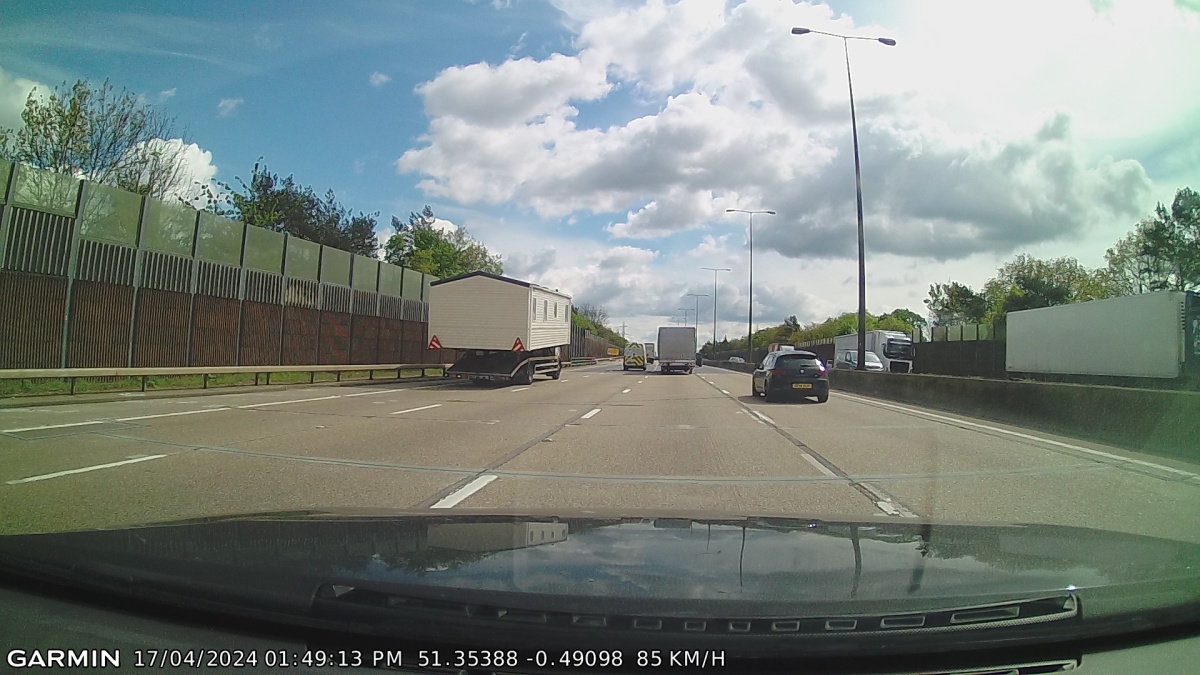
There I was, driving at less than the regulation speed (yes, I was) eastward on the M25 motorway. The details are stamped on a picture taken by my neat little Garmin dashcam. What’s in the picture? It’s a moveable building sitting on the back of a lorry. Nothing unusual about a lorry transporting stuff from A to B. What I saw was a large building on a relatively small lorry. When first seeing something like this on a busy road, my instinct is to give it a very wide margin.

The rectangular building was rocking gently. It was not a windless day. Not overly windy but a strong gusty breeze was blowing. Clear skies and dry tarmac. So, good driving conditions for a normal lorry with a normal load on a normal day. I’d estimate that this lorry was doing about 80km/hr. It wouldn’t be too difficult to do the sums in terms of the wind resistance of the building. It’s going to be significant. A large flat surface being pushed through the air at motorway speeds. As for sidewinds and gusts, this is a horrendous monster.

Back to safety being a mindset. My thought was – what on earth gave the carriers the idea that this arrangement for a wide load was a safe one for a motorway journey? No escort vehicle. No flashing lights. Just a couple of small red triangles. The straps and wooden blocks holding the load in place looked feeble. A powerful gust of wind on an exposed stretch of road and who knows what would have happen next. It wouldn’t have been pretty. I hope they got to their destination without incident.

Had this been done on private land then there would have been little public risk. Being done on a busy motorway – that’s a different matter. How do people convince themselves that such transport arrangements will be fine? I speculate:

  • Money. Maybe the haulage contractor undercut rivals to get the job. Maybe using a small lorry and ditching any escort vehicle saved money. Maybe there was time pressure and this was all that was available.
  • Bravado: A carrier imagines they have special skills and abilities so they can take risks that others would not take. Something uniquely puts them above others in the field. This cock-sure attitude is not uncommon.
  • Short Cuts. I’ve heard this argument used before – we did it last time and it worked, so we’ll do it again. That learned deviance is the source of many accidents. Past and present can have very different outcomes.
  • Shoulder shrugging: I’ve heard this argument used too – it’s legal, it’s within the rules so it can’t be wrong, can it? (The load maybe within the approved weight limits for the lorry. There may be no explicit rule on shape and size).

A good safety mindset means saying “no” when no is the right answer. All three of the above points can come into play and produce a toxic mix. Such is the way accidents happen. It doesn’t have to be this way but it often is. Before a critic says don’t be so high and mighty – yes, I’ve done foolish things too.

NOTE: The loading rules HGV maximum weights – GOV.UK (www.gov.uk)

AAM

This week, I watched an FAAs Advanced Air Mobility (AAM) webinar[1]. The subject was community engagement. AAM could be air taxies but it’s many uses of the new electric aircraft that are becoming a reality. The term eVTOL is used for those aircraft that have the capability of vertical flight. My reflection is that there are several aspects of AAM that need much more attention. Naturally, I’m taking the discussion of what’s going on in the US and thinking about it in relation to the UK.

  • Land Use Planning

Generally, National Aviation Authorities (NAAs) are consultees when it comes to land use planning. They do not determine planning applications. NAAs may well have set out policies and guidance on the subject but they will not be determining the site of vertiports.

It seems to me that there’s little chance that eVTOL aircraft routes will be established without sufficient community consent.  Community engagement has been appropriately recognised as essential. The aspects in play are like those for existing aerodromes. Often for AAM applications proposals are for the use of new locations, hence a concern. Anytime there’s a serious proposal for a new aerodrome the opposition is up and running long before the proposers have got their act together.

The subject is complicated by the mix of public and private ownership of infrastructure. If the intention is to interconnect AAM with other transport services (bus/train/boat/road), then complicated agreements are going to be inevitable. It’s not just about buildings and tarmac but having a trained workforce available is a location dependent issue too.

  • Business Models

I’m about to sound as if I’m securitising the plans of a contestant on The Apprentice[2]. There are plenty of way of losing money in commercial aviation. It’s been a well-practiced art over the years. Great ideas fall by the wayside after huge amounts of money have been expended. Customers are key. People must want to fly the routes available, time and time again. And like London Black Cabs be prepared to pay the fare. Given the relatively small cabin sizes that are on offer these people are likely to be moderately prosperous groups or individuals.

Regular schedules air services can produce a reliable income. Airport-to-airport connections seem like a good bet. Problem there is the conveyancing of weighty luggage. Busy airspace could be a challenge too. That said, with tens of thousands of people at both ends of a route, no doubt some people will choose a comfortable, speedy direct connection.

There are good possibilities for major event driven transport services. Getting to and from a motor race or horse race event or a concert or festival can be hell when tens of thousands of people are all trying to get to and from a location or venue. The numbers may well stack-up to make eVTOL a premium way of dodging the crowds in an environmentally sound way.

  • Batteries, Batteries, Batteries

Everything in respect of aircraft performance depends on power density. How much oomph can you get out of a small, light weigh physical space. Recharge and go. Do it, again and again. It’s as simple as that. Not only that but aircraft battery packs must be affordable and available. Whizzy technology that cost a mountain of cash and can only be use for a few hundred cycles is no use at all.

Power distribution infrastructure must be up to the job too. Who will pay for this is up for grabs. There’s a good case for public funding given that there are multiple uses of enhanced electrical supply. Given the monopolistic nature of power generation and distribution this will not be easy or quick.

That’s only three issues that require a great deal of attention. Not the attention of researchers. Not the attention of academics, Not the attention of political policy wonks. Connecting entrepreneurs and public bodies needs practical stimulus. The possibilities are exciting.


[1] https://youtu.be/1sfVuJlPQoY

[2] https://www.independent.co.uk/arts-entertainment/tv/news/the-apprentice-2024-winner-pies-b2531331.html

Responsibility

What do I have in common with former Prime Minister Liz Truss. Well, not much, I hope. Only I will stop myself from jumping on the band waggon and rubbishing the entirety of what she has to say. It’s astonishing to think that she was once a fully paid-up Liberal Democrat member. Her exit to the dark side is the stuff of decades past pulp fiction.

Truss’s published plans are clearly as mad a bag of frogs. Damming and disbanding anything and everything that you personally don’t like is a page out of the Trump playbook. Oh yes, there’s a community of enraged folks who will not read the detail and pied piper like follow the music. That will sell a tiny number of books before they pile-up in the high street charity shops of the country. Even they might flinch at stocking her castoffs in print. 10p would be too much.

Now, comes the; ah but. If I go back to the mid-1990s, I was writing about the proliferation of QANGOS[1]. Being a local Councillor at the time I felt a great deal of irritation in finding that so much government policy was focused on taking power away from elected local government and giving it to appointed bodies with no local accountability.

The Liberal Democrat approach has long been that power should be decentralised from central to regional and local government. A great deal of what we have seen in the last three decades has been exactly the opposite. Devolution in Scotland and Wales being the exception. Although, that didn’t make much difference when Brexit came along.

Giving specific powers to executive agencies is not the problem. You might think I’d say it was. No, the problem is the relationships between elected bodies and those who act as its agents. Once a democratically elected body has determined a course of action there’s benefit in having expert agencies, given clear terms of reference and a job to implement specific policies.

Politicians, generally make lossy managers. This is where the Truss / Trump doctrine, that politicians should control or manage everything as being extremely foolish. Centralisation does help when unified action is needed but for the most part keeping all decision making in-house degrades administration and enables it to become detached from reality.

Politicians are great critics. Their skills are best used to scrutinises activities at a high level. To exercise oversight and provide feedback derived from real life experiences (The Post Office scandal being an exception to this general assertion).

The former Prime Minister who holds the record for being the shortest in office had to take responsibility for her actions. In that most peculiar way, UK democracy worked. No well, but at least corrective action was taken in reaction to a calamitous situation.

Take back control in my mind means returning powers to regional and local government. Where QANGOS are necessarily then make sure they are kept under effective scrutiny. A lot of what I have said here is better said in a policy paper from 2007[2]. We know what to do but rarely do we do it.


[1] In the UK, the term QUANGO addresses “arm’s-length” government bodies, including “non-departmental public bodies” (NDPBs), non-ministerial government departments, and some executive agencies.

[2] https://www.libdemnewswire.com/files/2016/02/77.-Green-and-Prosperous-Communities-Local-Regeneration-for-the-21st-Century.pdf

Highways

The last time I visited the city of Baltimore was in 2012. It was the location of the annual seminar of the International Society of Air Safety Investigators (ISASI)[1]. That was when I was representing the European Aviation Safety Agency (EASA) at such international events.

The relationship between aviation accident investigators and regulators are generally cordial. There’s a great deal of work that requires cooperation and good communication. That’s not to say that the relationships between these two vital parts of national and international aviation safety systems is easy. It’s not. My reflection on that fact is that a degree of constructive tension is inevitable and not always a bad thing.

One way of seeing that relationship is that the primary role of an investigator is to make findings to prevent the repeat of a given accident. For a regulator the primary role is to ensure the complete aviation system runs safely on a day-to-day basis. Both organisations have the public interest at their heart. However, their operational context and perspective are different.

Firstly, my condolence to the families and friends of those who perished because of the Francis Scott Key Bridge accident[2]. The collapse victims and survivors had no way of knowing what was to happen on the night of the accident. I use the word “accident”. This was not an act of God, as some commentators would have it. The safety risks involved in the operation of the port in Baltimore could be anticipated.

In the US there’s an independent federal agency that is tasked with such major investigations. Interestingly, it’s the same one as that investigates aviation accidents and incidents. The National Transportation Safety Board (NTSB) is a multi-modal organisation. That is something we don’t have in the UK. Also, we don’t have a divide between federal and state organisations. Since in the UK we have separate independent national Air, Marine and Rail investigation agencies that cover the country (England, Scotland, Wales, and Northern Ireland).

I will not comment on the accident sequence or causes. It’s the job of an independent investigation to arrive at the technical facts. Recommendations will flow from that investigation.

Where a comment may be in order is that there are many locations across the globe where a vital piece of infrastructure, like a bridge being struck by a large container ship is a possibility. I’d generalise that further. When infrastructure that was designed a built 50 years ago meets modern day operational stress there’s going to be vulnerabilities. Yes, the aviation system is not immune from this fact too. It wasn’t so long ago when I read of PDP-11 computer hardware used for air traffic control (now, historic artifacts[3]). I’m sure there are still Boeing 747s, and alike that need floppy disks to update their hardware.

So, the wider subject is operational legacy systems working with modern systems. This is the interface that requires particular care. The safety risk appetite and exposure in the 1970s/80s was quite different from that which we expect upheld today.

Unfortunately, society is often reluctant to revisit this subject. Additionally, there’s the incentive to go for quick fixes and sweating assets. The example I have in mind the so-called “smart motorways” in the UK[4]. I don’t know how many fatalities can be linked to “smart motorways” but I’m sure, sadly, it’s too many.

POST: In time-off I enjoyed a trip out to Fort McHenry and a walk around the places where The Wire was filmed. The Fort McHenry story is interesting given its role in times of war. The British burnt the White House but the navy didn’t get past Fort McHenry in 1812.


[1] https://www.isasi.org/

[2] https://www.bbc.co.uk/news/av/world-us-canada-68661318

[3] https://www.tnmoc.org/air-traffic-control

[4] https://www.gov.uk/government/speeches/plans-for-new-smart-motorways-cancelled

Smart

One of the most irritating peak-time adverts on British TV, now, is the one where a fake Albert Einstein wibbles on to a fake dog in a hideously fake humorous manner. It’s condescending and preachy. What on earth the Albert Einstein has to do with household energy meters I can’t imagine. His famous equation is more useful for making nuclear bombs than measuring domestic power consumption. You might think the great man was an annoying Italian computer gaming character.

The smart meter is pushed on the basis that “you can better manage your energy”. I expect that’s true in most cases when they work well. I’ve had one for some time. We recently changed energy supplier. Guess what? In the transition I had to throw away an indicator and replace it with another.

In the news are reports of defunct smart meters causing people concerning problems. Smart meter mode means a meter can automatically send readings to an energy supplier. When they don’t work, lack of meter readings opens the door to energy companies making up bill estimates often to their advantage.

When I informed our power company, I got an education that put me right. Can’t possibly call the whole system a smart meter. No, that would be wrong. So, says the company:

“The smart meter you are enquiring about is actually an In Home Display, the smart meter is the meter on the wall.”

That informative reply reminded me of the Not The Nine O’clock sketch set in a gramophone shop. Foolish householder not knowing that it’s called an In Home Display (IHD). The smart meter is installed on the wall.

I’m in support of energy saving and the role an intelligent meter can play in monitoring the use of domestic energy. What are they trying to do – put me off?

Long gone are the days when meter readers knocked on the door and with a cheery smile jotted down the gas or electricity numbers in the understairs cupboard.

Now, I see the claim is that the “vast majority” of smart meters are operating as intended. That’s good. Those words mean about 88% according to a BBC report[1]. That sounds fine but what about the 12% who are in limbo? That’s not an inconsiderable number of people.

The roll out of smart metering technology started in 2011. There’s a first-generation and second-generation set-up out there in homes. A lot of work has been done to sort out communication problems. However, network coverage is not universal. Those connection issue are familiar to anyone with even the best mobile phone.

The BBC report is right to highlight problems. There ought to be a bigger focus on a plan for maintenance of the system as much as pushing new smart meter installations.


[1] https://www.bbc.co.uk/news/articles/cz9zqn77ezno

Safety Culture 2

This may sound at variance with my last blog. I hope it’s not. I hope it’s complementary. What I’m highlighting here has been observed over decades of contact with a wide variety of organisations.

The term safety culture is fused into the pillars of ICAO Annex 19. The essence of building a good safety culture that fosters sound practices and encourages communications, in a non-punitive environment is at the heart of standards and recommended practices. With all those decades behind us the reader might assume that there’s unambiguous and well aligned attitudes and ways of working throughout the aviation industry. That’s not so.

On a spectrum of what could be called hard to soft the manner of application of know best practices can take different forms. By the way, please disassociate those two words with both easy and difficult. That’s not what I mean.

In my interpretation “hard” means like pages of Niccolo Machiavelli’s The Prince[1]. Aggressive, persistent, mandatory, uncompromising and all encompassing.

In my interpretation “soft” means like pages of The Little Book of Calm by Paul Wilson[2]. Harmonious, enlightened, progressive, sympathetic, and understanding.

As with extremes on any scale, going to the ends of that scale are not the best way to operate. I say “best” in terms of getting to ways of working to endure with engagement and effectiveness. I observe much of this depends on how power is disseminated through an organisational structure. Highly hierarchical organisations will approach culture differently from organisations with a relatively flat management system.

It may not be surprising to suggest that aviation Authorities can veer towards the “hard” approach and staff Unions towards the “soft” approach. Even when both are trying to reach the same goal. Where people come from a military background, command and control can be an instinctive reaction. Where people come from an advanced technology company background, collaboration and communication can be an instinctive reaction. In my observation there are advantages in both a hard and soft safety cultural approaches.

One advantage of a hard safety culture is that the time between discovery of a safety problem, taking corrective action and resolving that operational problem can be short. Clearly, that has distinct safety advantages. Certain airlines come to mind.

One advantage of a soft safety culture is that there can be the discovery of safety problems that would otherwise remain hidden. Where collective ownership of the problem is not in question. Again, clearly, that has distinct safety advantages too. Certain manufacturers come to mind.

I guess my message is as per much ancient thinking. All things in moderation. Try to reap the benefits of both ends of the scale. Balance.


[1] https://www.londonreviewbookshop.co.uk/stock/the-prince-niccolo-machiavelli

[2] https://www.waterstones.com/book/the-little-book-of-calm/paul-wilson/9780241257449

Safety Culture

Civil aviation remains an extremely safe means of transport. That said, any form of complacency must be addressed. It’s reassuring to say the past has been great but what passengers are most concerned about is their next flight. To have the confidence, to think it irrational to be afraid of flying, to look forward to the next journey, we must have a safe aviation system everywhere and all the time.

For any widespread system that has complex interactions between people and technology there’s never a moment when it can be taken for granted. We count the numbers, but safety is not purely an absence of accidents and incidents. Numbers counted are always past events. They have no direct causal influence on what happens next. True, there are factors in past accidents and incidents that will pop up again and again, but every flight is a unique event.

One of my colleagues who was a senior captain in a major international airline always remined me of the fact that, for all that has gone before, flight risk begins the moment an aircraft sets off down the runway with the intention getting to a destination. When the wheels lift off the ground there’s no stopping time. Reliant on the diligence, vigilance, and integrity of everyone who made a flight possible, flight risk is then in the hands of the crew.

The above is perhaps why we talk a lot about safety culture. The whole aviation family has a role to play. The care, professionalism, and watchfulness of every person makes a difference.

This can extend from the drafting of a new component for a new design, that a decade down the line. ends up as a part of an aircraft just about to leave the gate. This can go back to a flight instructors’ message that emphasised a key point back in a pilot’s initial training, years ago. This can encompass the extra care a couple of air traffic controllers took as they changed shifts.

Safety culture comes from caring. It’s that heightened awareness of the consequence of actions. Being alert to possibilities. Both the good kind, and the bad.

Safety culture is a matter for both individuals and organisations. One without the other doesn’t work. Placing a vigilant person in an organisation that doesn’t care is much like placing a reckless person in an organisation that does care. Although this is what I’ve written, systemic problems are likely the ones that are most likely to cause negative outcomes. This is where the role of management has the most impact.

Culture exists in context. When the ways people interact are determined by practices, processes, and procedures there’s an obligation on management to ensure they fit the bill. Drivers are often economic. In a commercial operation that’s no surprise. It’s when that driver displaces the safety imperative then safety suffers. There’s been several occurrences of this negative phenomena in the last year.

Unfair

That’s one way to start a note. “As a member of the post-active population”, I now feel that all the activity I now do is conveniently wrapped up as being somewhat like cosmic dark matter. It’s there in theory but no one knows what it is in fact. It’s activity that’s hidden activity.

There’s a great deal of talk about the large number of those people in their 50s, and above who have left the conventional workforce post-COVID. Unfortunately, much of it is tainted. The general implication being that the protestant work ethic runs deep and those who are not on the traditional 9-5 treadmill are letting society down. As if the only work worth counting is that which statisticians count into that magic number, namely Gross domestic product (GDP). The tyranny of an abbreviation. A great deal of useful productive and valuable activity is excluded from GDP.

Trogging off to Sunshine Deserts[1] every day, electronically or physically, and making or processing stuff and pushing rocks up hill is counted as the gold standard. This way of looking at the society is foolish. It comes from commentators being way behind the curve and politicians living life as if they were stuck in an idyllic childhood.

This way of thinking is especially true in the UK. More so than other European countries, we are dependent up charities and voluntary workers. German visitors are often struck by the number of charity shops in the UK. If you ask how palliative care, emergency services, children’s support, food banks, homeless shelters and crisis support are funded in German the response is simple – taxes.

The amount of unpaid work, like that performed in the home or by volunteers, in a massive range of organisations, is huge in the UK. That’s not wholly a bad thing. Sadly, this reality not recognised in government policy circles, other than being a way of off-loading responsibilities as funding cuts kick in. Of course, there’s politicians who turn-up for photo shoots at election time when there’s smidgen of recognition. If a charity is not in vogue or well known even those opportunities to raise funds and profile are few and far between.

All the above said, I do support the call for some education organisations that are deemed charities to lose the privileges rightly afforded to much more worthy charities. I know that’s a matter of judgement but not all fish in the sea are the same.

Often, it’s has struck me as strange that tertiary colleges (public funded education)[2] must pay Value Added Tax (VAT), but private colleges deemed to be “charities” do not. An uneven distribution of privileges is another characteristic of a way of doing things in this country.

As I understand, it what’s going on looks like this. Staff at Any Town College, where most local young people get their post-16 educational experience, order reams of paper for a printer. They pay 20% VAT. Staff at an expensive Public School, like the Prime Minister’s ex-college, order reams of paper for a printer. They don’t pay 20% VAT. That’s crazy.

No wonder growth is slow. No wonder social mobility is stifled. No wonder people are desperate for political change.


[1] https://en.wikipedia.org/wiki/The_Fall_and_Rise_of_Reginald_Perrin

[2] https://feweek.co.uk/no-plans-to-exempt-colleges-from-vat-says-treasury-secretary/