Two Issues

It’s all to play for, as they say. The UK General Election starting pistol has been fired. Politicians are out of the gate. We are in for six weeks of intense competition for every place where the poll result isn’t a horribly foregone conclusion. Even in some of those places there’s a renewed sense that anything is possible. So, far gone is the public image of the Conservatives that Westminster constituencies, formerly thought to be a wilderness of opposition parties are now possibilities.

What are, yes, I know it’s not new to say so, the elephants in the room? The political parties seem set on what they want to talk about but it’s not a couple of remarkably big issues.

One is Brexit, and its overall impact and the other is Social Care. Two massive pressing issues that politicians are ducking and weaving to avoid. Discussions about the UK’s economy should not happen without discussing Brexit effects. On the other issue, the big truth is that the population of the UK is aging. Yet, we really don’t like talking about it.

One point of agreement is that we need the UK economy to do better. That’s a conditional on generating the funds needed to be able to repair the damage done over the last decade. The overall performance of the UK economy during the Conservative period in power has been undeniably poor. A big part of that poor performance comes from the disruption caused to the UK’s primary marketplace by Brexit. It has been a self-inflicted wound.

On Social Care the Conservatives made a succession of promises. If we look at their record on delivery, there’s nothing to show. Local government has been beaten up over the last decade. Report after report has shown ways forward for social care. Sadly, politicians in power have not been brave enough to push hard enough to implement recommendations that can ease the heavy burden placed on many families.

In my view, our best hope on these two issues is to back the Liberal Democrats. The Conservatives have demonstrated their inability to address these issues. Labour has been timid on both. Fearful that the tabloid newspapers will attack them at a critical moment.

There’s an excellent case for rebuilding the UK’s relationship with the European Union. Single Market membership wouldn’t happen overnight but surely, it’s the direction to head in. The free flow of trade, in a marketplace that is so large, and on our country’s, doorstep would boost the UK’s economy overnight.

For the sake of a few billion of public spending. Set in the context that annual government spending of a thousand billion, then priority action could be taken on Social Care. The difference this would make in helping those in extreme difficulty would be enormous.

I dare say MP Micheal Gove, who is standing down at this election, is right. It’s time for a younger generation to take up leadership roles and to sort out the mistakes that have been made over the last decade. Our liberal democracy needs to get back on track.

Image

It’s strange what DNA throws up. I’m, apparently, one quarter Scottish. There’s a smidgen of Scandinavian ancestry too. I never would have thought that at all. Just about everything I’ve ever done in looking at family history points to one place and that’s the West Country. There are Dorset graveyards where the Vincent name is sprinkled around liberally. How we see ourselves, and others can shape our thinking more than the objective facts. It maybe stories that we’ve been told. It maybe dramatic events that left an indelible mark.

Popular culture plays a big part in shaping our impressions. Images stick. They can be a good shorthand for the recollection of past happenings. It’s General Election time. If you are of my age, who can forget the Spitting Image portrayal of David Steel and David Owen as leaders of the SDP/Alliance in the 1980s[1]. It was devastating.

The red and evil eyes of Tony Blair staring out of a newspaper page are difficult to forget. Even if using them as a campaign tactic proved futile. More recently Boris Johnson hanging from a zipwire[2] is difficult to erase from the mind, however hard one might try.

Social media has changed the landscape of image making and breaking. Video is cheap. Simple and freely available software tools make anything possible. What’s different is that proliferation of comic images means there are fewer that really hit home and become memorable.

I think the current Prime Minister (PM) getting completely soaked in the pouring rain, as he announced a snap election, is probably going to stick. Like London Mayor Johnson on the zipwire, he was stuck in a silly situation of his own making. A situation that slowly became more and more ridiculous.

What images do the current candidates for UK PM conjure up? Here’s my offering. 

Sunak is half Mr Bean and half a sort of slippery eel like wideboy[3] who’d sell you any pig in a poke. An undertone of a late-night shopping channel star fizzed around him.

Starmer has a hint of Mr Mainwaring[4] about him. Resolutely stoic, he’s making an art of being dull. It’s as if his only colour is a grey shade of marron. A practically lifeless monotone.

Davey, standing in front of one of his colourful and much-liked gimmicks, is more circus master. On other occasions he’s inclined to light-hearted sermons akin to Father Mulcahy in M.A.S.H.

Tice exudes a pre-INTERNET age pinstriped city trader who echoes the movie Wall Steet[5]. It’s the “greed is good” clip that most comes to my mind.

These are purely off-the-wall personal thoughts. No doubt more imaginative public images will come to the fore in the next 6-weeks.

POST: No Green party candidate comes to mind. The SNP are following the Labour party line in curated drabness.


[1] https://thecritic.co.uk/what-spitting-image-did-to-british-politics/

[2] https://www.bbc.co.uk/news/uk-england-london-19079733

[3] https://www.urbandictionary.com/define.php?term=%5BWide%5D%20Boy

[4] https://www.imdb.com/title/tt0062552/

[5] https://youtu.be/VVxYOQS6ggk

Star’s Law

It’s one thing to hear a report. It’s another to understand – what does it mean? Planning reform doesn’t often capture the national headlines. In this case, it’s a national celebrity that seems to be running changes in planning laws[1].

I’m more than a bit suspicious when I see the lines explaining legislation that say: “A full impact assessment has not been produced for this instrument as no, or no significant, impact on the private, voluntary or public sector is foreseen.” The word significant is purely subjective.

Like so many Statutory Instruments[2] (SIs) this subject makes for a hard read. SIs are English law that is made, not by parliamentarians debating and voting on it, but by amendments to existing law placed in front of them for a short while.

There’s no doubt that English farmers and landowners, under pressure post-Brexit, are going to be pleased by the planning alleviations offered by this new planning law. Being able to convert existing buildings into new houses, or new businesses, like farm shops, without local authorities intervening to say “no” has been dubbed – cutting red tape.

It needs to be noted that this action is being taken in the run up to a General Election (GE). For me, I see this as a two-edged sword. Sure, the name of UK Minister Michael Gove might be viewed more favourably by English farmers and landowners. That may not be the case by those people who live in the countryside adjacent to new developments.

Planning gets local people very agitated. A risk of a middle-class “civil war” is more likely to come from villagers and residents of small country towns than ever is the case from farmers. Neighbour disputes can be some of the worst disputes. I know of a case where a shotgun was used to make a point and that wasn’t by the farmer concerned. Boundaries being the issue.

Mr Gove has made a political choice. Framing the argument as cuts to “needless bureaucracy” may not be the whole picture, or even an accurate one but it does make Ministers feel good – like a sugar rush.

Converting more former agricultural buildings into dwellings or small businesses does make sense in many situations. Doing it without proper controls opens a pandora’s box of possible conflicts and disputes. Afterall the planning system is supposed to balance the rights and responsibilities of all concerned.

It’s all too easy for those in central government, heavily lobbied, to make local government the evil monster. I could say: a simple matter of power play and political expediency. Especially when the government minister making the decisions has just seen his political party devastated in local government elections.

Building more houses and shops without the need for planning permission might be a bit like that sugar rush, I mentioned. It last for a short while and then, well you know what happens.


[1] https://www.independent.co.uk/business/jeremy-clarkson-farm-shop-downing-street-b2341181.html

[2] https://www.legislation.gov.uk/uksi/2024/579/made

Challenger

It’s another phrase from HHGTTG. “Mostly harmless”. However, there are things that may seem mostly harmless that subsequently turn out to be far from harmless. It’s that law of unintended consequences playing out in real life.

In the UK, we are stuck with the First Past The Post (FPTP) electoral system. There is no good in pretending otherwise. Pretending that its perverse effects don’t exist is pure folly. Voting systems inevitably impact the results of elections.

What FPTP means is that the more parties, and their candidates that there are standing in an election, in each constituency, the more the votes cast can be spread. This reality often gives a big advantage to the incumbent. The one who came top of the poll last time votes were cast.

Thinking can go like this. The past winner always wins around here. So, my vote doesn’t count. If a past winner reinforces the impression that nothing has changed, then nothing will change. Because of this feeling of acquiescence, opposition voters may be more inclined to vote for a wide range of fringe candidates. Again, the thinking is that this doesn’t matter because the outcome of an election is a foregone conclusion.

In a lot of places up and down Britain this is how both Conservative and Labour politicians have stayed in power. It’s not because people think they are doing a good job. It’s more because their most immediate opposition struggles to marshal a concentration of votes for an alternative.

The conclusion from these facts is simple. If you are a voter who wants to see change then go for the opposition candidate likely to get the greatest number of votes. This is sometimes called tactical voting. It’s not so much tactical as realistic pragmatism aimed at bringing about real change. Look at the numbers. Unless the individuals concerned are one in a million, those formerly in 3rd place, or further adrift are there to do their best but not to bring about change. A vote for a mostly harmless candidate, way down the order, just helps to keep the current Member of Parliament in place.

2024 is a year of great potential. If change were ever needed it ‘s now. I’m confident that the British electorate is savvy enough to choose the path to change. This may mean choosing differently. This may mean taking a close look at the local situation.

No doubt a succession of bar charts will highlight who’s up and who’s down. Take a close look at them. Make sure the challenger really is the challenger. If the numbers say so, and you want change – go for it.

Choice

Desperate British Prime Minister (PM) comes out with the line that the future will be troubled and fast paced change will outstrip past progress. Ok, so what’s new? Hasn’t that been the path of the world since the invention of the computer? Acceleration of change is now locked into humanities destiny.

The audacity of the man is astonishing. Having been intimately associated with calamitous failures of the past decade he espouses his unique abilities to keep us safe and secure.

Hell, I thought former PM Boris Johnson had a big ego. Monday’s speech goes beyond ridiculous[1]. When he says: “People are abusing our liberal democratic values” what comes to my mind is the right-wing government he leads.

We all know, it’s reported continuously, how dangerous the world has become. Noone in any major political party would dismiss that reality. That is bar the eccentric, downright crazy and maybe the fringes of the Greens party.

Interestingly, as far as I know, PM Rishi Sunak isn’t a climate change denier, but he doesn’t have much to say on this monumental global issue. When he says: “And in this world of greater conflict and danger, 100 million people are now displaced globally.” It should occur to him that competition for resources in a world where the climate is changing is at the root of this movement. By the way, there are 8 billion people in the world[2]. So, let’s get our reality in proportion. True, the 0.1 billion people now displaced globally is a figure likely to grow in the next decade. But they are not the enemy.

I had to laugh when I came to the mention in the speech of “robust plans”. The thing that has been characteristic of this Conservative period of government is the distinct lack of planning.

The country’s whole relationship with its neighbours was changed without any plan (Brexit). The ups and downs of the COVID epidemic were endured without a plan, other than that which was made up day-to-day. Year-on-year cuts in defence spending have only been reversed in the wake of global events not a plan of any kind. Surely the Conservatives can only offer a – make it up as we go along – way of governing? It’s what they’ve always done. Hence, the slow decline that has afflicted the country.

The PM lapses into a lazy “needs must” argument that sprinkled with Brexit bull****. Shakespeare would have approved. One example, in All’s Well That Ends Well:

Countess: Tell me thy reason why thou wilt marry.

Clown: My poor body, madam, requires it: I am driven on by the flesh; and he must needs go that the devil drives.

Nothing wrong with being positive about the future. As a country we can do great things. What the PM claims is to have a plan. What he hasn’t got is a plan. And if he did have a plan the likelihood of his own side following that plan is absolutely minimal. He only goes where the devil drives. 


[1] https://www.gov.uk/government/speeches/pm-speech-on-security-13-may-2024

[2] https://www.census.gov/popclock/world

ID

Photo ID is essential, or your ballot will be denied to you in the UK. You can’t vote in elections. That was the case for service veterans, last Thursday. The armed forces veteran card was not deemed acceptable ID[1]. This card was heralded as a great step forward by Conservative Ministers. It seems they had not thought through the implications of the new ID card.

The Electoral Reform Society pointed out that the arbitrary nature of voter ID rules is a problem.

No doubt to get milk the publicity, Boris Johnson, former PM, praised the officials who turned him away from the polling station where he attempted to vote in the South Oxfordshire police commissioner vote[2]. That inspired one or two cartoons. As you would expect featuring clowns. The legacy of Boris Johnson’s chaotic time in the premiership continues to echo.

News is not all negative on the voting front. The 15-year time limit on the eligibility of British people living overseas has been lifted. They will now be permitted to vote in UK elections[3]. Most interestingly, around 3.5 million additional people will have the right to vote in the forthcoming UK General Election. I wonder how those living in the European Union (EU) will vote.

Anyway, if we look at the results from last Thursday, the Conservative attempt at what could be called voter suppression seem to have backfired. Big time. My view is that we should be making it easier for citizens to vote and not harder to vote. As one joker pointed out, in this Parliament, there have been more cases of MP’s misdemeanours than there have been of voter fraud.

I agree that many of the heartfelt arguments of 25-years ago about ID cards are now somewhat moot. The way we use mobile phones has put paid to those arguments. Big Brother is here to stay. It’s astonishing how much personal information we give away freely, not to the Government, but to commercial entities committed to extracting profits from our data.

Formally proving ID is an anarchic process in the UK. There are multiple means, and they are all confusing or mixtures of one another. What is becoming a fixed point is one’s mobile phone number. So many computer systems send a text message that requires acknowledgement to prove who you are who you say you are. The assumption being that the person with the mobile phone is the person who owns the phone, and its number.

Maybe it is time for one unified and recognised official UK ID system.


[1] https://www.telegraph.co.uk/politics/2024/05/02/minister-apologises-veteran-turned-away-refused-voter-id/

[2] https://www.theguardian.com/politics/article/2024/may/04/boris-johnson-pays-tribute-to-polling-staff-who-refused-to-let-him-vote-without-id

[3] https://www.gov.uk/voting-when-abroad

1997 & Today

Thursday was the anniversary of a moment of great political change in Britian. In fact, it was more than political change. It was a renaissance. 1997 was the year Tony Blair became Britain’s youngest Prime Minister (PM) in 185 years. Recession lingered as the British economy had been stumbling along since the previous General Election (GE). People were ready for change. Where have we heard that before?

Paddy Ashdown’s leadership secured a net gain of 28 seats for the Liberal Democrats. That made their total in Parliament to be 46 MPs. Blair landed with 418 seats in the Commons and the Conservatives fell to 165 seats. And to think, for all his failings, former PM John Major was nothing like as ineffective as the current crop of Conservative MPs.

In 1997, there was an air of excitement. What was suppressed energy and optimism burst to the surface. For a short while there was a great sense of possibilities. The chaos of past years could be put behind the country and a new era could start. OK, that positivity had a shadow. There were one or two signs of more chaos to come less than 20 years later. The Referendum Party failed to secure any seats in Parliament, but their troublesome movement did not die.

It was the year I stepped down from Surrey County Council. My four-year term on the council had come to an end. Happily, I won a seat on Reigate and Banstead Borough Council. Surrey has a two-tier system of local government.

How do I describe the feelings of that that spread through that Thursday and the weekend of almost 27 years ago? Wow. It seems such a long time ago when I spell it out in numbers. Those years have passed quickly.

“It was a new age. It was the end of history. It was the year everything changed.” For Science Fiction fans that’s a few words from the series called: Babylon 5. Probably the keenest to tackle “political” stories of any popular Science Fiction series. It was certainly littered with great monologues and speeches.

“It was the year of fire, the year of destruction, the year we took back what was ours.” It’s that last bit that echoes in today’s gloomy situation. I think most of the nation wants a General Election – now. They want that opportunity take back what was ours. To take back our democracy. For good or ill, it’s people’s votes that should determine what happens next.

It’s 2024. We’ve got a PM that we didn’t vote for, a Foreign Secretary that is unelected and rouge right-wing MPs, on his own side, clawing at the PM day-by-day. Not to mention a stack of discredited former PMs. And discredited MPs. And a long line of capable one-nation conservative MPs who have been hounded out of their party.

Putting the personality politics to one side, polluted rivers and seas, overstretched public services, crumbling infrastructure, failure to sort out social care for an aging population, lack of industrial policy, you name it there’s a massive list of issues that need attention.

The Conservatives have stollen what was ours. The story of the last decade is a sad one. Distractions, broken promises and divisive pandering have taken center stage putting sound governance firmly on the back burner.

Now, we are at the dawn of a new age. Or at least we could be. Our best hope for peace and prosperity is to welcome change. Embrace it. Not delay it. Change is coming one way, or another. Let’s return the UK to be a shining beacon in Europe. A shining beacon in the world. I could be as dramatic as to say: “All around us, it was as if the universe were holding its breath . . . waiting.”

We have the power to put chaos and despair behind us. We must choose to use it. The ballot box is the place to start.

POST: Change is happening. The local election results are in. Local election results 2024 in England – BBC News

Runaway

Real votes in real ballot boxes are the best way to get an indication of where we are in these unsettling times. OK, I admit that the voter turnout for local elections doesn’t match that of a General Election (GE) in the UK, by a long way. However, what you can say is that those who are motivated to vote in local elections are certainly going to make the effort to vote in a GE.

So, the voting trend that has been observed over the last year, at least, continues. The Labour Party is gaining ground. The Conservative Party is sinking rapidly. The Liberal Democrats and Greens are making measured progress. Independents are gaining. Nationalists are treading water. The newcomer, the Reform Party is growing rapidly from a petite base.

If you have any association with, or supportive opinion of the Conservative Party this must be an extremely unsettling time. Yes, a lot can change in the next few months but the political party in power in the UK is steaming towards an iceberg at high speed. It’s the modern-day Titanic of the British political scene. It’s quite sinkable. It’s members running in different directions.

Often vigorously supported by “conservatives” is the British First Past The Post (FPTP) voting system for GEs. As is self-evident from any inspection of its history, FPTP punishes harshly small political parties or political parties whose national support dips below a certain point. Probably for the first time in decades the British Conservative Party looks as if its heading for that fine line whereby it’s devastated by the results of a national election. The political dynamics are different in England, Scotland, Wales, and Northern Ireland. That said, the general trend of decline of the modern Conservative Party is national.

Brexit is a failed past experiment. The Banking crisis of 20-years ago, COVID-19 and so called “woke” don’t cut it as excuses. That’s pure desperation. Agreed, that no one predicted how conflict and war would be such a pressing concern.

It’s an opinion, but I’ll express it anyway, that the public are swept by a mood of discontent. They are soundly fed-up with the British Conservative Party. There’s little, if anything, that can be done about the trend set by this public mood. It’s an abstract concept, the “public mood” and not so easy to quantify or qualify. It’s the sort of thing that we only know by its symptoms.

The tone of language used to describe the Prime Minister (PM) and his Cabinet is one sign. It’s as much to say – who the hell would want his job unless they were barking mad? Putting on a brave face when the trend is set.

Moving away from the Titanic analogy to that of a runaway train[1], the image in my mind is that of a steam train driver frantically pulling every leaver that can be found but nothing changes. The train is going to crash.

T’was in the year of 24. On that old Westminster line. When the wind was blowing shrill. The polls closed. And the party would not hold. And Number 10 came racing down the hill.

I’ll bet someone can do better than me with that children’s favourite.

POST: Here’s why I made that reference from the 1960s-70s. Ed Stewpot Stewart’s Junior Choice ( 1OOO Tracks For Kidz Of The 60’s n 70’s ) – playlist by ANDREW HARRY BRIGGS | Spotify and Ed Stewart’s Junior Choice – playlist by Shaun Russell | Spotify


[1]Michael Holliday ‘The Runaway Train’ 1956 78 rpm https://www.youtube.com/watch?v=rNgpzF9N3_M

Pheasant

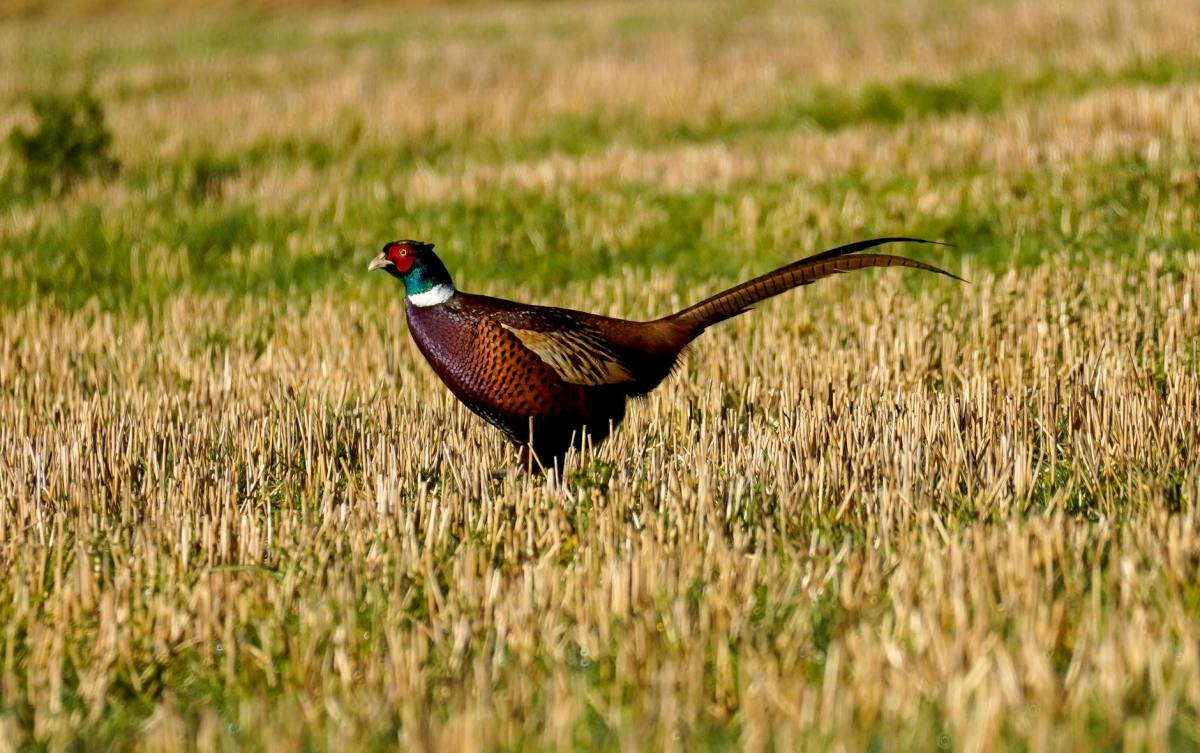
It’s a wonder to me that common Pheasants[1] survive at all in the wild. I guess they are of a certain size that means there are not so many predators in the English countryside. Their greatest predator is us. Males are particularly colourful and stately in appearance. Quite unlike the Canadian Geese who inhabit the riverbank, Pheasants walk like well-dressed gentlemen on their way to the theatre. They rarely take to the air. It’s such an inconvenience. They don’t so much dive and swoop as much as hop and jump.

Here we have a bird that surveys the world from the roof of our small garden shed. He likes the garden fence as much as plodding around on the lawn. Never troubled by the other bird life, it’s as if he’s related to royalty. Male Pheasants are definite show-offs.

A lot of UK Pheasants are reared for shooting. They are “non-native” birds. That doesn’t seem so much like sport to me. It’s more like shooting fish in a barrel. Love that wonderful idiom. The lack of self-awareness exhibited by the male Pheasant that visits us suggests that shooting him would be a pointless exercise. It would just be a way of covering the ground with lead shot.

Now, that springs to mind a traditional tongue twisting rhyme, namely:

I’m not a pheasant plucker,

I’m a pheasant plucker’s son,

But I’ll keep on plucking pheasants

‘Till the pheasant plucker comes.

One thing to try is to say the rhyme slowly and then speed-up each time you repeat it. It’s bad enough for native English speakers to master that one.

That simple English rhyme has some heritage[2]. As a modern idiom the pheasant plucker can become a pleasant, well you fill in the next word. It has an “f” at the start. If we had wandering bands of minstrels in 21st Century England, then I’m sure they would make something of those more challenging words. It would probably be done on an iPad in a blackened-out bedroom and launched on social media first.

Maybe we need a cyberspace version of a cobbled stone village square where such nonsense can be attempted. One that’s not owned by a massive corporate proprietor determined to scrape advertising revenues out of it. A place for off-the-wall acts to test their metal. And not one that’s a desperate scrolling fest for bored fingers. Not so much a Tick and a Tock but a gather round experience, I’ve got something interesting to show you. A curious audience gathers and stays for more than 10 seconds. A lively cultural experience is put-on to delight and amuse.

Let’s just say our structing pheasant inspired this thought. From birdsmith to wordsmith.


[1] https://www.rspb.org.uk/birds-and-wildlife/pheasant

[2] https://www.learnarhyme.com/tongue-twisters/pheasant-plucker

AAM

This week, I watched an FAAs Advanced Air Mobility (AAM) webinar[1]. The subject was community engagement. AAM could be air taxies but it’s many uses of the new electric aircraft that are becoming a reality. The term eVTOL is used for those aircraft that have the capability of vertical flight. My reflection is that there are several aspects of AAM that need much more attention. Naturally, I’m taking the discussion of what’s going on in the US and thinking about it in relation to the UK.

  • Land Use Planning

Generally, National Aviation Authorities (NAAs) are consultees when it comes to land use planning. They do not determine planning applications. NAAs may well have set out policies and guidance on the subject but they will not be determining the site of vertiports.

It seems to me that there’s little chance that eVTOL aircraft routes will be established without sufficient community consent.  Community engagement has been appropriately recognised as essential. The aspects in play are like those for existing aerodromes. Often for AAM applications proposals are for the use of new locations, hence a concern. Anytime there’s a serious proposal for a new aerodrome the opposition is up and running long before the proposers have got their act together.

The subject is complicated by the mix of public and private ownership of infrastructure. If the intention is to interconnect AAM with other transport services (bus/train/boat/road), then complicated agreements are going to be inevitable. It’s not just about buildings and tarmac but having a trained workforce available is a location dependent issue too.

  • Business Models

I’m about to sound as if I’m securitising the plans of a contestant on The Apprentice[2]. There are plenty of way of losing money in commercial aviation. It’s been a well-practiced art over the years. Great ideas fall by the wayside after huge amounts of money have been expended. Customers are key. People must want to fly the routes available, time and time again. And like London Black Cabs be prepared to pay the fare. Given the relatively small cabin sizes that are on offer these people are likely to be moderately prosperous groups or individuals.

Regular schedules air services can produce a reliable income. Airport-to-airport connections seem like a good bet. Problem there is the conveyancing of weighty luggage. Busy airspace could be a challenge too. That said, with tens of thousands of people at both ends of a route, no doubt some people will choose a comfortable, speedy direct connection.

There are good possibilities for major event driven transport services. Getting to and from a motor race or horse race event or a concert or festival can be hell when tens of thousands of people are all trying to get to and from a location or venue. The numbers may well stack-up to make eVTOL a premium way of dodging the crowds in an environmentally sound way.

  • Batteries, Batteries, Batteries

Everything in respect of aircraft performance depends on power density. How much oomph can you get out of a small, light weigh physical space. Recharge and go. Do it, again and again. It’s as simple as that. Not only that but aircraft battery packs must be affordable and available. Whizzy technology that cost a mountain of cash and can only be use for a few hundred cycles is no use at all.

Power distribution infrastructure must be up to the job too. Who will pay for this is up for grabs. There’s a good case for public funding given that there are multiple uses of enhanced electrical supply. Given the monopolistic nature of power generation and distribution this will not be easy or quick.

That’s only three issues that require a great deal of attention. Not the attention of researchers. Not the attention of academics, Not the attention of political policy wonks. Connecting entrepreneurs and public bodies needs practical stimulus. The possibilities are exciting.


[1] https://youtu.be/1sfVuJlPQoY

[2] https://www.independent.co.uk/arts-entertainment/tv/news/the-apprentice-2024-winner-pies-b2531331.html