The Evolution of Air Traffic Control

Until civil air traffic started to grow the need for its control wasn’t the number one consideration. The pilot was the master of the skies. A basic “see and avoid” approach was taken. See another aircraft and avoid it at all costs. Note, I am talking about the early 1920s.

If you want a nice exploration of how it all started keep an eye on the site of the Croydon Airport Visitor Centre[1]. The first London airport was not Heathrow or Gatwick. No, there’s a stretch of grass, a hotel, industrial units and out of town shopping standing on the site in Croydon of the first London airport. 

Firstly, we can thank Marconi for the first radiotelephony. Providing a means for pilots to speak to airports enabled the development of Air Traffic Control (ATC)[2]. It got going out of necessity because there was limited space on the ground and many aircraft wanted to take-off and land.

Aerial navigation took off in the 1920s. A hundred years ago. WWII drove advancement in every aspect of technology. After WWII, the basic having been established, an international body was established to set standards for international flying. That’s where today’s ICAO originated.

Radar and VHF radio transmissions were the cutting-edge technology that enabled air traffic to grow. Radio navigation aids developed as did automatic landing systems. So, by the time the jet-age started there was a whole selection of technology available to manage air traffic. Not only that but the standards required for these systems to interoperate around the globe were put down on paper.

That legacy has served aviation remarkably well. Incremental changes have been made as new capabilities have been developed. Most notable of that evolution is to return elements of control to the cockpit. A traffic alert and collision avoidance system (TCAS) does just that. It provides a safety net.

What we have available to manage dense airspace and busy airports is a complex, highly interconnected, interdependent set of systems of systems and procedures that is not easy to unravel. Each part, in each phase of flight, plays its role in assuring safe operations.

News and rumours are that quick fixes are being demanded in the US. Responding to recent accidents and a perception that all the above in antiquated, a well know tech guru has been thrown at the “problem”. I shouldn’t be a cynic, as having a fresh pair of eyes looking at the next steps in the development of air traffic management should be good – shouldn’t it?

It’s my observation, as an engineer who knows a thing or two about these things, is that any simple solution means that the parties have not thought long enough about the problem. In this case there are no quick fixes. However, there’s likely to be incremental improvements and they will not come cheap. 


[1] https://www.historiccroydonairport.org.uk/opening-hours/

[2] https://www.historiccroydonairport.org.uk/interesting-topics/air-traffic-control/
Legacy, A Cautionary Tale

English is full of pithy phrases that echo through the pages of history. One of the greatest contributors to this phenomenon was Shakespeare. Lots of quips and quotes and snippets of wisdom come from his numerous plays (and other literary imitations).

The phrase or maximum that I have in mind is: “Beware of an old man in a hurry.” It’s not the only one on the same basic theme. My dad used to say that there’s “No fool like an old fool”. Honestly, as a child I had no idea what he was getting at. I guess it was to sum-up an observation of someone’s behaviour. It’s not a complementary saying.

There’re several ways of interpreting the “old man in a hurry” saying.

For one, and I’m just about to clock 65 years, the way the world seems is conditioned by the fact that one’s final moments are a lot closer than they were as an ambitious young man.

Another interpretation is that we might expect an older person, with more experience, will be guided to make better life decisions. However, in reality, the reverse is so often true.

I could go as far as to say that the “beware” part is to beware of imbedded prejudices and reduced peripheral vison that can come with age.

Doing a quick bit of research the source of this short English saying is not ancient wisdom from a Greek scholar or scribbling Roman sage. Not even a contemplative Medieval monk.

No, it’s a young British Conservative politician talking about an old Liberal. In fact, probably the most successful old Liberal that has ever graced Parliament. The one who left this county with the world’s biggest Empire. When he passed at 88 years, Britain was the most developed, most prosperous nation and biggest manufacturer the world had ever known. If we were ever to call to Make Britain Great Again, we’d call for an old Liberal. MBGA doesn’t exactly flow of the tongue. Anyway, GB (Great Britain) endures as a name.

The young British Conservative politician was Churchill’s father, Randolph, and the old Liberal was an energetic, fired-up Gladstone.

Can I now use “Beware of an old man in a hurry” as I reflect on the week’s News? Does President Trump see the world as a racing clock? Knowing that mortality looms. Knowing that any marks that are to be made need to be made – now. The “long-game” is for others to play.

When time is almost up the tendency to rashness can be understood. A lot depends on whether the subject of legacy looms large in the thinking of a leader. Through the millennia legacy has mattered a great deal to leaders.

Gladstone’s success was marred by the eventual destruction of the Party he led. He did transform government from a boys-club of privilege, at least in part, but the future of Ireland became his achillea heel. As a Liberal, he found building a powerful country didn’t mean granting privilege for politician’s and friends’ private businesses but ensuring that the working class were represented.

Trump’s haste, and lack of longer-sighted goals, appears real. Constitutions, democracy and the public good will endure. Mean-time hang on to your hats.

Challenges Facing Supersonic Flight

Congratulations go to “Boom” for their supersonic jet flight[1]. Civil aerospace hasn’t ventured into this space for some time. Breaking the sound barrier is not an everyday occurrence in the civil world. There may be an international market for such new aircraft as much as there’s a market for fast cars and expensive boats.

However, I do not think a supersonic flight is the future of civil aerospace. It’s not mainstream. The environmental objectives for the future of aviation are ambitious. Generally, that means getting people from A to B in as clean and efficient a manner as is feasible. That does not include going ever faster and faster.

This new aircraft type is likely to be solely made in America. So, it does fit with the current political direction of the administration in the US. A triumph of technology. President Trump’s instinct to get rid of rules and regulations may work in the favour of Boom. However, in the end, the deciding factor will be – will the international marketplace want such a new aircraft type?

I certainly recall amazing ambition of the people who brought us the Eclipse aircraft[2]. Small light jets were going to be everywhere. Like a Silicon Valley revolution for the aerospace industries. That didn’t happen as predicted because the economics didn’t stack up. I don’t recall rules and regulations being the problem.

Even so, BOOM technology will have a hard job meeting international safety and environmental standards. I seem to remember that’s not new for supersonic flight. Even if the advancements made improve noise performance, there’s emissions and contrails to ponder.

There is another consideration too. It’s the problem Advanced Air Mobility (AAM) is facing now. To capitalise on their capabilities, these aircraft technologies require the reorganisation (modernisation) of national airspace. Plus, agreement at international level[3].

Supersonic flight over the world’s oceans may get agreement. Supersonic flight over national territory is a much harder sell. Some fliers may pay to slashing their travel times on-route. Going round and round in a stack, waiting to land, with conventional aircraft all around, will soon dispel any excitement.

Good luck to Boom. If civil use is minimal, no doubt defence applications will be numerous.


[1] https://boomsupersonic.com/

[2] https://www.eclipse.aero/about/

[3] https://www.icao.int/environmental-protection/Pages/default.aspx

Speed

Daily writing prompt
Have you ever unintentionally broken the law?

There was a plain envelope waiting for me when I came through the front door, on Thursday last. It didn’t look like the regular ones that are house bills, statements or unwanted advertising junk. Yes, I’m primitive. I’m still paper based, to a great extent.

When I did get to opening it, my heart sank a little. Now, I hadn’t seen one of those for years and years. Inside was a formal bold printed form. Simple question. Was I the person driving my car on such and such a date, in the place named? They got me. I followed a link to a site that held motorway pictures. These images had gone from my recollection but there they were in curated digital realism. Big electronic signs, in bright red, hanging over the M25 motorway saying 60 miles per hour. Trouble is the calculated speed on the form was not 60.

By a small margin of error, the indicated speed of my car was enough to trigger the plain envelope that was not a welcome addition to my correspondence pile. Unintentionally I’d broken the law. I say unintentionally because I’m in the habit of using the speed limiter on my car to make sure such occurrences don’t happen. On this occasion my lapse is almost certainly going to turn into the need to go on a speed awareness course. Never mind.

Question mark?

Daily writing prompt
If there were a biography about you, what would the title be?

That not an easy one. There are titles that stick for the strangest of reasons. One for me is David Niven’s: “The Moon’s a Balloon”, which is autobiographical. Simple and captures an actor’s life being one of illusions.

Spike Milligan gravestone epitaph could be a title of a life story: “I told you I was ill…”.  Which sums up the unexpected and terminal nature of life. Not to take anything too seriously.

Douglas Adams’s Hitchhiker’s Guide to the Galaxy is a good source of inspiration. I could take: “So Long, and Thanks for All the Fish” and convert it into “Bye, and Thanks for All the Toast”.

There are a lot of titles that big-up their subject on the basis that book sales might be higher if the story is about untold struggle and marvellous achievements. Epic tales can be repetitive even if they are universal.

I don’t know if anyone has used it, but I have in mind the title: “What was all that about?” Imagining that my biography is published after I’ve past. Although, I doubt if such a whimsical publication would hit the streets in our cosmos.

The Future of High Streets

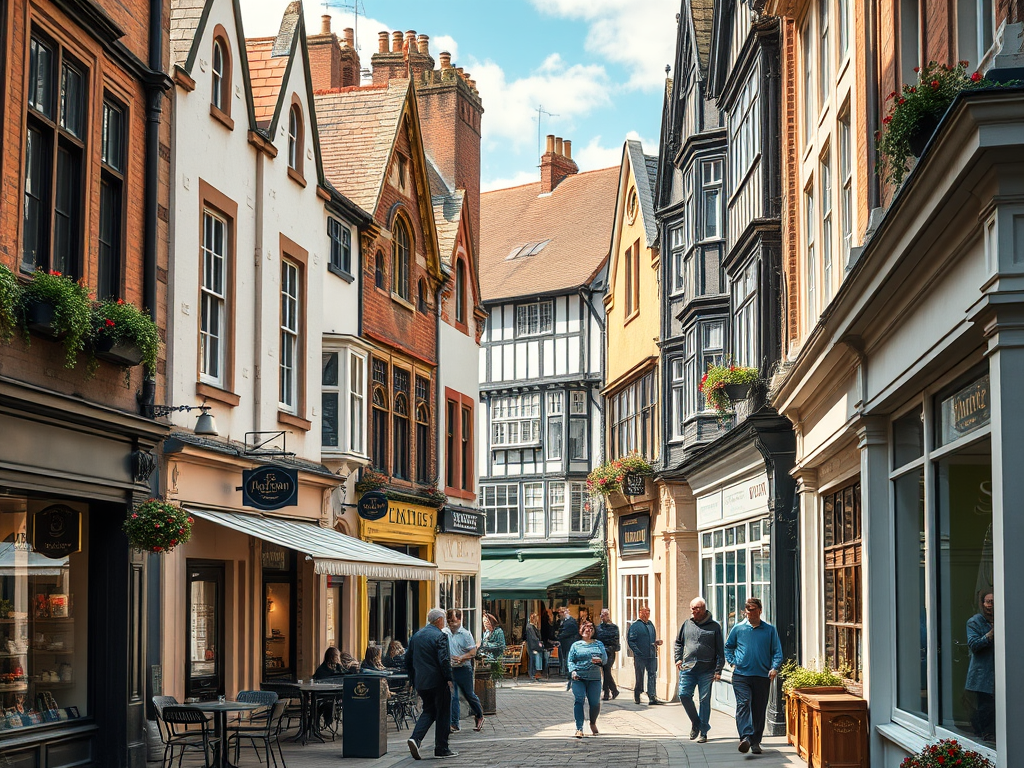
Traveling is great. There’s always something new to try. OK, I’ll add a caveat to that observation. There’s usually something new to try. What I’m focusing on here is our English urban environment. Whether that be the centre of a major city or a main street of a small town. Variety is the spice. Often communing from layers and layers of changes over decades.

What I can’t pretend is that all is well. There are well-known places that have cut out a specialist niche to thrive whatever the tidal wave of changes. However, even they are impacted by the trend for bland uniformity that the commercial world loves so much.

Yes, I might have a delightful afternoon in Oxford or Bath and think all is well. Then a stop in a less well-regarded city or town and the problems becomes clear. The shifting sands of our High Streets is leaving areas blighted by neglect or sanitised by unthinking development.

The function of the High Street is no longer that captured in Victorian photographs. The butcher, the baker and the candlestick maker. This Dickensian Street scene maybe nice to look at as a novelty. It hardly makes sense unless the intention is to preserve a museum like atmosphere.  

Our town planning can still be caught up a sort of Victoriana. Intent on preserving the line of shops that has existed since the traction engine replaced the horse. It’s nice to see, centrally placed, a traditional coaching inn, but even they survive as restaurants serving specialised cuisine or dusty antique shops.

So, what to do? I have a couple of themes. One is community identity. Another is facing the reality of the on-line world, and another is to bring everyday life back into centres.

Avoiding the bland mediocrity of modern design[1] should be up there high on the list. Future generations will castigate us we leave them such dull ordinariness as to make them look away. Every place has a story. It’s not a question of packaging that story up as a museum exhibit. It’s more a question of making a 21st century interpretation of a history.

Embrace the on-line world. It’s not going away. I don’t say hordes of flashing lights and screens the size of houses. No, let’s be a less crass. Free high-speed connections ought to be in the heart of our communities. Innovative thinking like portals[2] between centres offers opportunities. Even if these must be carefully managed. Connecting places creates new experiences.

There’s often a tussle between the wish to bring living spaces back to High Steets and the demands of the night-time economy. People make spaces work. That could be window boxes full of flowers or tables out on cobbled streets on a moon light night. What’s clear is that public transport, infrastructure, and affordable housing are a must.

More effort is needed to square this circle. Make sure a good life can be lived in a centre but at the same time it be welcoming to visitors. That’s tough for designers and planners but that’s where they should aim.


[1] https://www.prospectmagazine.co.uk/essays/42227/the-duel-has-modern-architecture-ruined-britain

[2] https://time.com/6977881/dublin-new-york-city-portal-temporarily-shut-down/

About Animals and Flying

Pigs do fly[1]. But only the more privileged ones. Yes, animals that fly are not restricted to those with their own wings. It’s true that the animal kingdom has been showing us how to fly long before powered flight took-off. Nothing more graceful than a bird of pray swooping and diving. We (humans) can’t match much of what they do with our flying machines however hard we try.

Birds long inspired great thinkers. They opened the prospect of human flight. If they can do it – why can’t we? Surely the right combination of aerodynamic structures and a source of power would solve the problem. Shocking, in a way, that it wasn’t until a couple of keen bicycle repair men and a smart mechanic persisted until they had a working machine. That was only just over a hundred years back.

So, today’s novelty News item[2] of a cat that didn’t want to leave an aircraft puts a smile on my morning face. For all the farm cats I have known, the story doesn’t surprise me at all. It’s the sort of situation where humans are almost powerless in the face of the preferences of a feline.

Naturally, the engineering staff of an airline will have a good look at where the cat has been in its wanderings. There’s always the remote chance for a rogue moggy to play with something they shouldn’t ought to play with. Even on a modern Boeing 737.

I used the word “remote” but there are definite cases of loose animals causing air safety hazards. Looking this one up, because it sits vaguely in my memory, I do recall a dog that crewed through electrical cables after it got free in a cargo hold. Now, however lovable and cuddly a dog maybe that’s a place that no one wants to be in.

Back in 2002, American Airlines Flight 282 approached New York’s JFK. It was a Boeing 757 that landed with chewed-up electrical cables. Crew members heard noises coming from the cargo hold and found that some aircraft radio and navigational equipment wasn’t working. A dog had chewed its way through a cargo bulkhead and attacked wires in an electronics compartment. 

A quick search reveals that there are more cases of incidents caused by loose animals than might first be thought. Animals are potentially hazardous cargo. Sadly, often these flight incidents are not good for the animals concerned.

One thing to remember is that a large aircraft, at flight altitude, is pressurised. That’s not at the air pressure on the ground (unless an airport is a long way up a mountain range). A dog with breathing difficulties is going to find an aircraft environment distressing. Dogs can be skillful escape artists. Myself, I’m not keen to share a flight with them.


[1] https://intradco-global.com/livestock-transport/

[2] https://www.thesun.co.uk/news/33273791/cat-causes-chaos-ryanair-plane-rome/

The Swiss Cheese Model in Aviation Safety

Models in safety thinking take different shapes and forms. A conversation might start – what’s a model? Why are they useful?

Here’s a go at an answer. It’s always risky to explain why something works. It can be like a dry analysis of the particulars of a good joke. That kills the essence. As the words attributed to Albert Einstein say: if you can’t explain it simply then you don’t understand it well enough. Even if that’s not literally a quote it sums-up the need for simplicity.

Aviation is a highly complex, interconnected, socio-technical system with a legacy that coexists with rapid advancement. There are few parts of the globe that are not touched by aviation in some way or another. Getting to and from Arctic wastes, commuting between vast cities or traversing the widest oceans. Aviation touches all of them every day.

There is no piece of paper big enough to write a detailed description of every part of the worldwide aviation system. Even the most extensive computer simulations just take on a small part of the whole. I often use this phrase – “it’s more than a head full”. What I mean is that however smart we might think we are, the normal person can only comprehend a slice of what’s happening. A slice frozen in time.

We get over our limitations in perception and understanding but approximating. That is to carve out a “model” of what’s happening and how parts of a complex system interact. That sounds easy enough to construct. It’s a lot harder than first might be thought.

For one, a model needs to be sufficiently universal to capture an underlying reality or theme.

Next, a model needs to be useful. It has utility. It’s proven to work. To produce useful outcomes.

Thirdly, a model needs to communicate a message across cultures, beliefs and disciplines.

A model that meets all the needs described above can be as big an advancement as any hard technology. I guess it’s not surprising that a professor of psychology comes up with one that has been used and reused successfully over decades.

This week has seen the passing of Professor James T. Reason. He’s left us with a legacy that’s almost incomparable. His Swiss cheese model[1] has become a basic part of every aviation safety professional’s training.

I’ve debated and discussed accident causation a lot. The Swiss cheese model[2] is not the only way of thinking about how accidents happen, but it is an extremely good one. It promotes a way of thinking about how to defend against accidents. That’s powerful.

Like all models it’s a simplification of a highly complex system. Its great strength is that this model allows us to see through the mist. To see part of what is obscured by complexity. That is immensely valuable.

Thank you, Professor Reason. 

NOTE: An IFA Video with Professor Reason Every Day – 20 min film – International Federation of Airworthiness.


[1] https://en.wikipedia.org/wiki/Swiss_cheese_model

[2] https://www.eurocontrol.int/sites/default/files/library/017_Swiss_Cheese_Model.pdf

Pragmatism in British Politics

Pragmatism has long been a part of British life. Idealism too but to a lesser extent. That said, the shelves of literary works probably tip in the balance of idealism. There’s always an “insightful” quote to pull of the shelf and plonk into a speech or scribblings like this.

There’s a comfort in putting important decisions down to known facts and up-to-date realities. This way of working tends to favour short-term action based on weighing-up the here and now. What’s best for us where we stand at this moment? How much money have we got?

If you are an ardent socialist or committed liberal or dyed-in-the-wool right-winger, then pragmatism can make your flesh crawl. It leads to the question – what do you really believe in? Intellectual prowess is challenged by a call to make it up as we go along.

Pragmatism encourages hypocrisy. Now, that might be phrased as an uncomfortable negative. The truth is that no successful organisation has ever escaped a great deal of honest hypocrisy. Positions on even the most hard-fought issues do change. That’s not a negative. Just a couple of minutes surveying the history of the last half century, more than proves the case.

So, when I hear the UK Prime Minister (PM) talk of “ruthless pragmatism” I do wince a bit. It’s not that pragmatism per-se is an evil. No way. Mere survival in any political landscape and someone must react to the here and now in a way that doesn’t sink the ship.

PM Keir Starmer talking on Europe[1] is like listening to a rich Victorian woman having on extremely tight underwear. There’s no way she can loosen it in public. Her peers would disown her. When no one is looking an immense sense of relief can be gained in shedding the constraining garments. Behind closed doors the ridiculous restraints are shed.

Frankly, UK opposition to joining youth mobility schemes[2] in Europe is a stupid as stupid can get. I mean stupid times a billion. Now, some madcap idealists might be scared that British youth might, if taught early, be influenced in ways that would last throughout their lives. Such would be their indoctrination that eventual the push on the UK to join to European Union (EU) would be overwhelming.

There’s another word beginning with “p”. Take pragmatism and replace it with paranoia. The later seems to be fashionable just now. Forget the idealist approach where at least views tend to be based on a plausible creed. Paranoia is such that no previous experience is necessary. It’s all-over social media and more and more conventional media. Pragmatism is met with disbelief. So, is it wise for Keir Starmer to make that word a number one headliner?

A philosophical political pragmatism has been long practiced in the UK. I don’t see that stopping anytime soon. But what’s to be gained by headlining it? Not a lot I’d say. In fact, it gives ammunition to the light blue swivel-eyed loons[3].


[1] https://www.independent.co.uk/voices/editorials/keir-starmer-brexit-reset-europe-b2692118.html

[2] https://lordslibrary.parliament.uk/youth-mobility-schemes/

[3] https://www.independent.co.uk/news/uk/politics/swivelgate-david-cameron-goes-to-war-with-the-press-over-swiveleyed-loons-slur-8622277.html

Sun up to Sun down

Daily writing prompt
Describe your most ideal day from beginning to end.

Arise from a slumber as sharp as a nail. Gaze out of the window on a sun filled world. Remain completely stoical about the morning’s News. Drink that first cup of tea whilst marvelling at a crazy Squirrel upside down on our bird table. Open to the notion that it’s possible to learn something new as the day pans out.

Have a plan to do tasks entirely of my own choosing however meaningless that might be. Tick-off those tasks with a smug satisfaction as the six-o’clock News looms. Sit back without a care. Chat about whatever it is that bubbles to the surface. Slowly subside into a comfy armchair. Realise how fortunate it is to live in a part of the world not blighted by conflict.