Hero to Zero

How to go hero to zero in 30 seconds. I hired a large van for a week. From a company that had done a good job for me in the past. I had a lot of confidence in their offer. Fine their location had changed. Once the company was in Redhill in Surrey. The office was easy walking distance from my house. Now, they have an office in the small town of Dorking. So, it’s a short train ride away.

The Surrey towns of Reigate and Dorking are separated by about 8 miles. They both sit under the North Downs. The main A25 road links the two towns and probably has done for centuries. Without delays that’s about 20 minutes door to door. Normally.

Moving house is one of the most stressful events in life. That’s what we are currently about. It’s a move further West. It’s a move to take us away from the dreadful mess that the M25 motorway has become in the last couple of decades. From 3 lanes to 4 lanes, it’s got worse not better. Why do we think we can build our way out of traffic jams?

So, for the last week I’ve been driving a large van backwards and forwards from Reigate to Newbury. The hired van was everything I needed. Only about 7000 miles on the clock and plenty of space. If I had one niggle it was the need for a reversing camera. Beepers are just not enough.

The rental company, named after a famous starship, that went where no man has gone before, was topping my hero list. What I needed when I needed it and at a good price. With only a minor inconvenience when picking-up and dropping-off. Or, so I though.

Named storms are popular this year. Driving through one of them is no fun. Traffic slows and the inevitable bump or blown down tree holds everyone up. Nothing moves the way it does on a sunny day. It’s times like these when planning can be more guess work than science. Whatever a satnav calculates.

In my wisdom I thought – let’s try a cross country route home. Get off the habit of using the M4 and M25 motorways. Programmed the satnav and away I went. Leaving Newbury lunchtime thinking that getting the van back to the rental company by 5pm would be no sweat.

My route took me from Newbury to Basingstoke and then to the M3 motorway. Then towards London and coming off the motorway to take the Blackwater valley route to the Hogs Back. Those references are for Surrey residents because they will know what I’m talking about. Trundling along the Hogs Back I then hit the main A3 into Guildford. Now, my logic went like this. I’ll avoid the Wisley junction reconstruction or permanent hold-up by taking the main A25 all the way back to Reigate. So, I did. All going well until I reached the closure of that main road[1]. At that point I was committed to getting back to Reigate to unload my packing boxes. Can’t carry them on the train.

When road closures happen in Surrey, at rush hour the mess is insane. The diversion I took up over the North Downs and back down again onto the A217 road was miserably slow. What’s worse is that I knew I had to turn around and go back to Dorking to return the rental van. The clock was ticking. 

Anyway, enduring the tedious frustration of doing a short journey, by miles, over a long time wore away at my generally cheerful disposition. Thus, I was glad to get back to the rental company office in Dorking only about 20 minutes late, after 5pm.

I was committed to leaving the van and taking the train home. That trading estate rental office closes at 5pm. A dark and empty parking space was free, but nowhere could I see anywhere to drop the van’s keys? It seems inconceivable to me that an international rental company would not have a key drop. I searched the plot. There was nowhere. All there was an unhelpful notice on the door of the company’s office. So, I locked the van, kept the keys, and walked to the train station. Idea being to return the keys as soon as the office reopened next morning. Seemed logical.

Next morning, I got up early and set off for Dorking. Sadly, the closure of the A25 was still an on-going problem. All the rush hour traffic had the same issue to contend with on their way to work. This is why I’m happy to be leaving Surrey. A short journey turns into a tedious trek at the drop of a hat. The county’s roads are unable to cope with the levels of traffic. But, as planned I get to the Dorking office of the rental company at 8am when the office opened. Enterprise were still in my hero category as the van was inspected and the mileage typed into a company handheld device. I would have given them 10 out of 10. Job done.

In the warm, in the rental office, just as I thought the paperwork had been done – hold on a moment it’s charging you an extra day for a late return. Computers do these sorts of things. They have no awareness of the world other than the numbers they crunch. Unthinking beasts.

I’ll have a word with my manager. Those were the words spoken. Me being me, I though that’ll be no problem given the effort I’ve made to return the keys. Let’s face it if there was a drop box last night they would be doing exactly as they are now. Van returned in 100% condition and keys in hand.

Then to my surprise the office manager, who insisted on using my first name, says no we are going to have to change you for an extra day. In 30 seconds, Enterprise went from being my number one van rental choice to a huge bottomless zero. I argued the logic of my position and the unforeseen local conditions that prevailed. I outlined the best efforts that I’d made.

Then I got the most galling response – it’s company policy. I suggested that the office manager might use a little judgement or digression in this case. I hit nothing but a stone wall. The computer says so. The charge is the charge. No deviation possible. It’s astonishing that an office manager can’t make a reasonable judgement. If that’s Enterprise company policy I don’t want that kind of service. Other companies are available.

What didn’t help either was the prospect of the return journey in my car knowing that the main Reigate Road was closed. As per my prediction the short journey home again was awful.

Hero to zero – Enterprise. Hero to zero in 30-seconds. My future business will go elsewhere.

POST: This quote from the Enterprise website is meaningless. “We understand that things don’t always go to plan so, if you are running a few minutes late we won’t charge you for an extra day, we give you a grace period of up to 29 minutes to cover unforeseen delays“.

Part 2.

Change is always welcome. The above rental made me think twice about using the services of Enterprise. In my new town, they have a much more easy to get to office. It’s a 20 minute walk from the house. So, I ate my pride and booked a big van for a couple of days. The job was much the same as before. It’s all part of a house move that is lasting far too long.

Here I am renting from Enterprise Rent-A-Car once more. This time I’ll drop the label “zero”. From picking up the van to dropping it off everything worked as it should. My large commercial van took a heavy book case and a king sized bed from Reigate to Newbury without a hitch.


[1] https://www.getsurrey.co.uk/news/surrey-news/live-a25-traffic-updates-after-28495765

Votes count

Sneaking past the national news this week was a change that is of more than a little significance.

For more than a decade, I did live outside these shores. All the time that I did, I continued to vote in local and national elections. At that time, I still had an address in the UK. What would have happened if I’d continued to live abroad, for more than 15-years, is that my right to vote would have been taken away. This so-called 15-year rule meant that millions of British citizens were excluded from voting.

During the referendum of 2016 a great number of British citizens living abroad were unable to vote for or against Brexit. At the time this was seen as a great injustice. This was especially true for those who maintained strong links with the UK.

Now, almost without anyone noticing, the UK is aligning itself with other major democracies in the world. The 15-year rule has been scrapped. Some people estimate that the change to the franchise could mean an additional 3 million British citizens will have the right to vote restored.

British citizens living abroad, who no longer have an address in the UK, can now register to vote in UK General Elections. Which is convenient given that one is imminent. Naturally, this still requires those who are eligible to know about the change and to register to vote.

Interestingly, it’s the Conservatives who promised to enact “Votes for Life” in three previous election manifestoes. It’s taken a long time but the reality of the extension of the franchise is now with us[1].

The ability to donate to political parties comes with these changes. Maybe that’s one reason that Conservatives were persuaded of the need to change voting rights for the British abroad.

There’s still a possible Brexit related uncertainty. Should they occur, each UK referendum has different voting rules. So, the general restoration of the franchise may not impact any future vote on the reversal of Brexit. That would be a matter for specific legislation.

Lifelong voting rights have both a plus and a minus. For most people who retain interests in the UK it’s a matter of natural justice. They may have UK pensions, pay taxes, or have family members that are directly affected by changes that British politicians can, and do make.

For those people who have completely severed ties with the UK it maybe argued that this restored right to vote is generous. However, there’s no obligation for those who have no interests in British governance to register to vote.

Given that the British abroad can all participate in national elections, it will be interesting to see if future UK governments take more interest in their situations.

Starting on 16 January 2024, if you are a British citizen living abroad, now is the time to act. Register to vote.


[1] https://www.gov.uk/voting-when-abroad

On my radio

Out on the edge of the city of Coventry is the campus of Warwick University. At the heart of the campus is the Warwick Arts Centre. I recall “Rockpile[1]” when they played a UK university tour in 1978 or 9. One of their concerts was at the Warwick Arts Centre and I was there.

It was a fantastic night. No idea how I got there or got home to my rundown student accommodation in Coventry. My student days were at what was then called the Lanchester Polytechnic. A clumsy group of post-war modernist buildings strung up in the centre of a struggling city.

Music-wise I was living at the centre of the known universe. Between 1978 and 82 Coventry was alive. Venues were full. It was a youthful eruption of music. There was an air of decay in the crumbling manufacturing heart of the West Midlands. The brutalist and raw concrete architecture of the city was gathering moss, springing leaks, and not living up to the idealism that built it. Maybe the cost of living was not so hight, but something kicked-off an explosion of creativity. The energy of 40-years ago made its mark on popular culture.

Anyway, what I’m recalling here is a BBC Radio 1 DJ. She was that at the time. This week Annie Nightingale[2] has passed away. It seems fit to remember her with her finger on the pulse of what was happening. She was at the Rockpile Warwick Arts Centre concert, seeing and being seen. Much senior to the students in that hall. That didn’t matter one bit. Whispers went around in respect – that’s Annie Nightingale. We knew we were at a special event.

There’s another recollection I want to get off my chest. It involves cassette tape and an amber-red Sunbeam Imp[3]. Making compilations was all the rage with cassette tape. In this case it was Annie Nightingale’s compilation. Probably in the early 1980s.

Who knows which Halloween it was, but I had one recoding of one radio show she did that was my favourite car tape. Her instincts were prefect. It was one of those tapes that could be played repeatedly wherever I was going. My school days echo with the “Monster Mash.” A smile comes over my face when I hear Barnes & Barnes and Fish Heads[4]. Or “Werewolves of London” by Warren Zevon[5]. Don’t Fear the Reaper by Blue Öyster Cult. A great selection of fun packed horror-themed tunes.

Annie’s Halloween radio show was a masterpiece. She defined cult classics. Her earnest side aside she was mischievous. In a box. I know not where that tape may still exist. I’ve a mind to look for it. Thanks Annie.


[1] https://en.wikipedia.org/wiki/Rockpile

[2] https://www.theguardian.com/tv-and-radio/2024/jan/12/annie-nightingale-radio-1-dj-dies-aged-83

[3] https://classicmotorsports.com/articles/not-mini-sunbeam-imp/

[4] https://youtu.be/cn73Wtem0No

[5] https://youtu.be/c6M89iDabwM

Snow

In Hertford, Hereford, and Hampshire, hurricanes hardly ever happen. Good job too, I’d say. The phrase is from a song called: “The Rain in Spain,” in the musical My Fair Lady. That was a Christmas treat. It’s antiquated but still a wonderful classic film[1]. Yes, some of the miming is rather questionable but the story is told in a leisurely and wonderfully warm way. It’s just enjoyable entertainment.

It’s not pitching. What’s not pitching? The snow. The snow is not pitching, I said. This morning when we had flurries of half-hearted snow. Snow not sleet. The sort of light snow that I could be confident in saying was going nowhere. It danced around in the air more for performance than doing anything that was going to mess-up my day. Fluffy and gentle and certainly no hurricanes.

Sue looked at me. She’s done this before. You see London folk are hardly acquainted with the term I used to describe what the wispy snow was doing. Strangely, I thought Chat GPT would draw the same blank on the use of this verb of mine, namely to pitch. It didn’t. Whereas Microsoft’s AI hadn’t a clue when I asked did about “Hertford, Hereford, and Hampshire”, for my simple West Country verb it got it right away. Although, the AI’s explanation was to say that the word was from the city of Bristol. How could it have known any better?

It’s an alternative word for settle. The snow fell but it didn’t settle. I’d say the snow fell but it didn’t pitch. I’d say that instinctively. So, ingrained I’d wonder why anyone would use a different word. It means that the snow that was falling disappears as soon as it hit the ground. In other words, it’s too warm or the snow not plentiful enough for any accumulation or hazard for that matter.

Fictional professor Henry Higgins would no doubt have looked at me with disdain. Londoners have this way of thinking that theirs is the only valid English language spoken. What will the proliferation of digital bots do to innocent regional quirks? Will Chat GPT become a snobbish tyrant like Higgins? Or will it become like a journalist writing for The Sun newspaper? Writing as if my reading age was about 10 years old? I have no answer to that one.

It would be a shame if inevitable electronification stuffed us all into the same box. Ironed out the ripples and variations in langauage. Gave the pedants a leg-up and arrogantly kicked the rest of us. Will we need a Campaign for Real Speaking?

On another point. Conversations can go off at abstract tangents. One thing I’ve noticed about AI is that when it’s fumbling for an answer it will throw-up anything with a vague link to the subject of interest. It’s saying – I’m still not sure what you’re asking so I’ll take a blunderbuss approach.

Today, I learnt something I already knew. I knew it because last year I did a lecture at the University of Hertfordshire. However, the information had disappeared into the far corners of my brain. The University of Hertfordshire has an American Football Club called the Hertfordshire Hurricanes. I wonder if some cocky smart alec[2] named the team because of the musical. I’ll bet – not.

POST: An answer could be that the site of the University is the site of a former British aircraft factory. The de Havilland Aircraft Company Limited. However, the Hawker Hurricane was not produced on that site. de Havilland did produce propellers for the Hurricane.


[1] https://www.imdb.com/title/tt0058385/

[2] https://grammarist.com/usage/smart-alec-and-smart-aleck/

Time

My watch is playing up. It tends to freeze its screen. Any amount of pressing of buttons doesn’t have the desired effect. This is the third Garmin watch that has graced my arm. This one is full of smart features. Not, that I need a fraction of what it can do. Up until now it’s been faithful. So, I’m annoyed that it’s behaving badly.

These trails and tribulations led me to going back to a conventional watch. Dial and hands. A slightly more up-market Swiss watch that has been worn more on special occasions than the everyday Garmin. I like it. Only it’s metal, chunky and weighty. More of a real proper watch than the plastics of the Garmin. More residual value too.

This moment of reflection is about the demise of the traditional wristwatch. They haven’t gone out of fashion entirely. In fact, there’s more fashion watches displayed in shop windows than ever. But I wonder who buys them? I’m reliably led to believe that young people use their phone to tell the time. That simple but essential act. Since the mobile phone is almost inseparable from the human hand it’s pushed other devices into the wilderness. It does it all.

Maybe a couple of decades ago, I’d feel awkward if I’d forgotten to put my watch on in the morning. It would sit there expectantly. Its role was essential. Although timepieces were ubiquitous, around the house, car, and work, the only one that was personal was my own watch.

There wasn’t the necessity for a device to be “smart” either. A watch was a watch. A camera was a camera. A phone was a phone. A Walkman was a Walkman. The list goes on. Making this point makes me feel like a primitive relic from a long-forgotten past.

In the land that time forgot. No, not me. Time has always been important. If it’s not planning or scheduling, I’ve a fair amount of project management activity in my past. Deadlines, milestones, and critical paths coloured up on Gantt Charts[1]. Yes, time and tide wait for no man. A nice little idiom.

Time can be personal. At one time my mother had the kitchen wall clock set about 5-minutre in advance. The underlying idea being that if you were a moment or two late in starting or finishing a job then you were not late in reality. Even better when the deception instilled a bit of urgency into a task when in-fact there was time enough.

Going back further, I remember a childhood conversation with an ancient distant relative who lived in the shadow of a towering railway viaduct. Time then, in the small hamlet where he lived, was linked to the time of the steam trains on the Somerset and Dorset line. No need for clocks. Farm routines, like bringing the cows in for milking were arranged according to passing trains.

I expect I’ll get my Garmin watch, with its accurate navigation functions, up and running again. It may need a new battery. I do wonder if I need the precision or the range of its capabilities. Like the technology packed in my phone, its use is more habit than necessity, in a lot of cases. We are beguiled by “can do” technology.


[1] The first Gantt chart was devised in mid 1890s by Karol Adamiecki, an engineer who ran a steelworks in southern Poland.

Comment

Custom and practice are as important as the rules and regulations that are part of our lives. Now and then, someone is criticized for applying the letter of the law without care for the spirit of the law. The same is true for custom and practice. Whereby, acting outside past norms can trigger a backlash.

Because, in free countries we believe in a free press, the rules and regulations that imping on what should and should not be said about events are always hard fought over. The banner of the “public interest” is touted as overriding. It may or may not be, but there’s an argument to be had.

In the aviation safety profession, I’ve grown up with an instinctively “need to know” disposition. I’ve shaken it off, mostly but there are signs that the attitude persists. This instinct can run counter to the transparency and openness that most people expect to see.

Why talk about the way major events are talked about?

A case in point is the recent runway collision in Tokyo. There’s much already written about the newsworthy aspects of the event, so I’ll desist from adding much more. There’s a lot of speculation too.

Graphs can be drawn of the media attention given to such tragic events against time. It’s typical that from moments after a major aviation accident until a few days after most initial facts are known there’s a huge surge in activity. This used to be described as newspaper column inches.

Today, wide ranging speculation is inevitable. It can be highly literate, and, on the other side of the coin, it can be badly informed, and now and then damaging.

In over three decades, I’ve been dealing with aviation accidents and incidents there has been notable changes in media and communications. For one, the universality of the INTERNET is now unquestionable. For another, the deference offered to authorities has diminished markedly. For yet another, the speed of with which images can travel around the globe is astonishing.

Most aviation professionals are tempered by caution. Aware of the techical complexities that can arise in aviation accident scenarios. What can seem in the heat of the moment to be an obvious cause and effect, after detailed analysis turns out to be wrong, or only a partial picture.

So, should aviation professionals be scathing about the enormous growth in commentary and public speculation? Especially when some of it is wild and or even outrageous on social media. No. I don’t think so. Like it or not this is our digital world. The freedom it affords to throw-up any opinion or theory can only be tempered a bit. The hope is always that the pure dross fades away when a reputable authority challenges it.

That then puts a responsibility on someone, with professional knowledge to challenge ill-founded speculation. Or, at least, to ensure that the major media outlets have reliable sources of trustworthy information. I don’t think aviation professionals should remain silent concerning speculation. That may have been the strategy decades ago. It no longer works. The greatest degree of transparency and openness, based on verifiable facts, should be the aim.

Comment?

The Will

We’ve entered the first days of a New Year. Traditionally, it’s a time for reflection and speculation.

Looking back at the path behind.  Looking forward at the unmade path ahead. Four and twenty years into the new millennium perhaps it’s not so enjoyable to look back. To be reminded of the travails of the last decade, in particular, isn’t that helpful. We can go back to feel good moments, like 2012 and the London Olympics[1]. Sadly, there hasn’t been enough of these moments of unity and common purpose. Unscrupulous politicians have become fixated on dividing people.

This year, the opportunities to change all that are staring us in the face. It’s an Olympic year[2]. Choices abound. Elections mark an opportunity to carve a new path ahead. Doomsayers are totalling up the conflicts in the world. Listing the threats. Calling our attention to our weaknesses. This is one side of the coin. I’d rather highlight the other side of the coin.

As much as humanity is well capable of breaking things it’s getting ever better at fixing things. We may be slow in recognising climate change, but it’s spurring innovation on a massive level.

Despite the aging demographic in this country, the world is more youthful. That worldwide youth is gaining better education, in numbers unimaginable in past millennia.

The Human vs. Machine narrative is a false one. The choice is ours as to what to do with technology. We need to take that responsibility. The means to do so are available to us if we choose to us them.

Health outcomes, at a global level are improving. Our understanding of the afflictions of humanity is advancing to meet the challenge. Our responsiveness to new threats is improving.

So, don’t look down at your feet. Look up, look forward and prepare for a better future.

There’s also a stubborn noise in our political debate. Every request is for more money. The thesis is that the problem, whatever it is, will be solved by more money. Sometimes that’s the way to go. Investing in science and research has been shown to work. It clearly helps to have a well-trained and well-motivated workforce. However, this sum isn’t digital. In other words: More Money = solution. Less Money = failure. In a lot of cases, it’s not money that is the missing component.

Much of what I’ve observed fits a different equation. Namely, sustained political will equals progress. Lack of political will equals stagnation. And political will deployed like a blunderbuss equals disappointment and waste. I’m talking of a version of “A House Divided Cannot Stand.” The issue is how to differentiate and not how to divide. They are different.

The British high-speed rail debate is a sad example. Sustained political will can deliver. Poor management, shilly-shallying and constantly shuffling the pack, which is what has happened, lays the tracks to failure and waste in the long term.

2024 can be a year when we take back control of our destiny. Commitment to building a better country. A generous and inclusive society that brings people together. We have the will.


[1] https://www.londonolympics2012.com/

[2] https://www.paris2024.org/en/

Eurostar

More than a few times the thought that climate change will impact transport has been raised. Not so much as transport impacting climate change but the two go hand in hand. Whereas the assumptions built into roads, rails and airports were of their time, time doesn’t stand still.

More frequent heavy rain and raised tides, and the flooding associated with them, are to be expected. To hear that the rail tracks between London and the Channel Tunnel have been underwater shouldn’t be too much of a shock. Flooding is a worldwide threat to public transport systems. In London, over the last couple of days, flooded tunnels brought travel chaos. Millions of gallons of water were not where they were supposed to be.

We can get used to disruption caused by strong winds and torrential rain sweeping across the country. The question to ask is – should we? I always wonder as soon as I see the word: “unprecedented” in a public statement. Huge volumes of water may not have been predicted to overwhelm the pumping systems designed to keep them under control, but now we know. It makes me think we are going to hear the word “unprecedented” a lot more in future.

This city centre to coastline railway is relatively new[1]. It cost £6.84 billion and opened in November 2007. Most travel commentators would say that it has been a great success. I was looking forward to the day that the German train company, Deutsche Bahn was to implement plans for a London to Frankfurt train service. Sadly, that project was shelved in 2018. I wonder why[2]? That “B” word again.

The subject of these comment, the Thames Tunnel is over 3km long. The rail lines dive beneath the river from the counties of Essex to Kent. This High-Speed rail tunnel goes under the river near Fiddler’s Reach. This part of the River Thames, much like most of the tidal river, was once busy with commercial shipping. It’s been the site of unfortunate events before[3].

Further upstream is the Thames Barrier. A truly magnificent structure. The barrier protects central London against a storm surge. It works well. However, it will eventually need to be replaced. The inexorable tide, no pun intended, is moving just one way.

Risk is a multifaceted factor: operational, economic, social, political, safety, security. Did current risk assessments foresee a likelihood of flooding? I don’t know. The safe running of High-Speed trains through underwater tunnels should be subject to risk assessment. I’m sure it is.

Eurostar has experienced a set back as 2023 comes to an end. Eurostar services are again running as normal. But this weather-related event highlights the fact that climate change will impact transport systems. If the thought has not found its way onto the desk of a civil servant, it might be as well to do a high-level audit of the nations transport infrastructure.

Either that or get used to using the word “unprecedented” a lot more.


[1] High Speed 1 (HS1) is a 109.9-kilometre high-speed railway linking London with the Channel Tunnel.

[2] https://www.independent.co.uk/news/uk/politics/london-frankfurt-cologne-train-deutsche-bahn-db-eurostar-cancelled-shelved-a8394806.html

[3] https://www.britainfromabove.org.uk/en/image/EAW143996

Autotraffic

Driving back from Christmas. That’s not a Chris Rea song. Although, he did write “Driving home for Christmas[1]” while stuck in heavy traffic. I expect the feelings are similar – moving down the line. It took some time. Redlights flickering everywhere. Looking at the drivers next to me – looking just like me. Looking stoic or miserable or both.

Our carborne irritations were trivial when compared with the conditions in Scotland. We didn’t get 80 mph winds. At least the snail’s pace of the traffic on the main A303 was a snail’s pace. Inch by inch we moved closer to where we wanted to be. No streetlights on the jammed part of the A303, yesterday. The light went up and down with the heavy cloud cover. Colours ranging from gloomy grey to even gloomier dark grey.

Windborne debris, litter, like discarded crisp packets, set off on journeys of their own. Waterfilled potholes blended into the grey of everything. Crushed traffic bollards popped up as if they were growing amongst the sodden grass verges. Occasional motorcyclists took their life in the hands as they weaved amongst dozy drivers.

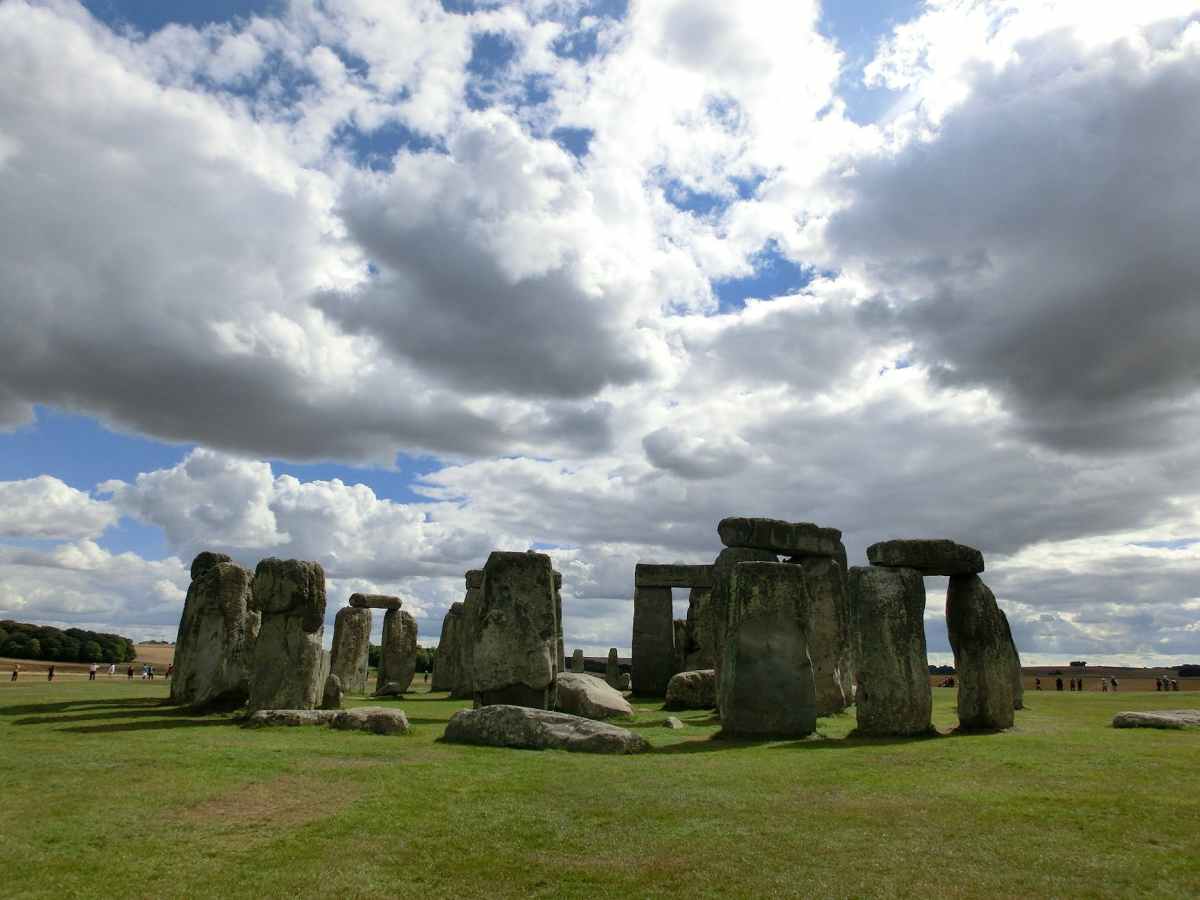
In the stationary moments my mind wandered. Who were those people dressed in the storm gear doing the tourist march around Stonehenge? They were not going to give up one moment of their vacation. What’s a blizzard of rain comparted to a once in a lifetime trip around ancient stones?

I got to thinking – how would this work if half the cars around me were automated? Human behaviour is pretty erratic. Driver temperament goes from kind and generous to intensely mean. From the laidback CofE vicar to the road rage professional. The circumstance of the drivers is hugely different too. One may be surrounded by screaming children while another is lone, absorbed in their favourite podcast. The first is a couple of hours into the worst drive of their entire lives. The second is in no hurry and happy for the day to drift by.

I sincerely hope that the makers and promoters of “driverless” cars take the human factor seriously. We know enough from aviation to know that the interaction between humans and semi-automated machines is exceedingly complex. That’s in situations where operating procedures are tightly controlled and monitored.

It’s one thing for car makers to rattle on about the importance of safety, it’s another for promises to meet the road. I’d say this is particularly true for the average British main road. Given its provenance there’s an excruciating number of variables. A truly dynamic set of variables that increase dramatically with speed. Weather goes from plus thirty summers to minus ten ice packs. Worn white lines come and go. Grass verges overhang the carriage way. Tarmac cracks and puddles compete with mud sloshing across the road in the heavy rain. Magpies dart into the road to munch the carcass of a dead hedgehog. The one that didn’t make it across the road.

Human drivers compensate for all the imperfections because that’s just what we do. It’s amazing even what the worst of us do. On the other hand, machines must characterise every single non-standard situation with accuracy, reliability and at great speed. Next time, I’m driving home for Christmas it will be manual. Likely, for a decade more too.


[1] https://youtu.be/uSjq7x67kzM

Gerrit

Apparently, Gerrit is the Dutch, and Frisian form of the more familiar name Gerard. It’s the name the UK Met Office[1] has given to the winter storm that has just barrelled its way across the country. I don’t normally write about wind and rain, but this storm is worth a short note. Not least because there was plenty of it for me to see as I was stuck in heavy traffic up on Salisbury Plain.

There’s some niggly social media kick-back on this habit of naming of storms. It’s winter after all. Having gloomy warnings pop-up for yucky British winter weather can get a bit tedious. In this case, I did take note of the weather warnings for Wednesday. Fortunately, the strong winds were blowing the right way for me. West to east.

My plan. Yes, I did have a vague travel plan. My plan was to get a major part of my journey, eastward on the main A303, done before the weather turned into heavy rain and strong winds. That well-meaning plan failed. Salisbury Plain[2] is an expanse of open chalkland which is exposed to weather from all directions. Today, I’ve spent too much time watching grey clouds traverse those uplands.

I blame Stonehenge. If prehistoric people hadn’t built it where they did then we’d have no traffic jams. The roads would be free. Those ancient builders must have been Europeans. In fact, they were since countries didn’t exist. Sorry, that’s just me pretending to be a Daily Express reporter.

Sure, enough it’s the stretch of the A303 that passes by Stonehenge that is the worst for traffic build up. Winter or summer. One of the reasons is the shear level of traffic on this main road. It’s a popular route across southern of England but it suffers from a classic road syndrome. The better it gets (condition wise) the more traffic it attracts. Road “improvements” continues to be made, often at great expense and controversy. The encampment of road protestors at Stonehenge has disappeared. That said, I’m absolutely sure their objections to further expansion of the road haven’t gone.

This year, for late December the temperature is remarkably warm. It’s wet too. Warm and wet. Is that what climate change has in-store for us in the south of England? Dull British winter weather is grey with extra grey bits. It can be mighty depressing. Short days don’t help either. Gradually they are getting longer. If only the worst of winter wasn’t still to come.

Whiling the hours away in nose to tail traffic doesn’t help with spirts. The only consolation is to look out at the drama of the landscape and the storm all around. I tend to get stoical about the whole sufferance. I pity those who sit agitated at the wheel trying to squeeze one car length ahead by getting out of roundabouts faster than others. The constant stop-go of taillights is a sure sign of a driver’s irritation. Me, I try to cruise forward inch by inch using as little power as possible.

The idiocy of playing psychological games in heavy traffic makes me wonder if some drivers ought to have a licence. This happens when two lanes merge into one. Me, I obey the one and one rule. Traffic should weave together in fairness to everyone. One from the left and one from the right.

So, bye bye Storm Gerrit. Thanks for bringing the winter wind and rain. The important part of all this is that we got home safely. Later than expected by safe.


[1] https://www.metoffice.gov.uk/about-us/press-office/news/weather-and-climate/2023/storm-gerrit-named

[2] https://en.wikipedia.org/wiki/Salisbury_Plain