The Will

We’ve entered the first days of a New Year. Traditionally, it’s a time for reflection and speculation.

Looking back at the path behind.  Looking forward at the unmade path ahead. Four and twenty years into the new millennium perhaps it’s not so enjoyable to look back. To be reminded of the travails of the last decade, in particular, isn’t that helpful. We can go back to feel good moments, like 2012 and the London Olympics[1]. Sadly, there hasn’t been enough of these moments of unity and common purpose. Unscrupulous politicians have become fixated on dividing people.

This year, the opportunities to change all that are staring us in the face. It’s an Olympic year[2]. Choices abound. Elections mark an opportunity to carve a new path ahead. Doomsayers are totalling up the conflicts in the world. Listing the threats. Calling our attention to our weaknesses. This is one side of the coin. I’d rather highlight the other side of the coin.

As much as humanity is well capable of breaking things it’s getting ever better at fixing things. We may be slow in recognising climate change, but it’s spurring innovation on a massive level.

Despite the aging demographic in this country, the world is more youthful. That worldwide youth is gaining better education, in numbers unimaginable in past millennia.

The Human vs. Machine narrative is a false one. The choice is ours as to what to do with technology. We need to take that responsibility. The means to do so are available to us if we choose to us them.

Health outcomes, at a global level are improving. Our understanding of the afflictions of humanity is advancing to meet the challenge. Our responsiveness to new threats is improving.

So, don’t look down at your feet. Look up, look forward and prepare for a better future.

There’s also a stubborn noise in our political debate. Every request is for more money. The thesis is that the problem, whatever it is, will be solved by more money. Sometimes that’s the way to go. Investing in science and research has been shown to work. It clearly helps to have a well-trained and well-motivated workforce. However, this sum isn’t digital. In other words: More Money = solution. Less Money = failure. In a lot of cases, it’s not money that is the missing component.

Much of what I’ve observed fits a different equation. Namely, sustained political will equals progress. Lack of political will equals stagnation. And political will deployed like a blunderbuss equals disappointment and waste. I’m talking of a version of “A House Divided Cannot Stand.” The issue is how to differentiate and not how to divide. They are different.

The British high-speed rail debate is a sad example. Sustained political will can deliver. Poor management, shilly-shallying and constantly shuffling the pack, which is what has happened, lays the tracks to failure and waste in the long term.

2024 can be a year when we take back control of our destiny. Commitment to building a better country. A generous and inclusive society that brings people together. We have the will.


[1] https://www.londonolympics2012.com/

[2] https://www.paris2024.org/en/

Eurostar

More than a few times the thought that climate change will impact transport has been raised. Not so much as transport impacting climate change but the two go hand in hand. Whereas the assumptions built into roads, rails and airports were of their time, time doesn’t stand still.

More frequent heavy rain and raised tides, and the flooding associated with them, are to be expected. To hear that the rail tracks between London and the Channel Tunnel have been underwater shouldn’t be too much of a shock. Flooding is a worldwide threat to public transport systems. In London, over the last couple of days, flooded tunnels brought travel chaos. Millions of gallons of water were not where they were supposed to be.

We can get used to disruption caused by strong winds and torrential rain sweeping across the country. The question to ask is – should we? I always wonder as soon as I see the word: “unprecedented” in a public statement. Huge volumes of water may not have been predicted to overwhelm the pumping systems designed to keep them under control, but now we know. It makes me think we are going to hear the word “unprecedented” a lot more in future.

This city centre to coastline railway is relatively new[1]. It cost £6.84 billion and opened in November 2007. Most travel commentators would say that it has been a great success. I was looking forward to the day that the German train company, Deutsche Bahn was to implement plans for a London to Frankfurt train service. Sadly, that project was shelved in 2018. I wonder why[2]? That “B” word again.

The subject of these comment, the Thames Tunnel is over 3km long. The rail lines dive beneath the river from the counties of Essex to Kent. This High-Speed rail tunnel goes under the river near Fiddler’s Reach. This part of the River Thames, much like most of the tidal river, was once busy with commercial shipping. It’s been the site of unfortunate events before[3].

Further upstream is the Thames Barrier. A truly magnificent structure. The barrier protects central London against a storm surge. It works well. However, it will eventually need to be replaced. The inexorable tide, no pun intended, is moving just one way.

Risk is a multifaceted factor: operational, economic, social, political, safety, security. Did current risk assessments foresee a likelihood of flooding? I don’t know. The safe running of High-Speed trains through underwater tunnels should be subject to risk assessment. I’m sure it is.

Eurostar has experienced a set back as 2023 comes to an end. Eurostar services are again running as normal. But this weather-related event highlights the fact that climate change will impact transport systems. If the thought has not found its way onto the desk of a civil servant, it might be as well to do a high-level audit of the nations transport infrastructure.

Either that or get used to using the word “unprecedented” a lot more.


[1] High Speed 1 (HS1) is a 109.9-kilometre high-speed railway linking London with the Channel Tunnel.

[2] https://www.independent.co.uk/news/uk/politics/london-frankfurt-cologne-train-deutsche-bahn-db-eurostar-cancelled-shelved-a8394806.html

[3] https://www.britainfromabove.org.uk/en/image/EAW143996

Autotraffic

Driving back from Christmas. That’s not a Chris Rea song. Although, he did write “Driving home for Christmas[1]” while stuck in heavy traffic. I expect the feelings are similar – moving down the line. It took some time. Redlights flickering everywhere. Looking at the drivers next to me – looking just like me. Looking stoic or miserable or both.

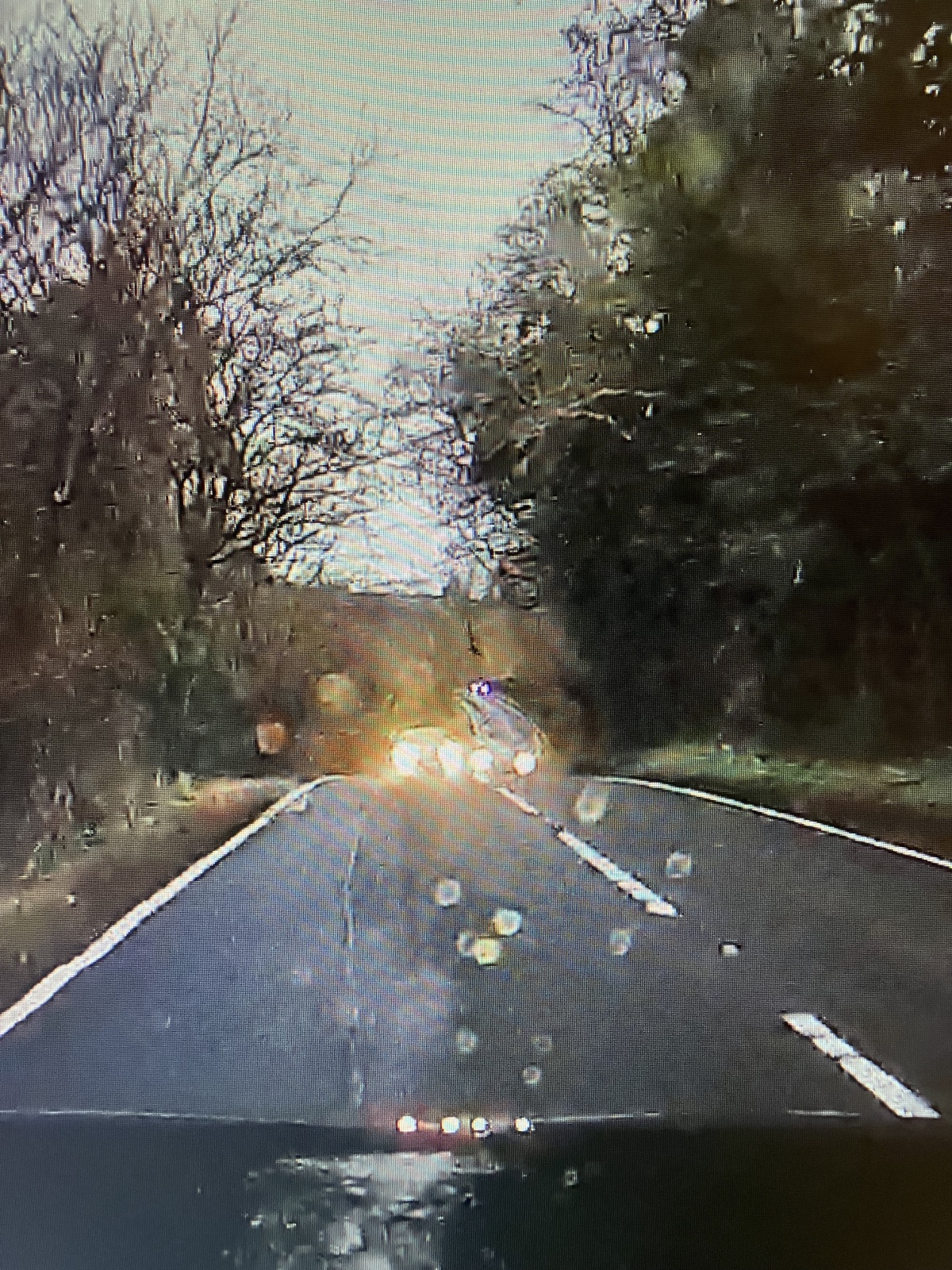
Our carborne irritations were trivial when compared with the conditions in Scotland. We didn’t get 80 mph winds. At least the snail’s pace of the traffic on the main A303 was a snail’s pace. Inch by inch we moved closer to where we wanted to be. No streetlights on the jammed part of the A303, yesterday. The light went up and down with the heavy cloud cover. Colours ranging from gloomy grey to even gloomier dark grey.

Windborne debris, litter, like discarded crisp packets, set off on journeys of their own. Waterfilled potholes blended into the grey of everything. Crushed traffic bollards popped up as if they were growing amongst the sodden grass verges. Occasional motorcyclists took their life in the hands as they weaved amongst dozy drivers.

In the stationary moments my mind wandered. Who were those people dressed in the storm gear doing the tourist march around Stonehenge? They were not going to give up one moment of their vacation. What’s a blizzard of rain comparted to a once in a lifetime trip around ancient stones?

I got to thinking – how would this work if half the cars around me were automated? Human behaviour is pretty erratic. Driver temperament goes from kind and generous to intensely mean. From the laidback CofE vicar to the road rage professional. The circumstance of the drivers is hugely different too. One may be surrounded by screaming children while another is lone, absorbed in their favourite podcast. The first is a couple of hours into the worst drive of their entire lives. The second is in no hurry and happy for the day to drift by.

I sincerely hope that the makers and promoters of “driverless” cars take the human factor seriously. We know enough from aviation to know that the interaction between humans and semi-automated machines is exceedingly complex. That’s in situations where operating procedures are tightly controlled and monitored.

It’s one thing for car makers to rattle on about the importance of safety, it’s another for promises to meet the road. I’d say this is particularly true for the average British main road. Given its provenance there’s an excruciating number of variables. A truly dynamic set of variables that increase dramatically with speed. Weather goes from plus thirty summers to minus ten ice packs. Worn white lines come and go. Grass verges overhang the carriage way. Tarmac cracks and puddles compete with mud sloshing across the road in the heavy rain. Magpies dart into the road to munch the carcass of a dead hedgehog. The one that didn’t make it across the road.

Human drivers compensate for all the imperfections because that’s just what we do. It’s amazing even what the worst of us do. On the other hand, machines must characterise every single non-standard situation with accuracy, reliability and at great speed. Next time, I’m driving home for Christmas it will be manual. Likely, for a decade more too.


[1] https://youtu.be/uSjq7x67kzM

Gerrit

Apparently, Gerrit is the Dutch, and Frisian form of the more familiar name Gerard. It’s the name the UK Met Office[1] has given to the winter storm that has just barrelled its way across the country. I don’t normally write about wind and rain, but this storm is worth a short note. Not least because there was plenty of it for me to see as I was stuck in heavy traffic up on Salisbury Plain.

There’s some niggly social media kick-back on this habit of naming of storms. It’s winter after all. Having gloomy warnings pop-up for yucky British winter weather can get a bit tedious. In this case, I did take note of the weather warnings for Wednesday. Fortunately, the strong winds were blowing the right way for me. West to east.

My plan. Yes, I did have a vague travel plan. My plan was to get a major part of my journey, eastward on the main A303, done before the weather turned into heavy rain and strong winds. That well-meaning plan failed. Salisbury Plain[2] is an expanse of open chalkland which is exposed to weather from all directions. Today, I’ve spent too much time watching grey clouds traverse those uplands.

I blame Stonehenge. If prehistoric people hadn’t built it where they did then we’d have no traffic jams. The roads would be free. Those ancient builders must have been Europeans. In fact, they were since countries didn’t exist. Sorry, that’s just me pretending to be a Daily Express reporter.

Sure, enough it’s the stretch of the A303 that passes by Stonehenge that is the worst for traffic build up. Winter or summer. One of the reasons is the shear level of traffic on this main road. It’s a popular route across southern of England but it suffers from a classic road syndrome. The better it gets (condition wise) the more traffic it attracts. Road “improvements” continues to be made, often at great expense and controversy. The encampment of road protestors at Stonehenge has disappeared. That said, I’m absolutely sure their objections to further expansion of the road haven’t gone.

This year, for late December the temperature is remarkably warm. It’s wet too. Warm and wet. Is that what climate change has in-store for us in the south of England? Dull British winter weather is grey with extra grey bits. It can be mighty depressing. Short days don’t help either. Gradually they are getting longer. If only the worst of winter wasn’t still to come.

Whiling the hours away in nose to tail traffic doesn’t help with spirts. The only consolation is to look out at the drama of the landscape and the storm all around. I tend to get stoical about the whole sufferance. I pity those who sit agitated at the wheel trying to squeeze one car length ahead by getting out of roundabouts faster than others. The constant stop-go of taillights is a sure sign of a driver’s irritation. Me, I try to cruise forward inch by inch using as little power as possible.

The idiocy of playing psychological games in heavy traffic makes me wonder if some drivers ought to have a licence. This happens when two lanes merge into one. Me, I obey the one and one rule. Traffic should weave together in fairness to everyone. One from the left and one from the right.

So, bye bye Storm Gerrit. Thanks for bringing the winter wind and rain. The important part of all this is that we got home safely. Later than expected by safe.


[1] https://www.metoffice.gov.uk/about-us/press-office/news/weather-and-climate/2023/storm-gerrit-named

[2] https://en.wikipedia.org/wiki/Salisbury_Plain

Election

US President Donald Trump a second time around. Now, there’s a thought to concentrate minds.

It was our summer holiday in 2015. Doesn’t seem all that long ago. In July, we took a British Airways flight out of London Heathrow to Boston[1]. Picked up a car and drove. This may have been my last flight on a jumbo, a Boeing 747-400 before COVID struck and pensioned them off[2].

It was a terrific adventure as we had about 10 days to explore New England and the Hudson Valley. Sue and I had done a similar trip before but this time we had a well-thought-out itinerary that took us to new places. A couple of nights here and a couple of nights there, as we drove through the beautiful countryside in the sunshine.

This is not a travelog. A part of the story of the trip is of arriving at a motel after a long day, switching on a scruffy TV and watching practically whatever comes on first. On this road trip, often, the News was first. The News had a focus on the selection process for Republican candidates for the coming Presidential race. That’s the November 2016 United States presidential election.

The News was really like a scene from The Usual Suspects[3]. A line of suited and booted candidates vying for position, looking uncomfortable and one strange turbulent outlier. It was as if an alien had landed at a bank clerks’ convention. Commentators were going out of their way to say that the outlier didn’t have what it took to win a grown-up race. Of course, you know who I’m taking about.

As we went from motel to motel it became apparent from the viewing that we snatched that the Republican selection was not a normal one. The orthodox candidates had no idea how to deal with a bawdy cocky Donald Trump. The idea that Trump might serve as the 45th president of the United States was way off the chart. This media personality, come self-proclaimed successful businessman was hammering away at the mild-mannered dull opposition somewhat like a man with a chainsaw might attack a chicken coop. Still commentators derided the idea that he might win.

Let’s just say we have all learnt a lot since mid-2015. There are few people who can claim to have predicted what was to happen for the next 8-years. That is with 2017 to 2021, with Trump installed as the most powerful man on Earth. It sends shivers down my spine thinking about it. That said, the golf courses of world probably gained a lot and social media has never looked back.

The habit of spewing out constant streams of falsehoods and odious propaganda worked first-time around. Aided and abetted by shadowy media forces and with loads of funding the real estate man won. Surprisingly, all of this is alive and kicking in 2023. Ready for the same outcome.

Millions of people believed Trump, and guess what, they still do. By urging his supporters to march on Capitol Hill, when the last election result was being certified, he showed what he might do next. An insurgency, the like of which the United States hasn’t ever seen. The Usual Suspects maybe two movies in one. 2016 and 2024 maybe two elections with one outcome. It doesn’t seem like the law, however it’s interpreted, will prevent him standing for public office.


[1] BOS Boston United States, Logan International

[2] https://www.stroudnewsandjournal.co.uk/news/18590175.boeing-747-jumbo-jet-graveyard-gloucestershire/

[3] https://www.imdb.com/title/tt0114814

Pod

Will podcasts overtake broadcast radio? It’s a question that it had not occurred to me to ask until yesterday. I’ve not been a first adopter as far as listening to podcasts. There’s a routine of turning the radio on at a particular time of day to listen to news and current affairs. That daily routine or habit is born of a long tradition. The morning starts with the Today programme on BBC Radio 4.

Yes, I’m way behind the curve. Go into any large electrical shop, one wall of the warehouse will be filled with earpieces and headphones of every size and shape. The variety of choices is staggering. Sit on bus, train, or aeroplane and more than half the people around will be turned into a source of audio entertainment. Music and talk fight for our attention.

This is great for the streamers and downloaders but lossy for conversation. Sitting next to an interesting person on a long flight is a wonderful way of occupying a couple of hours. That opportunity is diminishing as people become absorbed in digital media. Even the smallest of phones has become a multipurpose entertainment system.

I have long been converted to digital media. FM radio is great for its universality but with less DAB[1] blind spots its life expectancy must be diminishing. Broadcast digital radio based on DAB is a global standard even though coverage is not universal. The digital avalanche is pushing aside any remaining analogue system that populate our lives. Ironically, as far as physical media ownership is concerned, vinyl and even cassettes are resurgent. On the airwaves it’s less likely there will be a romance for analogue radio.

Why have I reassessed the virtues of podcasts? Yesterday, I listened to The Rest Is Politics[2]. This podcast has a conversational style. It’s Alastair Campbell and Rory Stewart talking about current affairs in the UK. Two people who have had their moment in the political sun but remain articulate and inquisitive. They have something to say and it’s engaging.

This is a bridge to podcasts from broadcast radio in that the material is up to date. The topics discussed are wrapped around the news. It’s refreshing too. The ability of the two to argue in a calm and collected manner is unusual in our time. So much of the presentation of news is calamitous and confrontational that this is shocking to say.

Maybe that’s the role of podcasts. Reflection and analysis can be better done in slow time. Broadcast radio news is crammed full of snippets of what’s happening. It would loose its edge if it drifted off into too much extended investigations or drawn-out interviews. So, what may seem like competition between two forms of readily accessible media should be viewed as complementary. Both can fulfil an appealing role in the digital media landscape.


[1] https://www.worlddab.org/

[2] https://podcasts.apple.com/gb/podcast/the-rest-is-politics/id1611374685

Good News

It’s good to see. Sad, in terms of so many lost years. Now, the UK has rejoined the Horizon Europe and Copernicus programmes with a new agreement with the EU.

The evidence is clear. Most people in the UK have recognised the mistake of Brexit. What public polling there is shows a strong trend going one way and one way for sure. A post-TCA Brexit poll of polls shows a stable rejection of Brexit. The British public worried about the economy, inflation, and the NHS. Brexit is a minority interest[1].

Even those who voted for Brexit, including the current Prime Minister (PM) have come to recognise that the UK needs a new set of agreements with the European Union (EU).

Announced back in September[2], a new customised deal opens the world’s largest research programme to UK scientists, researchers, and businesses. It could be seen as baby steps, but the direction of travel is towards much more collaboration with our closest friends and neighbours across Europe is on the cards[3].

This week, the UK was welcomed back to the Horizon research family. Starting from 1 January 2024, UK citizens will be able to participate in the EU’s research and innovation programme. This is a tremendous victory for common sense and a win-win outcome for global scientific advancement. British researchers and scientists will now be able to apply for grants and projects with certainty.

The UK joins Canada and New Zealand with an association agreement[4]. Other non-EU countries are also negotiating for an association to Horizon Europe. The current version of Horizon Europe began in 2021 and runs until 2027.

I’d written before about how the UK had shot itself in the foot by being so dogmatic about Brexit that it had severed links that it had no need to sever. One day we will look back on the post 2016 madness and wonder what it was all about. Historians and social scientist will write voluminous tones on every aspect of the subject. Textbooks will fill libraries. They will do so to warn of the mistakes that can be made by headline chasing Conservative politicians.

The economy continues to be seen as a most important issue for the country. Reconstructing a productive relationship with our European partners is an absolute must.

Let’s hope this move will reestablish some of the wonderful industrious links between universities across Europe and with other global partners. In the past UK researchers led a high percentage of projects. Life will be different as a non-EU country. Nevertheless, participation in the programme is a great boost. It’s not free but it is worth every penny or cent.


[1] https://www.ipsos.com/en-uk/ipsos-issues-index-september-2023

[2] https://www.gov.uk/government/news/uk-joins-horizon-europe-under-a-new-bespoke-deal

[3] https://www.gov.uk/government/news/landmark-moment-for-scientists-researchers-and-businesses-as-uk-association-to-80-billion-horizon-research-programme-officially-sealed

[4] https://sciencebusiness.net/news/horizon-europe/uk-primed-rebuild-its-standing-eu-research-after-officially-joining-horizon

GE2024

Let me spectate. I’m no professional commentator, pollster or political pundit but do try to keep myself up to speed with the current affairs. The question in the mind of a lot of people is: when will the next UK General Election take place?

In these days before Christmas, it’s possible the Prime Minister (PM) doesn’t even know the answer to this question. It’s a balance of how strategic or opportunist he will be when it comes to making such big decisions. Most current predictions are that the Conservatives are destined to be defeated. The gap in the national opinion polls is substantial. That makes the decision of timing of an election one that could mark the end of the current PM’s term of office or elevation to Conservative saviour. Currently, political parties are desperately selecting candidates for each constituency. Something is afoot. Better stop there before I get tempted into a pun.

Let’s put aside any consideration of a winter vote. Arctic weather gloom hovers like cold mist. With the prospect of large heating bills upsetting most of the population there’s no politician who will want to accept the blame for that situation. Naturally, they will say that they are working at pace to tame inflation and overseas conflicts are the root of the pain.

The first step on the road ahead is next year’s springtime. Local elections are expected. Every year, they take place on the first Thursday in May. This is when a third, or less of the electorate put a cross in a box. At the same time London’s next mayor will be elected. So, 2nd May 2024 will be like a mini political barometer. Real votes in real ballot boxes are always a better indicator than sampling or sage views.

The European Parliament election is scheduled for 6th to 9th June 2024. You may think this European Union (EU) election has no bearing on the UK, but I beg to differ. If there’s a significant advance of right-wing political parties across Europe, then the impact will be felt in the UK.

The 2020 United States (US) presidential election was quite a show. In prospect, for the 2024 US presidential election is a gripping event despite the weak selection of candidates. That US national election is scheduled for Tuesday, 5th November 2024. Guy Fawkes day[1] in the UK.

Let’s assume the Conservative party will want to hang on, not to the bitter end, but to get as much time elapsed after the pandemic shockwave, Partygate, mini budget madness and the cost-of-living crisis as they can. We are still reeling from the post-Brexit political earthquakes that have trashed confidence and the economy. Will the cost of government be political exile? That all said, people have shifted a long way since last year. The big question is: who do you trust?

The UK’s Labour party opposition should be confident and smiling. However, the opposition probably feels aggrieved having to wait so long for others to fail before getting an opportunity to win a general election. What doesn’t help is that the electorate are now pessimistic about any sustained recovery. Sadly, the public mood is beset with quite a sense of decline-ism.

Traditionally, in the UK, September is party conference season. That leaves October open for an election. But as noted above there’s a news media attention getting clash between what’s happening in the UK and US. Since significant geopolitical tensions are going to be raging throughout 2024, I think that topic may not be an influencing factor on the UK election date question.

Rolling the dice as late as October 2024 has several advantages for the incumbents. If there’s good summertime news, say inflation reduced and a modicum of economic growth the government will claim a great success. The struggle between democracy or autocracy around the globe could give a UK PM a platform on which to make one or two grand gestures. Also, with nearly a year to go, the opportunity for the opposition parties to trip-up increases.

When polls ask is Britain a better place to live than it was ten years ago or a worse place to live than ten years ago the pointer points at worse. It’s hard to imagine this will not impact voter intentions. 

#ukpolitics #ukpolitics #politics #generalelection


[1] https://www.parliament.uk/about/living-heritage/evolutionofparliament/parliamentaryauthority/the-gunpowder-plot-of-1605/overview/people-behind-the-plot/guy-fawkes-/

Ineptitude

Yesterday’s announcement went like this: “The government will also increase the minimum income required for British citizens and those settled in the UK who want their family members to join them.” This Conservative view, that families are a burdening the State persists like a stubborn stain.

The Universal Declaration of Human Right says: The family is the natural and fundamental group unit of society and is entitled to protection by society and the State.

Clearly, by the measures announced, in the case of this UK Government the family is not a fundamental group unit of society. In fact, family members based overseas will be required to separate in the event of a person accepting a low income in the UK. That low income in the UK maybe relatively large when compared with what is available in their home country.

I guess this is fine for lawmakers when considering the level of a Minister or Member of Parliament’s salary and benefits. There’s no impediment that will impact their lives in this respect regardless of the nationality of their partner and children.

What I’m wondering is: what will be the case if a British pensioner, living in a European country, who wishes to return with a partner or children who don’t have British passports? If the increased threshold of £38,700 applies, then that will effectively ban them from returning unless they have a generous pension. It may be the case that they have worked on overseas and accumulated a non-UK pension, but this would be irrelevant if the deciding factors is a UK earnings threshold.

I don’t think there’s much disagreement that those who wish to move to the UK should be able to support themselves. The UK minimum wage is set at £21,673.60 for a 40-hour week. So, is the UK Government saying that no one can support themselves on the UK minimum wage?

Ministers have been quick to deny any responsibility for the chaotic state of the immigration system in the UK. Instead, they pretend that they are adapting to changing circumstances. The fact that they are 100% responsible for the current circumstances is brushed aside.

Having persisted for years with one set of flawed notions Ministers now announce another set of ill-thought-out proposals. The Brexit slogan of Take Back Control did not envisage giving control to a cabal of incompetence. In stark reality, that is what has happened.

The knee jerk reactions and ever shifting sand of the last decade need to come to an end. The British people should not be denied a General Election. More months of more chaos and ineptitude are incredibly damaging.

POST: U-turn. Minimum income requirement will not be increased as much as originally announced. A new threshold will be applied from the spring. A policy designed to exclude people from entry to the UK has been watered down for practical reasons.

Two upfront

One of the fundamentals that remains a part of civil aviation is having two pilots in the cockpit. It’s an indication of the safety related activities of the crew of a civil aircraft. Today, we have a mixture of human control and management. Pilots still fly hands-on when the need arises. The expectation is that throughout their working lives pilots have the competence to do so, at any stage in a flight.

Progressively, since the establishment of aviation’s international order in the 1940s the required crewing of aircraft has changed. Back in September, I visited the de Havilland Aircraft Museum in Hertfordshire. There I walked through the fuselage of a de Havilland DH106 Comet[1]. This was the first turbojet-powered airliner to go into service and it changed the experience of flying forever and a day.

That passenger aircraft, like aircraft of the time, had four crew stations in the cockpit. Two pilots, a navigator and flight engineer. It was the era when electronics consisted of valves in large radio sets and such long since forgotten devices as magnetic amplifiers. The story from the 1940s of IBM saying, “I think there is a world market for maybe five computers” is often repeated.

For modern airliners the navigator and flight engineer have gone. Their functions have not gone. It’s that having a crew member dedicated to the tasks they performed is no longer required. As the world of vacuum-tube electronics gave way to transistors and then to integrated circuits so computing got more powerful, cheaper, and abundant.

With a few significant failures along the way, commercial flying got safer and safer. The wave of change in a human lifetime has affected every mode of transport. More people travel to more places, more safely than ever could have been imagined 80-years ago. Does that mean the path ahead will take a similar shape? Excitable futurologists may paint a colourful picture based on this history.

Let’s get away from the attractive notion of straight lines on graph paper. That idea that progress is assumed to be linear. Tomorrow will be progressively “better” by an incremental advance. That’s not happening now. What we have is differential advances. Some big and some small. 

The aviation safety curve is almost flat. The air traffic curve, with a big hole made by COVID, is climbing again. The technology curve is rapidly accelerating. The environmental impact curve is troubling. The air passenger experience curve may even be at a turning point.

Touchscreen tablets already help flight preparation and management[2]. Flight plan changes can be uploaded and changed with a button press[3]. The squeezing of massive computing power into small spaces is being taken for granted. What does this leave a crew to do?

Back to the start. Two pilots in the cockpit, with executive responsibilities, remains the model that maintains public confidence in civil aviation. The golden rules still apply. Fly, navigate and communicate in that order. Crews, however much technology surrounds them, still need to act when things do not go as expected. Does this mean two cockpit crew forever? I don’t know.


[1] https://www.dehavillandmuseum.co.uk/aircraft/de-havilland-dh106-comet-1a/

[2] https://aircraft.airbus.com/en/newsroom/news/2021-02-electronic-flight-bag-the-new-standard

[3] https://simpleflying.com/datalink-communications-aviation-guide/