The Legacy of Paine

Reading a little of Thomas Paine’s rantings about the inequities of monarchy, it’s clear why he is remembered as a key part of the story of American Independence.

It’s not surprising that he viewed the British institutions of the 17th Century as arbitrary and tyrannical. An Englishman fervently attacking his country of birth. Pointing out every flaw and deficiency in respect of the condition of the common man.

He was a revolutionary provocateur and a provocateur of revolutions. His widely read pamphlets, the social media postings of the day, stimulated the American Revolution. A cry for freedom and escape from everything he thought rotten in Europe. America being a potential beacon of hope. Denouncing the English aristocracy sealed his fate. Now, he known as a founding American. So, where are we after 250 years[1]?

Europe to a great extent, slowly but surely, followed the American experiment. The power of privilege, the monarch, the aristocracy diminished, and the common man, and eventually woman too, asserted their rights through the ballot box.

Britain, although there are committed republicans, hasn’t thrown off the monarchy. It’s adapted its role in such a way that it retains popular public support. Europe has many “bicycling” monarchs who hold colourful ceremonial roles mostly as a celebration of traditions.

Are the roles of the continents reversing? Are the American States drifting towards a new monarchy? That concentration of arbitrary power and privilege in one place. It’s a situation for political philosophers to ponder.

Take recent utterings in the News that are wholly wrong. The European Union (EU) is in part, so that Europeans can be more like Americans. That’s not a popular thing to say so I’d better step with care. Although, much as changed in the post-war world, federalism isn’t coming to Europe any time soon.

The EU solves the historic diplomatic problem of asking – I want to call Europe. Who do I call? Recent generations in both continents have benefited tremendously from the constructive and positive dialogue across the Atlantic.

Back to my question. Are the roles of the continents reversing? Imagine Europe as the premier global bastion of freedom, democracy and liberty. A renaissance of enlightenment, of free speech and human rights. Perhaps it is already.

Sadly, it would be wrong of me to record this as fact. With the rise of populism and right-wing fantasists, we would do well to go back and read Thomas Paine. Although, that’s not an entirely a clear-cut line to take. Paine was very much in favour of small government and self-reliance. Traditional Republican themes. I’ll take his revulsion at tyranny.


[1] The Bicentennial culminated on Sunday, July 4, 1976, with the 200th anniversary of the adoption of the Declaration of Independence.

Relationship with the EU

Monday, Monday[1]. It’s a wonderful 60s song. Harmonies and mood are perfect. I wonder if the harmonies and mood will be perfect for the Prime Minister (PM) on Monday. Already the Sunday Press are setting the stage for Monday’s performance.

Reset, recalibration, reheat, rekindle, re-whatever. It’s a moment when relations between the UK and the European Union (EU) can make realistic progress[2]. In world full of uncertainty (could be a song in that one), for once the direction of travel is a constructive and positive.

I think the word “deal” is getting overplayed. Indications are that there’s no fundamental shift from Brexit meaning Brexit, as one former PM liked to say. In fact, the current PM is being highly cautious in the light of his Party’s reading of the latest opinion polls. For no sane reason I can think of, the swivel-eyed loons of the far-right are making hay.

It’s astonishing me how dim-witted the Conservative Party is in objecting to something when they don’t even know, for sure, what it is. Mind-blowing. And the rum cult of Reform Party doing the same with extra bile. What a load of prehistoric fruit loops.

Brexit supporters are spreading misinformation, again. Saying that UK has no influence. It’s true, the UK doesn’t have votes in the European Council or Parliament, but significant influence can be exercised on standards, and regulatory guidance, nevertheless. A better “deal” can bring much greater influence. Absolutely vital in the digital world, and for the UK, a country with a services-based economy.

Brexit has cost the UK dearly. The UK Treasury would have billions more in its coffers if the 2016 referendum had never taken place. The standard of living of every person in the UK is lower because of Brexit bungling. Ideally, that great mistake is an event to be written up for the history books and then forgotten.

On top of the above, uncharacteristic moves in the US, with Trump tariffs there’s nasty hit at the UK’s future prosperity. There couldn’t be a better time to repair relationships with the UK’s nearest neighbours. The countries with which we share most of our long history.

Even for those on the political right, practically, the EU is never going away, so until the day the UK rejoins the block, it’s wise to have the best possible relationship in all matters. Goods, services and people need to connect as a case of mutual benefit.

It’s time for hope. An optimistic tone should be set. A smile. Let’s hope we are singing Monday, Monday so good to me, Monday morning was all I hoped it would be. Naturally, that there be no crying, come Monday evening.


[1] https://genius.com/The-mamas-and-the-papas-monday-monday-lyrics

[2] https://www.independent.co.uk/news/uk/politics/brexit-uk-eu-reset-trade-deal-starmer-b2752285.html

Cities Shaped by War

War is failure. Humans being quick to aggression, possessive and slow to reconciliation, it’s plagued every corner of history. Reason to go to war can be imperial, territorial, moral or ethical. In a democratic society, defeating an evil becomes an overwhelming imperative. That was certainly the case in the six years of the second world war. This week, it’s time to look back. To recollect the impact of the world war. To remember the sacrifice and suffering. To be thankful for the last 80-years years of relative peace in Europe.

For me these recollections take me to the experience of living in two cities. Cities on different sides of past conflicts. Severely damaged by the conflict. Targets because of their civic and industrial strength. Both cathedral cities with an ancient heritage.

My student life was spent in Coventry[1]. A decade of my working life was spent in Cologne[2].

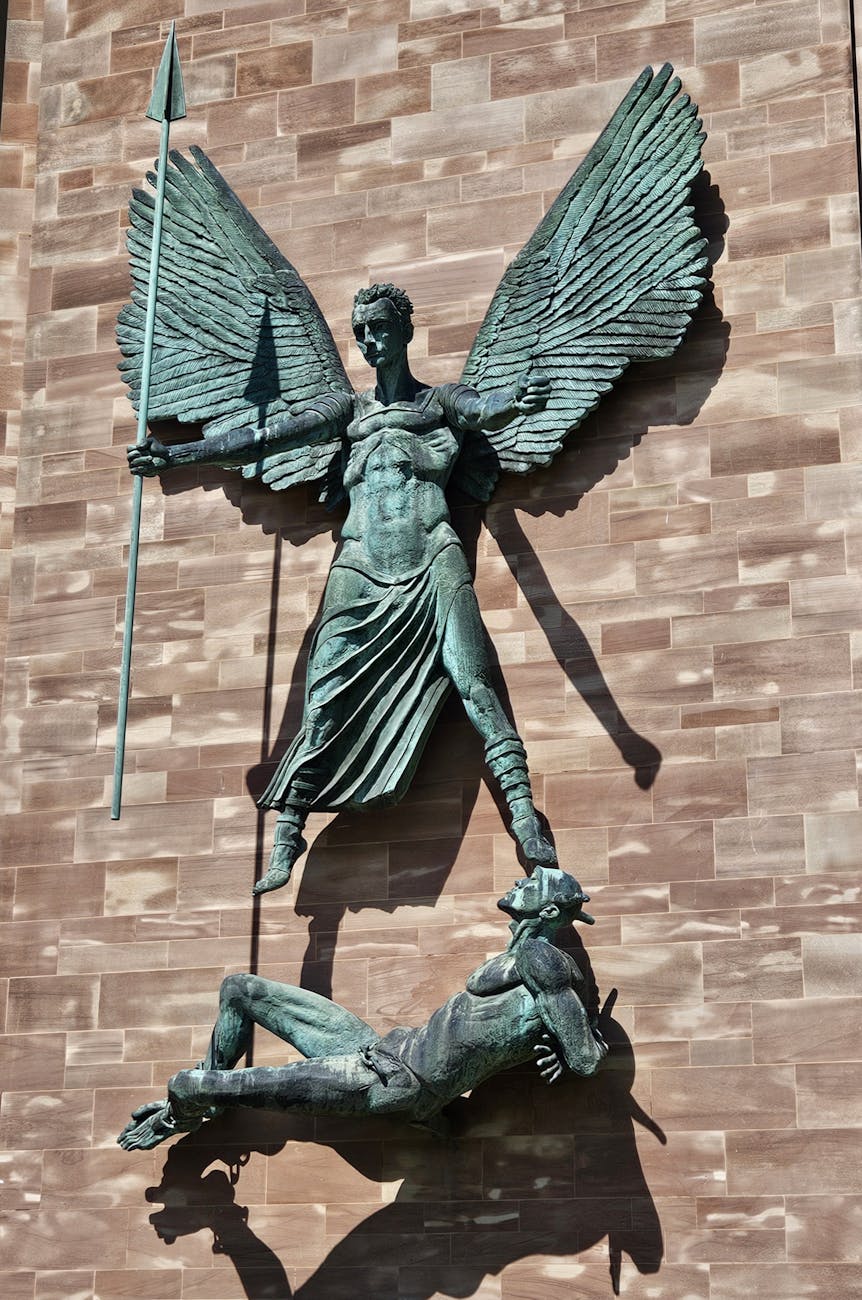
Arriving as a fresh-faced student in the heart of the industrial Midlands, the architecture of Coventry city centre was so striking. It was that post-war vision of rebirth at a time when economic decline had set in. With an inner ring-road that was like a go-cart track, 50s style concrete avenues, windblown and neglected, there was little of the Medieval splendour of the pre-war city remaining. Standing proud in the middle of it was, and is, the skeleton of the old cathedral and the new one that ascended like a phoenix from the flames of war. Well worth a visit, the cathedral built in the 60s is a wonderful modern design. It plays with light and space to elevate emotions. A sign that we have a great capacity for reconciliation and regeneration.

Moving on just over 20-years, my encounter with Germany’s fourth largest city was full of hope and optimism. Based in Cologne, I experienced a city with even deeper roots than Coventry. Ironically, it was the destruction of the war that uncovered much of the Roman remains on display. At Cologne’s heart is a magnificent gothic cathedral that is more dominating of the landscape than perhaps ever it has been. Here the citizens of the city took a different approach to post-war rebuilding. Not so much embracing everything that was new, although there’s quite a bit of that approach, but reconstructing the old city in its original style. The culture of the city survives in the traditions of the annual carnival.

These two European cities have taken different paths. All the same, there are threads of common experience. Both have seen industrial decline and a search for a better future to thrive and grow. Both are distinctive and culturally colourful. Both carry the baggage of a brutalist architecture that was fashionable on the drawing boards of the late 1950s.

Visting the past in museums and walking the streets the marks of the last war are there to be seen by everyone. Passed by every day. Yet, mostly ignored in the humdrum of commuting and the busy obsession we have of staring at a “mobile” or call it a “handy”. Now and then it’s as well to look up. To look and see the bullet marks on stone structures, the nicely arranged medieval or Roman stones and cobbles, or the conserved streets that contain the ghosts of past generations. For good or ill, war has shaped the world we inhabit.

Peace is a far far better condition. I think of the “Coventry Cross of Nails[3]” as a symbol of reconciliation and peace. Let’s not forget.


[1] https://www.coventry.ac.uk/

[2] https://www.koelner-dom.de/en

[3] https://www.coventrycathedral.org.uk/reconciliation/community-of-the-cross-of-nails

Revitalising Manufacturing

Yes, it’s good to have good trading relations with other countries. With a degree of pragmatism – as many as possible. Naturally, there are lines drawn in cases where countries share little of the UK’s values or are dictator run aggressors. Counting the hundreds of sovereign countries there are around the globe, a majority are friendly and mostly interested in mutual wellbeing.

However, post-2016[1] we are still living in strange times in the UK. In the same breath as some people talk of sovereignty and surrender, they say an extremely wealthy man in the US can solve all the UK’s problems. This nonsense defies any kind of logic.

There’s a peculiar celebration of the UK joining the Asia-Pacific Comprehensive and Progressive Agreement for Trans-Pacific Partnership (CPTPP) bloc. As if we didn’t have a huge trading block on our immediate doorstep. Joining one that offers a tiny gain overtime whilst leaving the other has cost a massive economic hit. The one thousands of miles away is significantly culturally different but the one next door is one where we share a common history.

I learn that there’s no point even thinking that logic has any influence on a Brexit supporter. Non whatsoever. Their view of the world comes from some lost imperial age.

Sadly, Brexit talk is only mumbled in darkened corners. That whopping great elephant in the room continues to get ignored. Even the UK’s new Labour Government is carrying on as if there were the former Conservative bunglers. There’s some woolly talk of reconciliation. There’s a lot of right-wing scaremongering. Practically, not a lot is changing.

In real terms, both UK exports and imports of goods are lower than in 2016, having shrunk by 1% and 2%, respectively[2]. Which is crazy given the new economic horizons. Especially in the switch to the need for more environmentally responsible goods. We should be modernising and strengthening UK design and manufacturing. Not just a bit but putting a rocket under both. Half hearted nice words by minor Ministers don’t cut it.

International trade fantasies will not build a stronger domestic economy and that illusive positive growth that’s often talked about in political speeches. With the coming of highly advanced computing, like artificial intelligence, countries with predominantly service based economies are gong to struggle. Basic service orientated jobs are going to get more automated. Like the traditional factories Henry Ford would have recognised, office complexes are hollowing out.

At least the new Labour Government isn’t pushing wholesale reopening coal mines or returning to a dependency on North Sea oil rigs. That said, I’m unsure what their attitude and policy is to rock fracking and imported gas supplies.

To make real economic progress we (UK) must make Brexit history. With our colleagues in Europe, we can be an innovation powerhouse. Making home grown products for the world markets of the future. Not languishing in a tepid imperial past or tugging at the shirt tails of some mega weird pugilist.


[1] UK referendum result: Of those who voted, 51.89% voted to leave the EU (Leave), and 48.11% voted to remain a member of the EU (Remain).

[2] https://personal.lse.ac.uk/sampsont/BrexitUKTrade.pdf

Travelling Post-Brexit

Ever since Brexit, I’ve had to have my passport stamped in and out of European countries. It’s like a reversion to the days when I got my first British passport. That was back in the late 70s.  It has a frighteningly youthful picture. Occupation – student.

I’m not so phased by the coming changes to European Union (EU) border controls. Naturally, it’s worth asking if Britian has become a more dangerous nation since the time before Brexit when we enjoyed freedom of movement. It’s a pity we didn’t value that freedom a lot more. It was thrown away far too easily.

Today, the electronic border controls expect us to stare at a camera. A securely held, I hope, database is used to check a list of biometric numbers against my image. I guess that’s a sure-fire way of saying that Mr Blogs is indeed someone who looks very much like Mr Blogs. Facial recognition technology has come a long way.

The next steps in tightening-up controls will be fingerprinting[1]. Not in the manner of Sherlock Holmes, with an ink pad. No, in the digital age an ominous machine will scan our fingers and check its records to see that not only does Mr Blogs look as he should but that he’s got the essential characteristics of Mr Blogs.

Certainly, in this new regime British citizens will not be able to overstay in European countries. Ones travel records will be a lot more quantifiable and precise than stamping a piece of paper. That is assuming such digital border control machines will be relatively error free.

One of the benefits of Brexit is that it will be easier to track the movements of British criminals in and out of the EU. The reciprocal will not be true. It will not be easier for British authorities to track continental European criminals in an out of the UK.

Ah the luxury of being a Third Country. Longer ques. More uncertainty. Less privileges.

What’s more is the introduction of the new EU border control systems will be “phased[2]”. This change will not be one big bang. So, different ports and airports will be doing different things at different times. Now, it doesn’t take a genius to see that confusion is most likely.

Travelling in 2025 is going to be more than the usual adventure.


[1] https://commonslibrary.parliament.uk/the-eu-entry-exit-system-and-eu-travel-authorisation-system/

[2] https://www.independent.co.uk/travel/news-and-advice/eu-biometric-border-fingerprint-entry-delay-b2627645.html

National Rejoin March: Unity for a European Future

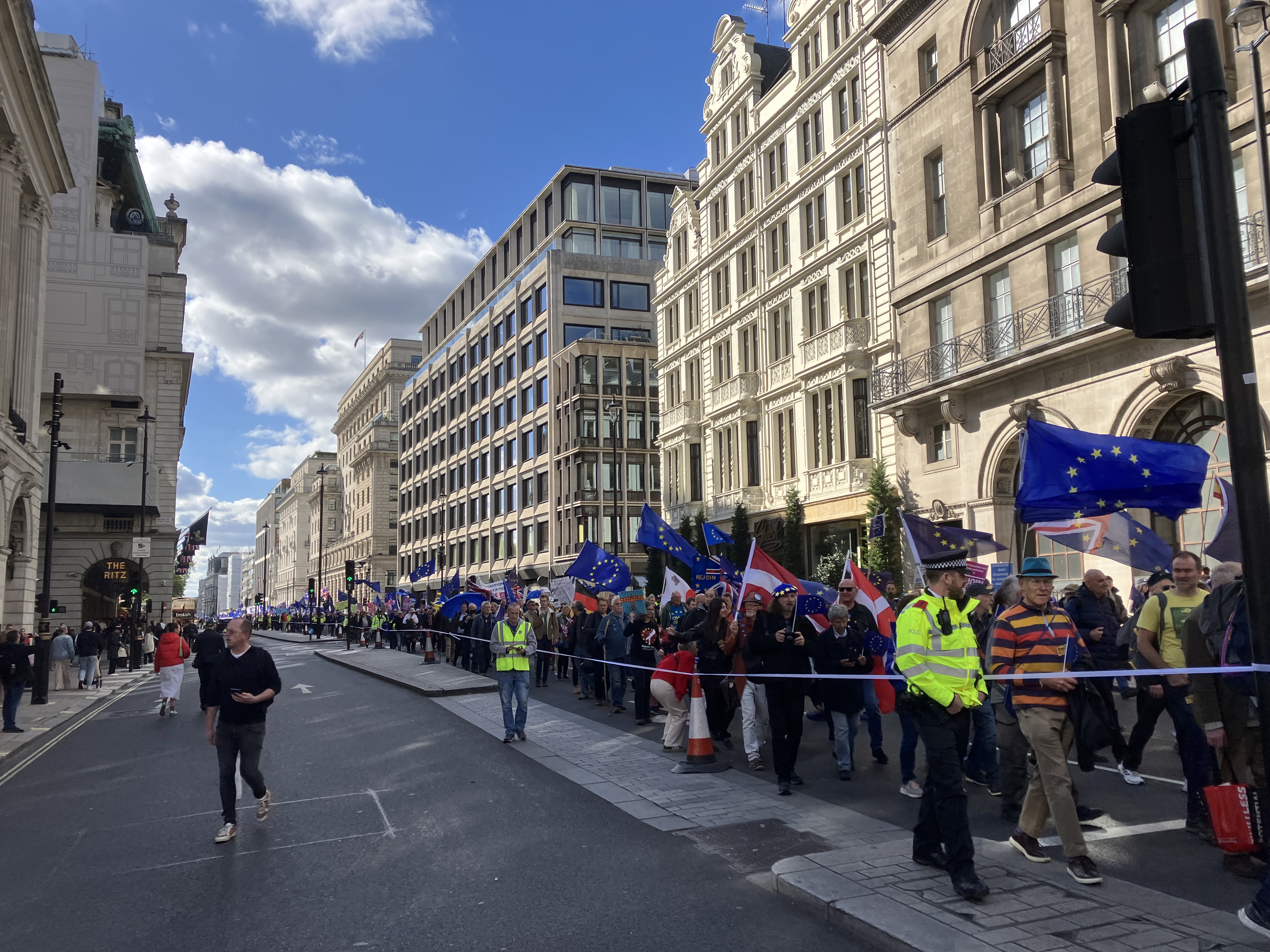
The European Movement[1] has been around for 75-years. Yesterday, I was surrounded by a good number of their membership. That, and many Liberal Democrats. People, young and old, from communities up and down Britain. There were lots of people from the creative industries, so badly hit by Brexit. In fact, there were people of every political background marching through the streets of central London.

Everybody had gathered in central London with the aim of reversing the tragedy that is Brexit. I say “is” and not “was” because the disaster continues to have marked repercussions on everyday life. Reclaiming the freedoms that we once had has brought people together in large numbers.

On Saturday, pro-European campaigners made their way from Park Lane to Parliament Square for the third annual National Rejoin March (NRM)[2]. The weather smiled on the gathering. It couldn’t have been better in the light of torrential rain and the endless storms of past days. The sunshine and blue skies warmed my sprit.

The occasional chant of “Boll*cks to Brexit” has been replaced by Reset, Repair, Rejoin. As is the tradition of these events, posters ranged from the more obvious slogans, like #BinBrexit to the imaginative and sometimes bizarre. The group dressed in eye catching elephant costumes had a point to make. The elephant in the room being the protesters theme.

Standing next to me, one young lad asked his mate why he had decided to be on this rejoin march. I thought his response most was appt: “Because I want to be on the right side of history”. To me that just about sums it up. Brexit is an aberration. Eventually, after a great deal of to-and-fro the strong likelihood is that the UK will rejoin the European Union (EU), or its successor. Everything we know points in that direction. It may take a decade. It may take more.

The Labour Party won the 4th July UK General Election, and while it pledged not to reopen the main parts of Britain’s deal to leave the EU, does claim to want a significant reset. So far, the indications are that this policy line is typical political rhetoric, and little more. But it must be said that this is the early days of a new British government. If their claim to want growth in the economy to fuel spending on public services is honest, they would be mighty foolish to discount rejoining the European Single Market.

Thousands gathered in London. This will go on year after year. The diminishing number of objectors, who chant from the sidelines, remind me of the “Dead Parrot Sketch”[3]. For all intents and purposes all the arguments for Brexit have perished, much like the poor parrot. Even when that’s an obvious fact there are still those few people who will defend it to the hilt. As we walked down St James’s Street a well dressed bloke in a side street seemed most agitated. Shouted abuses and ran off. I looked around. We all shrugged our shoulders. I certainly thought – what a sad man.

I’m sure Britain can reclaim its place in Europe. It will take resolve and continuous effort but, as has been pointed out, this campaign is on the right side of history.


[1] www.europeanmovement.co.uk

[2] https://uk.news.yahoo.com/protesters-call-uk-rejoin-european-154046221.html?

[3] https://youtu.be/vZw35VUBdzo

Two Issues

It’s all to play for, as they say. The UK General Election starting pistol has been fired. Politicians are out of the gate. We are in for six weeks of intense competition for every place where the poll result isn’t a horribly foregone conclusion. Even in some of those places there’s a renewed sense that anything is possible. So, far gone is the public image of the Conservatives that Westminster constituencies, formerly thought to be a wilderness of opposition parties are now possibilities.

What are, yes, I know it’s not new to say so, the elephants in the room? The political parties seem set on what they want to talk about but it’s not a couple of remarkably big issues.

One is Brexit, and its overall impact and the other is Social Care. Two massive pressing issues that politicians are ducking and weaving to avoid. Discussions about the UK’s economy should not happen without discussing Brexit effects. On the other issue, the big truth is that the population of the UK is aging. Yet, we really don’t like talking about it.

One point of agreement is that we need the UK economy to do better. That’s a conditional on generating the funds needed to be able to repair the damage done over the last decade. The overall performance of the UK economy during the Conservative period in power has been undeniably poor. A big part of that poor performance comes from the disruption caused to the UK’s primary marketplace by Brexit. It has been a self-inflicted wound.

On Social Care the Conservatives made a succession of promises. If we look at their record on delivery, there’s nothing to show. Local government has been beaten up over the last decade. Report after report has shown ways forward for social care. Sadly, politicians in power have not been brave enough to push hard enough to implement recommendations that can ease the heavy burden placed on many families.

In my view, our best hope on these two issues is to back the Liberal Democrats. The Conservatives have demonstrated their inability to address these issues. Labour has been timid on both. Fearful that the tabloid newspapers will attack them at a critical moment.

There’s an excellent case for rebuilding the UK’s relationship with the European Union. Single Market membership wouldn’t happen overnight but surely, it’s the direction to head in. The free flow of trade, in a marketplace that is so large, and on our country’s, doorstep would boost the UK’s economy overnight.

For the sake of a few billion of public spending. Set in the context that annual government spending of a thousand billion, then priority action could be taken on Social Care. The difference this would make in helping those in extreme difficulty would be enormous.

I dare say MP Micheal Gove, who is standing down at this election, is right. It’s time for a younger generation to take up leadership roles and to sort out the mistakes that have been made over the last decade. Our liberal democracy needs to get back on track.

The River

What a contrast. From plus 12 earlier in the week to minus 2. There’s a sheet of white frost covering the fields this morning. The flood water shimmers in the morning sun. Not cold enough to ice over as the water tries to escape back to the river.

I get woken-up to the sound of the 18 or so Canadian Geese who make the boggy grassland next to the River Lambourn[1] their feeding ground. I can understand how they get so big as they graze from dawn to dusk. Their take-off from the water is a long one as they flap furiously to get their great mass airborne. It’s quite a sight as they fly in formation.

These formidable geese are not alone. A few Mallards stray into their territory. For the most part they all seem to get along fine. Plenty of food for everyone. Little grass islands form where the water swirls around. I named one of them duck island.

The geology here is Valley Gravel according to the council’s local plan. I’m not sure what that means but I guess the riverbank will drain fast when the flood water abates. Standing on the ancient bridge on the Oxford Road, I can see that the river Lambourn is shallow and fast running.

I say ancient bridge given the Priory on the other side of the river. The north side. That bridge site certainly dates to the 16th Century. The road must have a long history as it leaves Newbury town and enters the village and environs of the castle of Donnington[2].

I’m imagining the role the area played in the 17th Century. The site of the English Civil War battle, the Second Battle of Newbury. The castle was held by Royalists. It was under siege from the Roundheads camped on this side of the river. The south side.

From what I’ve read so far, the siege was a long one. When it was broken, the defending forces were allowed to escape in honour of the brave fight that they had put up. For whatever reason, in 1646, Parliament voted to demolish the canon damaged castle. Today, only the grounds and gatehouse of the castle remains standing.

It’s nice to be able to look out of my kitchen window and see on the hill such a significant part of English history. The ruin sits on the horizon looking north. Often both the rising and setting sun light it up.


[1] https://www.kennetcatchment.org/catchment/lambourn/

[2] https://www.english-heritage.org.uk/visit/places/donnington-castle/

Democracy

It’s one thing to talk about elections in theory it’s another to talk about them in practice. Only one person knows when the next UK General Election will be held. It’s the privilege of one person to say so. Since the UK gave up on fixed terms, power rests with the Prime Minister.

The Fixed-term Parliaments Act 2011 set a five-year interval between ordinary general elections[1]. The next UK General Election would have been scheduled to take place on 2 May 2024. Now, all of that has gone, within the life of a Parliament, it’s for one person to call a General Election at the time of their choosing. Imagine a race where one competing athlete gets to fire the starting gun. There’s no role for Parliament in deciding when a UK General Election will be held.

What we do know about this year is that there will be European Elections held between 6th and 9th June. I would say, mark the dates on your calendar. In fact, I will say mark the dates on your calendar, if you’re a European citizen living and working in the UK.

In this case citizens know when they will have the power to exercise their democratic right. They can plan accordingly. They can play a part in the process. They can weight-up the options.

Hundreds of millions of people in Europe can determine the nature of the next European Parliament. British citizens, because of Brexit will have no say in this huge application of democracy.

This is undoubtably a time when unity amongst European allies is of paramount importance. There are threats in numerous places around the globe. The need for close cooperation between the UK and EU is becoming ever more evident[2].

Foreign policy and defence interests have a great number of common threads that bind Europe together. Couple that with the uncertainty that exists in relation to future transatlantic links, then getting along better is an absolute necessity.

The naïve – go it alone – attitude of Brexiters has unravelled. A more pragmatic settlement is essential for mutual benefit as we move forward. Defence industrial collaboration is a must. It hardly needs to be questioned. Many of the large aerospace and defence enterprises that the UK military depends upon are established European companies. Collaboration is nothing new.

War in Ukraine came as an unexpected nightmare. This European conflict is likely to become ever more protracted. Much as the country might wish it was not so, there are limited ways in which the conflict can be resolved. Self-determination remains a core belief amongst western democracies. This must be backed up by force otherwise it becomes meaningless.

After Brexit, going forward the UK will have no say, and no veto, over how EU defence progresses. From here, it’s best that cooperation, collaboration, and influence go hand in hand.


[1] https://commonslibrary.parliament.uk/research-briefings/sn06111/

[2] https://www.politico.eu/article/brexit-rishi-sunak-ukraine-war-europe-uk-inches-toward-eu-defense-projects/

Eurostar

More than a few times the thought that climate change will impact transport has been raised. Not so much as transport impacting climate change but the two go hand in hand. Whereas the assumptions built into roads, rails and airports were of their time, time doesn’t stand still.

More frequent heavy rain and raised tides, and the flooding associated with them, are to be expected. To hear that the rail tracks between London and the Channel Tunnel have been underwater shouldn’t be too much of a shock. Flooding is a worldwide threat to public transport systems. In London, over the last couple of days, flooded tunnels brought travel chaos. Millions of gallons of water were not where they were supposed to be.

We can get used to disruption caused by strong winds and torrential rain sweeping across the country. The question to ask is – should we? I always wonder as soon as I see the word: “unprecedented” in a public statement. Huge volumes of water may not have been predicted to overwhelm the pumping systems designed to keep them under control, but now we know. It makes me think we are going to hear the word “unprecedented” a lot more in future.

This city centre to coastline railway is relatively new[1]. It cost £6.84 billion and opened in November 2007. Most travel commentators would say that it has been a great success. I was looking forward to the day that the German train company, Deutsche Bahn was to implement plans for a London to Frankfurt train service. Sadly, that project was shelved in 2018. I wonder why[2]? That “B” word again.

The subject of these comment, the Thames Tunnel is over 3km long. The rail lines dive beneath the river from the counties of Essex to Kent. This High-Speed rail tunnel goes under the river near Fiddler’s Reach. This part of the River Thames, much like most of the tidal river, was once busy with commercial shipping. It’s been the site of unfortunate events before[3].

Further upstream is the Thames Barrier. A truly magnificent structure. The barrier protects central London against a storm surge. It works well. However, it will eventually need to be replaced. The inexorable tide, no pun intended, is moving just one way.

Risk is a multifaceted factor: operational, economic, social, political, safety, security. Did current risk assessments foresee a likelihood of flooding? I don’t know. The safe running of High-Speed trains through underwater tunnels should be subject to risk assessment. I’m sure it is.

Eurostar has experienced a set back as 2023 comes to an end. Eurostar services are again running as normal. But this weather-related event highlights the fact that climate change will impact transport systems. If the thought has not found its way onto the desk of a civil servant, it might be as well to do a high-level audit of the nations transport infrastructure.

Either that or get used to using the word “unprecedented” a lot more.


[1] High Speed 1 (HS1) is a 109.9-kilometre high-speed railway linking London with the Channel Tunnel.

[2] https://www.independent.co.uk/news/uk/politics/london-frankfurt-cologne-train-deutsche-bahn-db-eurostar-cancelled-shelved-a8394806.html

[3] https://www.britainfromabove.org.uk/en/image/EAW143996