Protecting Green Spaces

Listening to a Labour Minister use the word “streamlining” I reached for the off switch. My morning radio was bubbling away with a spokesperson justifying changes that remined me of that moment when the Earth was about to be demolished in the HHGTTG. I could imagine him saying; houses must be built because houses must be built.

Labour have been in power for less then a year but more and more they sound like the people they displaced. My thought was, with these recent land planning proposals, what’s the difference between what the Conservatives did and what Labour is doing now?

Let’s go back in time. One of the most dreadful planning changes of the past was the selling-off of school playing fields[1]. Green space, often surrounded by dwellings were erased. Countrywide, bricks, concrete and tarmac were prioritised over green spaces, local sports and nature. Not much to guess as to why the national is not as healthy as it should be.

It’s not new to say – what we learn from history is that we don’t learn from history.

Don’t get me wrong. I’m in favour of building more affordable houses where they are needed. It’s eminently reasonable to provide support for small and medium sized housebuilders. There are spaces that can take more dwellings provided the associated infrastructure comes along too.

By law, let’s not tip the balance in a way makes us all poorer. Our natural environment has taken one hell of a bashing in my lifetime. One of the indicators is the bug count. If I travelled any distance in the summer, in the early 1980s, in my bright red Sunbeam Imp, it wouldn’t be long before I’d need to stop to clean the windscreen of dead bugs. Today, drive as far as you like through the English countryside and there’s no such problem to address.

Labour’s Minister doing the morning rounds, spoke from a prepared script. Everything is above board. Government consulted on the proposals. Houses must be built because houses must be built. Consultations are fine. However, doing it and ignoring what people are saying is tantamount to manipulative deception.

Concreting over nature is not the way to go. Especially for small pockets of green spaces that still bring nature into cities, towns and villages. Infill and the eradication of small green spaces is just as bad as the momentous school playing field mistakes. It’s a one way trip. Watering down measures designed to protect nature is not the way to go.

Pushing forward with an aggressive approach to building foregoes long-term benefits for short-term political gain and blinkered treasury wishes. With the lessons learned over decades, priority to protecting our natural environment should not be sacrificed[2]. The Labour Government’s Planning & Infrastructure Bill needs amendment. Let’s hope that happens.


[1] https://www.itv.com/news/update/2012-08-17/how-previous-governments-compare-on-selling-off-playing-fields/

[2] https://www.wildlifetrusts.org/news/planning-bill-breaks-labours-nature-promises-say-wildlife-trusts-and-rspb


Peaceful Border

It’s superfluous to say so. Canada is not the US, and the US is not Canada.

It quickly becomes clear. I’ve been fortunate to visit places east-west and north south. Although not the far snowbound North. The two countries do share geography. Rocky Mountains stretch across the North America. From British Columbia to New Mexico. The Great Plains span North America. A stark contrast to the mountains, as a huge expanse. In the East, the rolling landscape of the Appalachian Mountains runs from Newfoundland to Alabama.

It’s not the same with social and economic geography or history. A profound difference has been forged by Canada’s citizens over a couple of hundred years.

If we look back to the late 17th and early 18th centuries the new world was a hugely different place than it is now. Britain, France, Spain, and their allies were fighting over vast territories. European conflicts translated into competition and trade wars. Eventually, America colonialist brought about a revolution, so there would be no need for royalty, aristocracy, or an imposed church. Rejecting their British masters, even if they did keep their system of laws.

At the start of the 19th century, the US did invade Canada with a couple of conflicts. So, the idea that the US may wish to annex a part, or all of Canada is not entirely new. I’m going to have to read up on the Battle of Stoney Creek of 1813. It seems a namesake of mine played a pivotal role in preventing the US from taking Canada[1]. No relation – I’m (almost) sure. Irish heritage.

My assumption is that US President Trump is doing what he has done times before. Mark out an extreme position from which then to shape future negotiations. That’s not so mad as it might appear. It’s not nice when considering the cordial relationships that have characterised so much of the recent past. Kicking at the sides of an ally.

Stretching over thousands of kilometres (or miles if you prefer), the boarder between the US and Canada is one of the most peaceful in the world. To reignite conflicts of a couple of hundred years ago is not a wise option. I’m sure Canada could call upon a great deal of support if the worst-case scenario were to prevail.

Mutuality may not be fashionable. It needs to be made fashionable, again. The notion of a win-win scenario where both parties benefit, it’s real, it’s not mythical. Both US and Canada are sovereign. It’s best for the world that it stays that way.


[1] https://www.biographi.ca/en/bio/vincent_john_7E.html

illusion

Daily writing prompt
What does “having it all” mean to you? Is it attainable?

Not a phrase I find the least bit appealing. Could be applied to the movie The Truman Show. Those three words, “having it all” are an illusion and not a comic one. Even the concept of “all” is dodgy. Our universe is so complex and astonishing that it’s impossible to know what’s around the next corner. At least that’s true for any current day human.

The only way to satisfy these criteria is to give-up on ambition, learning and wonder and settle for the here and now, whatever. Even if I say the criteria is now satisfied, the troublesome problem of doubt will inevitably creep in.

If you don’t believe me, just flip a decade. In 10-years, in our time, change occurs so quickly that what I once thought important is now way down the list. We are not meant to be static creatures. Our whole essence is change and the ability to adapt to it.

The Legacy of Paine

Reading a little of Thomas Paine’s rantings about the inequities of monarchy, it’s clear why he is remembered as a key part of the story of American Independence.

It’s not surprising that he viewed the British institutions of the 17th Century as arbitrary and tyrannical. An Englishman fervently attacking his country of birth. Pointing out every flaw and deficiency in respect of the condition of the common man.

He was a revolutionary provocateur and a provocateur of revolutions. His widely read pamphlets, the social media postings of the day, stimulated the American Revolution. A cry for freedom and escape from everything he thought rotten in Europe. America being a potential beacon of hope. Denouncing the English aristocracy sealed his fate. Now, he known as a founding American. So, where are we after 250 years[1]?

Europe to a great extent, slowly but surely, followed the American experiment. The power of privilege, the monarch, the aristocracy diminished, and the common man, and eventually woman too, asserted their rights through the ballot box.

Britain, although there are committed republicans, hasn’t thrown off the monarchy. It’s adapted its role in such a way that it retains popular public support. Europe has many “bicycling” monarchs who hold colourful ceremonial roles mostly as a celebration of traditions.

Are the roles of the continents reversing? Are the American States drifting towards a new monarchy? That concentration of arbitrary power and privilege in one place. It’s a situation for political philosophers to ponder.

Take recent utterings in the News that are wholly wrong. The European Union (EU) is in part, so that Europeans can be more like Americans. That’s not a popular thing to say so I’d better step with care. Although, much as changed in the post-war world, federalism isn’t coming to Europe any time soon.

The EU solves the historic diplomatic problem of asking – I want to call Europe. Who do I call? Recent generations in both continents have benefited tremendously from the constructive and positive dialogue across the Atlantic.

Back to my question. Are the roles of the continents reversing? Imagine Europe as the premier global bastion of freedom, democracy and liberty. A renaissance of enlightenment, of free speech and human rights. Perhaps it is already.

Sadly, it would be wrong of me to record this as fact. With the rise of populism and right-wing fantasists, we would do well to go back and read Thomas Paine. Although, that’s not an entirely a clear-cut line to take. Paine was very much in favour of small government and self-reliance. Traditional Republican themes. I’ll take his revulsion at tyranny.


[1] The Bicentennial culminated on Sunday, July 4, 1976, with the 200th anniversary of the adoption of the Declaration of Independence.

Two Centuries

The News can be overwhelming. It’s a constant barrage of terrible calamities, inadequacies, and past failures. I guess, that’s the manner of the daily News cycle. Put out a positive press release and watch it get ignored. Report of catastrophes and every media outlet copies the stories.

It’s as well to remember that within a week a new round of headlines displaces what was there before. It’s as well to step back. Perspective is an interesting phenomenon. It condenses the past, so that we see the major events more clearly. The nitty gritty of the everyday often fades and only the significant happenings remain.

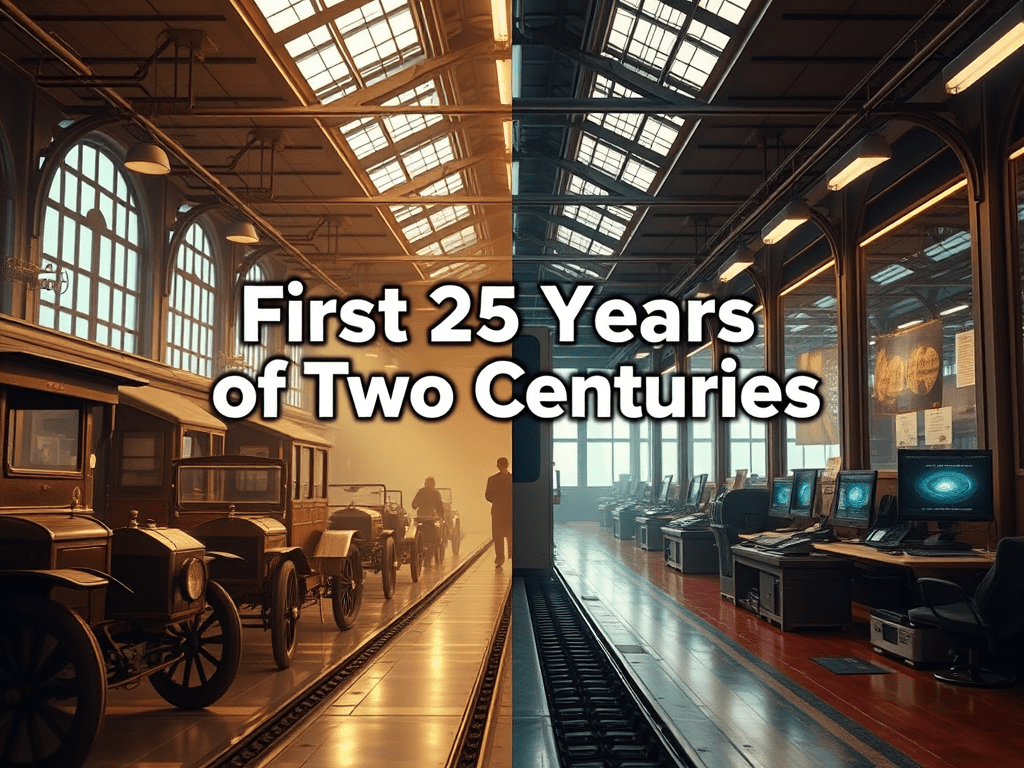
Let’s dabble in the macro and not the micro. What’s the big picture? It’s time to do a simple comparison. Take the first 25-years of the 20th Century and compare with the first 25-years of the 21st Century. Certainly, at the end of this year a complete summing-up could be done.

For now, I’ll do a random sweep across those two generations separated by a century.

Let’s think. There were no powered aeroplanes in 1900[1]. Few had an inkling that a world war was on the way. We were just figuring out what an Atom might be. Even the motor car was mostly for wealthy folk. The railways were king.

In 2000, I remember the optimistic fireworks and the controversy over the millennium dome. The forgotten panic of Y2K now seems strange. The World Wide Web[2] was getting traction amongst geeks. Mobile phones were gaining ground. Few saw the attack of 9/11 coming.

Being a child of the last century it’s easier to appreciate the changes. Let’s face it, today’s 25-year-olds had history lessons about subject that many people lived through. Although, there are a growing number of centenarians, most of them were in inkling in the parents’ eyes or babies pre-1925. Thus, we need to relay on the writers of history.

Here’s a proposition that warrants testing. Compared with the first 25-years of the 20th Century nothing much has happened in the first 25-years of the 21st Century. I know any division in time is an arbitrary matter. The Earth spinning on its axis cares little for human affairs. 24 hours in a day come and go whatever we do. That said, my proposition above does run contrary to the way people may feel about time passing. If indeed it does pass.

In both periods we might measure significance by the impact events have on people. There’s a propensity to say that world wars top the list in any account. That may well be fair. However, if we look at the growth in global population and the general improvements in human health despite that fact, then this is the greatest point to note.

When I say, nothing much has happened between 2000 and 2025, by comparison, it’s more to do with the pivotal moments that led to the creation of the technologies that we all now take for granted. Mastering the elements of science has made the biggest difference.

I’d say, in the public and social field, of politics, philosophy and economics[3] and we are as perhaps foolish as we have ever been. Convince me otherwise.


[1] https://www1.grc.nasa.gov/beginners-guide-to-aeronautics/powered-aircraft/

[2] https://www.w3.org/People/Berners-Lee/Weaving/Overview.html

[3] https://www.theguardian.com/education/2017/feb/23/ppe-oxford-university-degree-that-rules-britain

Collecting First Editions

Somewhere in several cardboard boxes I have books. Now, I know not where they are. Most of these books were published by Hodder and Stoughton. There were numerous print runs. Popular fiction.

What attracted me to these books was a character played by Roger Moore. No, I’m not talking about James Bond. Moore is probably best known for his portrayal of Bond. This was before he got that cinema role and global fame.

Author Leslie Charteris created a character called The Saint. That is Simon Templar. Roger Moore, as The Saint ran as a British TV series in the 1960s. What ran was an honest crime mystery series, with a Robin Hood style hero, who always won the day. His nemesis was a police inspector, even if they did cooperate towards righteous ends. The Saint didn’t always play by the rules. He fought tooth and nail to topple the ungodly.

Collectables are first editions of Leslie Charteris books. At one time they would appear forgotten in High Street charity shops. That day has gone.

The Saint Plays With Fire is worth revisiting. It’s a warning – especially now.

Avoiding Contrails and Enhancing Operations

Here I’m expanding on my earlier words on aircraft Contrails.

Airspace is a busy place. It’s most busy over Europe and the US. Over the oceans there’s more room, although on certain routes, like the North Atlantic, there’s plenty of daily air traffic.

Those who manage the airspace are primarily concerned with ensuring that aircraft collisions do not occur. The impact of mid-air collisions is devastating. There’re few people in aviation who can forget the events of an evening in July 2002. Over Überlingen, Germany[1], 71 people lost their lives at a time when the sky was not busy at all.

Managing the use of airspace is more than collision avoidance. Flying is perpetually concerned with the weather. What’s it doing, how is it changing and is it a hazard? It’s not just the safety of flying that demands up-to-date meteorological information. Knowing about the winds can enable more efficient operations, and that’s less fuel use for a given route.

Large thunderstorms need to be avoided. Regions of the world (example: intertropical convergence zone) make this a dynamic challenge. Manoeuvres may be planned but flight crews must be ready to act based on the information they have, like weather radar.

Turbulence is another phenomenon to be avoided, if possible. This can occur in clear air. It can be difficult to detect. Which explains the unpleasant examples that hit the News now and then[2].

Back in 2010, aviation had a reminder that avoidance encompassed any hazardous airspace. That was when an unpronounceable volcano in Iceland was spewing out ash at high altitudes. Plumes of volcanic ash, if ingested into aircraft engines, can cause major difficulties.

I’ve written these words to emphasise that the avoidance of contrail formation cannot be done as a stand-along consideration. It becomes one factor in a whole mix of factors.

Avoidance of contrail formation is about considering the mechanism that cause them to form. Clearly, the warmer the air is the harder it is for a contrail to form. The more humidity there is in the air, the easier it is for a contrail to form. Outside Air Temperature (OAT) and atmospheric humidity vary at each altitude. That relationship interacts with the aircraft inflight, and the outcome may be different for each aircraft type.

At least one academic study[3] says that adjustments of aircraft altitude of around 2000 ft could have a useful effect on contrail formation. That’s good to know but let’s not forget that Reduced Vertical Separation Minima (RVSM) [4] means a vertical spacing of 1000 ft in busy airspace.

My take on this fascinating subject is that there both a tactical and operational approach that can be practically taken by aviation.

At the tactical level, airlines can factor contrail avoidance into flight planning. Creating an algorithm that will weigh all the relevant flight factors. Improved sources of accurate and timely meteorological data and predictions will be needed.

At the operational level, it’s down to the flight crews to take advantage of environmental conditions as the opportunity arises. Much as dealing with turbulence, that is when safety and operational rules permit. To change altitude when its beneficial, computational help is likely to be needed. Over the ocean, air-ground communications systems may need to be further improved. An altitude change that avoids contrail formation but increases fuel consumption would not be a sustainable solution.

These computational tasks may well be well suited to machine learning. A useful application of artificial intelligence. I can imagine a cockpit weather radar display with a new set of symbology that indicates a low probability contrail formation zone ahead.

[Back in the 1990s, I worked on RVSM when the ARINC organisation was creating international standards. Safely increasing traffic in the North Atlantic region. Additionally, I participated in the certification of Future Air Navigation System (FANS) 1/A for use over the ocean. FANS led to more efficient aircraft operation due to shorter flying times and decreased fuel burn.]

POST: Looks like data crunching is underway Flight plans, but greener: The ICCT and Google’s mission to refine the Travel Impact Model – International Council on Clean Transportation


[1] https://www.bfu-web.de/EN/Publications/FinalReports/2002/Report_02_AX001-1-2_Ueberlingen_Report.pdf?__blob=publicationFile&v=1

[2] https://www.flightglobal.com/safety/turkish-777-rapidly-descended-during-crews-aggressive-response-to-turbulence-encounter/162937.article

[3] https://www.imperial.ac.uk/news/195294/small-altitude-changes-could-contrail-impact/

[4] https://skybrary.aero/articles/reduced-vertical-separation-minima-rvsm

Revisiting Brexit: Lessons

In life partnership is key. Most of us have no desire to live as a hermit. The dull confines of a hermitage are best left to a small few. That extends to communities as well. It’s rare for societies to live in isolation and avoiding relationships with others. People come together when they share values. So, it has been in Europe in the post-war era.

Relative to the astronomical losses that the whole UK accumulated because of Brexit, the gains of the latest European Union (EU) – UK deal are modest. The positive take, from Monday, is the direction of travel. Cool heads have prevailed, and a new deal of mutual benefit to both parties has been agreed. There’s more detail to follow as might be expected.

Unsurprisingly, those who failed miserably over the last decade are now carping bitterly[1]. Remember Johnson, who as UK Prime Minister (PM) had a large parliamentary majority that he threw away. His incompetent administration sealed an extremely bad deal.

The years following the 2016 referendum have been wasted years. Tedious nonsense about Brexit benefits have echoed through those years without anything good arising. Brexit “freedoms” are a metaphor for acting foolishly and without any relation to prevailing facts.

Last July, the British electorate said “no” to the parade of Conservative Party catastrophes[2]. The UK decided to go in a different direction. It was the Labour Party that toped the poll. Lib Dems and Greens doing well too. Since the General Election, and since the beginning of the year, the ebb and flow of global events has been truly turbulent. In historic terms, when UK PM Harold Macmillan was asked what the biggest challenge for a statesperson was, he replied: “Events, dear boy, events”[3]. Seems he was right.

Starmer is a fascinating character. Not the characteristic statement of a lifelong liberal, like me. The tool makers son, who schooled in Reigate, to become a top lawyer, climbed the slippery pole of pollical life, to become PM. Along the way he’s done what’s most typical of successful British politicians. That is, he’s changed his mind and allegiances along the way. Going from Labour Party leader to PM in 4-years is quite an achievement.

I don’t have to agree with the PM. In fact, as far as his priorities in government, I don’t agree with the PM a lot. Although, I’ve personalised these words, I wish to take due care. I speak only of him as PM. I’ve never met him. So, let’s focus on his role.

An EU-UK Brexit “reset” was inevitable. If it didn’t happen now, it would have happened eventually. Why would both global trading partners persist with a lose-lose situation? Dealing with serious national issues is a PM’s job. It’s not to avoid or obfuscate. Here Starmer is praiseworthy. Instead of struggling on as if nothing could be done, he’s acted.

What I dislike is the mindless bile that emerges in the conservative Press and in dark corners of social media. Swilling around with ever more hostile adjectives, it’s as if all sense has been lost by part of society. By all means express unhappiness if the cherished beliefs of Brexit are being contested. Everyone has a right to criticise. Please do it in a civilised manner.

What’s foolish is the leader of the Conservative Party who has jumped on the pessimist’s bandwagon. Why do they persist in talking Britain down? Gloomy and unattractive it’s no wonder their poll ratings are plunging. Instead of speaking on Europe, with eloquent and knowledgeable thoughtfulness, we get a diatribe of prejudice and backward thinking. Sad indeed.


[1] Read the Daily Telegraph, The Mail or Express. Newspapers in name only.

[2] https://researchbriefings.files.parliament.uk/documents/CBP-10009/CBP-10009.pdf

[3] Harold Macmillan’s time as PM (1957-1963) was marked by major events, including the Suez Crisis.

Understanding Contrails

Crisscrossing the sky, as I look up on a clear day, there are civil aircraft going about their business. People travelling across the Atlantic or coming back or on a day trip to Glasgow.

These shiny pinpoints of light in motion, set against a blue sky, are all the more visible because of the vapour trails they leave behind. Aircraft speed through the rarified atmosphere to leave a momentary trail as evidence of their presence.

Up with the aircraft in flight are natural clouds. Up at 30,000 feet there can be Cirrus clouds[1]. There might not be much air pressure at that altitude but there’s enough moisture to support cloud formation. The word “wispy” sums them up.

Aircraft create condensation trails that are known as contrails. How the English language likes to shorten. They are not mysterious or generate with evil intent in mind. It’s simple physics.

In my bathroom, with hot water gushing from the shower, moisture is the air. When that moist air meets a cold surface, like a window, condensation is sure to be seen. Airbourne it’s not so different. Hot emissions from powerful jet engines shooting out into a cold low-pressure environment and guess what?

Typically, contrails don’t last long. If there’s appreciable wind at high altitude, then they get dispersed quickly. Not only that but the icy temperatures up there soon return things to the status-quo. There are days, when the air is still, that the sky can become a crisscross of contrails where dispersion is more like a gentle merging.

The theory goes that the cumulative impact of lots of high-altitude flying is like the impact of additional cloud formation. It’s water vapour after all. It’s known, high altitude clouds can contribute to the greenhouse effect.

The point I’m getting to here is that lots of flying contributes to climate change. Primarily because of the burning of significant amounts of fossil fuel. As a secondary consideration there’s the issue of contrails across the globe.

This leads to the question – can their formation be avoided? Even, is there something useful to be gained in doing so. Trials and research are trying to establish the answer to these questions[2].

Initially, contrail avoidance sounds like it should be relatively easy to do. However, like so many good proposals it’s not so easy. Change needs to involve air traffic management, flight operations and international regulators.

First the atmospheric conditions need to be detected or predicted in a given location and then an avoidance needs to be planned and undertaken in coordination with everyone flying at high altitude at a given time. Lost of data to crunch.

It’s possible, in oceanic airspace, a dynamic aircraft system could perform this avoidance function. It would be an interesting design challenge for an avionics company to take up.

#Net Zero #SustainableAviation


[1] https://weather.metoffice.gov.uk/learn-about/weather/types-of-weather/clouds/high-clouds/cirrus

[2] https://news.aa.com/esg/climate-change/contrail-avoidance/

Relationship with the EU

Monday, Monday[1]. It’s a wonderful 60s song. Harmonies and mood are perfect. I wonder if the harmonies and mood will be perfect for the Prime Minister (PM) on Monday. Already the Sunday Press are setting the stage for Monday’s performance.

Reset, recalibration, reheat, rekindle, re-whatever. It’s a moment when relations between the UK and the European Union (EU) can make realistic progress[2]. In world full of uncertainty (could be a song in that one), for once the direction of travel is a constructive and positive.

I think the word “deal” is getting overplayed. Indications are that there’s no fundamental shift from Brexit meaning Brexit, as one former PM liked to say. In fact, the current PM is being highly cautious in the light of his Party’s reading of the latest opinion polls. For no sane reason I can think of, the swivel-eyed loons of the far-right are making hay.

It’s astonishing me how dim-witted the Conservative Party is in objecting to something when they don’t even know, for sure, what it is. Mind-blowing. And the rum cult of Reform Party doing the same with extra bile. What a load of prehistoric fruit loops.

Brexit supporters are spreading misinformation, again. Saying that UK has no influence. It’s true, the UK doesn’t have votes in the European Council or Parliament, but significant influence can be exercised on standards, and regulatory guidance, nevertheless. A better “deal” can bring much greater influence. Absolutely vital in the digital world, and for the UK, a country with a services-based economy.

Brexit has cost the UK dearly. The UK Treasury would have billions more in its coffers if the 2016 referendum had never taken place. The standard of living of every person in the UK is lower because of Brexit bungling. Ideally, that great mistake is an event to be written up for the history books and then forgotten.

On top of the above, uncharacteristic moves in the US, with Trump tariffs there’s nasty hit at the UK’s future prosperity. There couldn’t be a better time to repair relationships with the UK’s nearest neighbours. The countries with which we share most of our long history.

Even for those on the political right, practically, the EU is never going away, so until the day the UK rejoins the block, it’s wise to have the best possible relationship in all matters. Goods, services and people need to connect as a case of mutual benefit.

It’s time for hope. An optimistic tone should be set. A smile. Let’s hope we are singing Monday, Monday so good to me, Monday morning was all I hoped it would be. Naturally, that there be no crying, come Monday evening.


[1] https://genius.com/The-mamas-and-the-papas-monday-monday-lyrics

[2] https://www.independent.co.uk/news/uk/politics/brexit-uk-eu-reset-trade-deal-starmer-b2752285.html