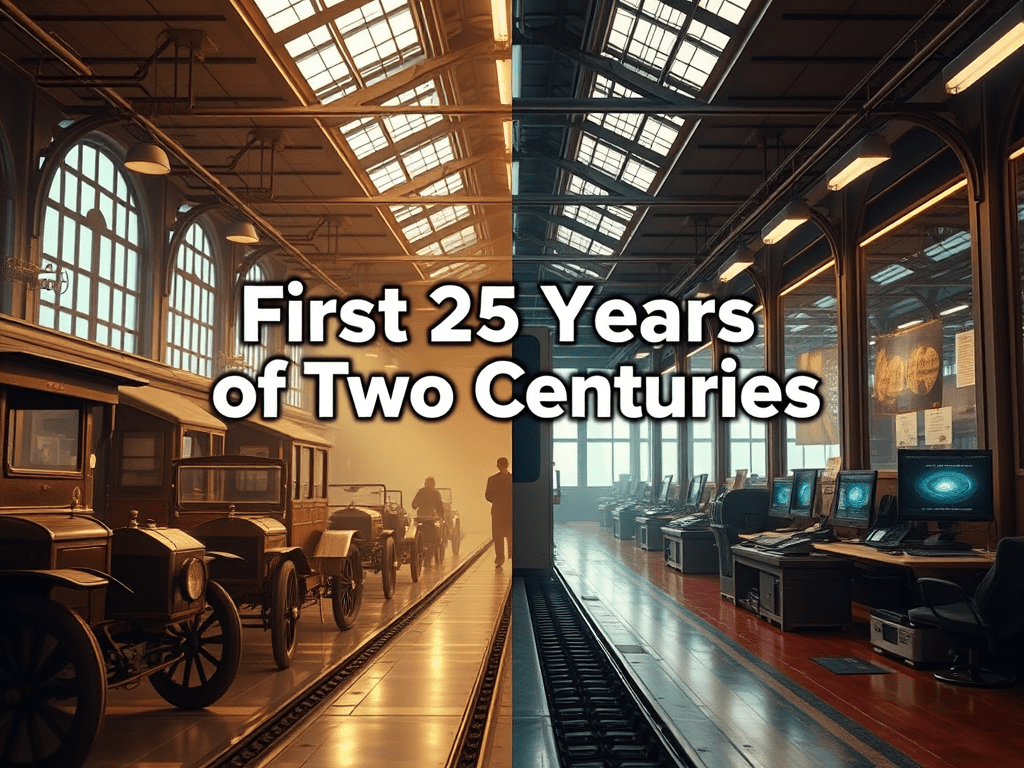
Two Centuries

The News can be overwhelming. It’s a constant barrage of terrible calamities, inadequacies, and past failures. I guess, that’s the manner of the daily News cycle. Put out a positive press release and watch it get ignored. Report of catastrophes and every media outlet copies the stories.

It’s as well to remember that within a week a new round of headlines displaces what was there before. It’s as well to step back. Perspective is an interesting phenomenon. It condenses the past, so that we see the major events more clearly. The nitty gritty of the everyday often fades and only the significant happenings remain.

Let’s dabble in the macro and not the micro. What’s the big picture? It’s time to do a simple comparison. Take the first 25-years of the 20th Century and compare with the first 25-years of the 21st Century. Certainly, at the end of this year a complete summing-up could be done.

For now, I’ll do a random sweep across those two generations separated by a century.

Let’s think. There were no powered aeroplanes in 1900[1]. Few had an inkling that a world war was on the way. We were just figuring out what an Atom might be. Even the motor car was mostly for wealthy folk. The railways were king.

In 2000, I remember the optimistic fireworks and the controversy over the millennium dome. The forgotten panic of Y2K now seems strange. The World Wide Web[2] was getting traction amongst geeks. Mobile phones were gaining ground. Few saw the attack of 9/11 coming.

Being a child of the last century it’s easier to appreciate the changes. Let’s face it, today’s 25-year-olds had history lessons about subject that many people lived through. Although, there are a growing number of centenarians, most of them were in inkling in the parents’ eyes or babies pre-1925. Thus, we need to relay on the writers of history.

Here’s a proposition that warrants testing. Compared with the first 25-years of the 20th Century nothing much has happened in the first 25-years of the 21st Century. I know any division in time is an arbitrary matter. The Earth spinning on its axis cares little for human affairs. 24 hours in a day come and go whatever we do. That said, my proposition above does run contrary to the way people may feel about time passing. If indeed it does pass.

In both periods we might measure significance by the impact events have on people. There’s a propensity to say that world wars top the list in any account. That may well be fair. However, if we look at the growth in global population and the general improvements in human health despite that fact, then this is the greatest point to note.

When I say, nothing much has happened between 2000 and 2025, by comparison, it’s more to do with the pivotal moments that led to the creation of the technologies that we all now take for granted. Mastering the elements of science has made the biggest difference.

I’d say, in the public and social field, of politics, philosophy and economics[3] and we are as perhaps foolish as we have ever been. Convince me otherwise.


[1] https://www1.grc.nasa.gov/beginners-guide-to-aeronautics/powered-aircraft/

[2] https://www.w3.org/People/Berners-Lee/Weaving/Overview.html

[3] https://www.theguardian.com/education/2017/feb/23/ppe-oxford-university-degree-that-rules-britain

Revolution: Hype vs Reality

Talk is of a revolution[1]. That sounds sensational. It sounds like marketing talk aimed at creating an insatiable desire for something new. So, that kind of talk immediately switches on the cynical side of my brain. Is this hype or is it real?

We’ve had plenty of both in my lifetime. Colourful boys adventure books with novelties like nuclear powered aircraft and moonbase vacations. It’s not that “flying a kite” is entirely bad. Those imaginings of the future had pictures of prototype flying cars. Now, we maybe on the verge of that prediction becoming real.

AI is not new. It’s been a research subject for decades. What we have most recently is the coming together of concepts and the practical machines on which to run those concepts. Amazing has been the speed of progress. That’s a modest word considering the sudden adoption of new tools that go way beyond simple INTERNET search engines.

Bill Hunter’s line: “You can’t stop progress”. At least that’s the line I remember of the 1994 film Muriel’s Wedding[2]. It was said on a rocky path to “progress” induced disaster.

My curiosity centres around avoiding the hype and finding out what’s real. That’s in the vain hope that I might not be left behind in this rapid surge of “progress”. So, to keep up with the latest technical developments I clicked on a TED App. The boss of TED, Chris Anderson has recently interviewed Sam Altman, the CEO of OpenAI[3]. He’s the guy behind ChatGPT. AI has elevated new people into the spotlight. It’s given established technology companies a headache. Their desire to be in the pack, or leading the pack is mighty strong.

My takeaways form this interview are that AI will outpace human intelligence, in time. No one knows how much time, but the path is set. The direction of travel isn’t in the control of traditional institutions or government departments. Society must get its head around a time when we live with machines that out pace us.

Second, it would be nice to have an enlightened global regulator to ensure that the massive amount of development going on produces outcomes that are for the public good. Chances of that happening are about zero, although not zero. There’s even a possibility that the industry at work on this technology realises the need for a set of enforceable rules.

Questions of safety are paramount. Even though society debated the impact that the INTERNET would have on us, steps to provide protections and boundaries only came about after the event. Lost in a storage box, I once had a book called “The Sleeping Sentinels”. Basically, the thought was that political parties and the legal profession are always more than ten steps behind the technologists. We are highly reactive.

One interesting aspect of the interview was the pauses. What was evident is that it’s hard to find the right language to describe what’s happening. Walking a tight rope between sounding like Chicken Little[4] and a wise respected elderly professor. Revolution is the right word.

POST: It’s not just IT Why AI Demands a New Breed of Leaders


[1] https://youtu.be/Xv8FBjo1Y8I

[2] https://www.youtube.com/watch?v=PLDcevp5w5o

[3] https://www.ted.com/talks/sam_altman_openai_s_sam_altman_talks_chatgpt_ai_agents_and_superintelligence_live_at_ted2025

[4] https://www.rottentomatoes.com/m/chicken_little

Pragmatism in British Politics

Pragmatism has long been a part of British life. Idealism too but to a lesser extent. That said, the shelves of literary works probably tip in the balance of idealism. There’s always an “insightful” quote to pull of the shelf and plonk into a speech or scribblings like this.

There’s a comfort in putting important decisions down to known facts and up-to-date realities. This way of working tends to favour short-term action based on weighing-up the here and now. What’s best for us where we stand at this moment? How much money have we got?

If you are an ardent socialist or committed liberal or dyed-in-the-wool right-winger, then pragmatism can make your flesh crawl. It leads to the question – what do you really believe in? Intellectual prowess is challenged by a call to make it up as we go along.

Pragmatism encourages hypocrisy. Now, that might be phrased as an uncomfortable negative. The truth is that no successful organisation has ever escaped a great deal of honest hypocrisy. Positions on even the most hard-fought issues do change. That’s not a negative. Just a couple of minutes surveying the history of the last half century, more than proves the case.

So, when I hear the UK Prime Minister (PM) talk of “ruthless pragmatism” I do wince a bit. It’s not that pragmatism per-se is an evil. No way. Mere survival in any political landscape and someone must react to the here and now in a way that doesn’t sink the ship.

PM Keir Starmer talking on Europe[1] is like listening to a rich Victorian woman having on extremely tight underwear. There’s no way she can loosen it in public. Her peers would disown her. When no one is looking an immense sense of relief can be gained in shedding the constraining garments. Behind closed doors the ridiculous restraints are shed.

Frankly, UK opposition to joining youth mobility schemes[2] in Europe is a stupid as stupid can get. I mean stupid times a billion. Now, some madcap idealists might be scared that British youth might, if taught early, be influenced in ways that would last throughout their lives. Such would be their indoctrination that eventual the push on the UK to join to European Union (EU) would be overwhelming.

There’s another word beginning with “p”. Take pragmatism and replace it with paranoia. The later seems to be fashionable just now. Forget the idealist approach where at least views tend to be based on a plausible creed. Paranoia is such that no previous experience is necessary. It’s all-over social media and more and more conventional media. Pragmatism is met with disbelief. So, is it wise for Keir Starmer to make that word a number one headliner?

A philosophical political pragmatism has been long practiced in the UK. I don’t see that stopping anytime soon. But what’s to be gained by headlining it? Not a lot I’d say. In fact, it gives ammunition to the light blue swivel-eyed loons[3].


[1] https://www.independent.co.uk/voices/editorials/keir-starmer-brexit-reset-europe-b2692118.html

[2] https://lordslibrary.parliament.uk/youth-mobility-schemes/

[3] https://www.independent.co.uk/news/uk/politics/swivelgate-david-cameron-goes-to-war-with-the-press-over-swiveleyed-loons-slur-8622277.html

John Gray’s Critique

If a dose of despondency is your Sunday morning tipple, I recommend BBC Radio 4’s “A Point of View[1]”. I often catch it as an alternative to listening to the driving rain bashing against the window as I wake-up on a Sunday morning.

What I dislike the most about John Gray’s analysis is that it dismisses all the hard-working people who daily strive to make the world a better place. I know, you are asking who John Gray is and what does he know? Well, he’s a British philosopher and author of a pile of serious books. He dabbles in political thinking and doom mongering.

On Sundays in the past, I relied heavily on Will Self creating an air of depressed inevitability that all the bad things about humans will eventually overcome us. A dower British journalist and political commentator who always seems to see the dark cloud instead of the silver lining.

Despite the grim tales of these speakers, they often have, lost in their rhetoric, a smidgen of wisdom. This morning John Gray argues that we need a new response to the growth of the right-wing charlatans who are rapidly climbing the greasy pole of national political life.

Naturally, a lot of us thought that’s what the UK General Election last July was all about. A reoccupation of the centre ground of British politics by the Labour Party. A renewed liberal democratic political consensus would emerge and save us all. Strangely, it doesn’t seem to be working out that way. Although, it might be a bit harsh to judge after only a few months.

Last night, I watched the second episode of the BBC’s period drama Wolf Hall[2]. My God, it’s good entertainment. A little heavy in places. Sharp and brilliantly executed. That last word being the key one. Tudor history is a reminder of how vicious political manoeuvring can be. Having a master, a King, who is determined to make the world turn around him and no one else.

So, should I agree with the likes of John Gray? That a darkness slithers around in human hearts. That we’d better be prepared, shake-off the status-quo and look for new ways to head-off the marketing men’s populist politics. Voiced by bombastic demigods and radical twerps.

He’s right in the sense that today’s politics is behind the curve. British political parties were forged in a different age. Largely, baring the virtues they espouse, they are outdated. Sure, fairness, liberty, and equality have not fallen out of fashion. But maybe the language surrounding them belongs in the 19th and 20th centuries.

One thing is for sure, Willo the Wisps, like Kemi Badenoch offer nothing new. Reform is just a cover for the populist worst of human nature. Yes, we do need someone to break new ground in British politics.

Oh, for a more cheerful Sunday morning.


[1] https://www.bbc.co.uk/sounds/play/m00254hz

[2] https://www.bbc.co.uk/iplayer/episodes/m002473m/wolf-hall

Daily writing prompt
If you could meet a historical figure, who would it be and why?

It’s one thing to have the fancify idea that just as in “Bill & Ted’s Excellent Adventure[1]”, I’d be able to talk to anyone but that’s just not on. I might meet Socrates, or some other great classical mind and ask questions about the meaning of life.

Let’s face it, nice idea but we wouldn’t understand a word we said to each other. There’s also that divide between the analogue and digital world. Technology 21st Century types take for granted would seem like magic stepping back a century. Thus, dude it’s the modern age where I’d focus attention. Set the dial on my time machine.

Let me go for Richard Feynman[2]. I’d ask how do you communicate complex ideas and make them seem not so complex? Then afterwards I’d be stuck with the dilemma that often strikes. Well, I thought I understood what he was saying but now I’m not so sure.

Strange that Bill & Ted went on their adventure the year Feynman passed on. That year, I was figuring out the space between the analogue and digital world.

If Feynman was busy, I’d go for Carl Sagan.


[1] https://youtu.be/oUDIBzecP1I

[2] https://www.nobelprize.org/prizes/physics/1965/feynman/biographical/

Safety Defined

I found myself saying the words: “the fundamentals remain the same”. A nice phrase that promotes the idea that there are some bedrock ideas that are immune from the winds of change. It’s as easy as saying that 2 plus 2 will always equal 4. Except I wasn’t taking about a mathematical relationship. A traditional set of rules that are so established that it becomes incredibly difficult to think differently. That is unless I get terribly esoteric and argumentative about what do we mean by plus and equals.

Safety is freedom from harm. That’s one of the simplest definitions of “safety”. Simplicity has merit but there’s one or two weaknesses in that basic definition. Although, it’s one that I’m happy to use. It communicates well. Theres a lot to be said for brevity.

The human condition is such that we are never ever free from potential harm. Such is the sheer complexity of our situation that the combinations and permutations of stuff that can harm us is immense. Every tiny cell in our bodies is doing something that it needs to get right. Yet, we exist relatively healthily with a myriad of flaws. Unfortunately, or fortunately, our awareness of the flaws that can harm us is often non-existent. Perhaps we have the freedom of ignorance.

Safety is freedom from harm with these caveats. Generally, even invoking the word “safety” implies that the stuff that can harm us is substantial and tangible. It’s something we might know and understand. Likewise, the word “harm” in this context doesn’t mean trivial or non-consequential actions. It’s something undesirable where effort would be made to avoid.

To compound my kicking away at what seems like a perfectly reasonable simple definition, the well-known dictionaries who publish their wisdom each have different variations on a theme.

Each definition has at least two parts for the abstract noun “safety”. Yes, it doesn’t have a physical form, in of itself but “safety” is a condition. The negative stuff to be avoided comes up as harm, danger, hurt, damage, injury, death, loss, and even risk. The act of avoidance of a negative outcome comes up as a condition of being free or protected.

Another dimension not explicitly mentioned in the common definitions is the dynamic nature of safety. It is not a static condition. Theoretically, the transition from a safe to an unsafe condition can take an infinite number of paths. In reality, some pathways are more probable than others.

This is where the discussion moves away from grammar to the substantial experience of safety. It’s locked into our thinking, and not often expressed that the dynamic nature of the subject means that probabilities always come to bare.

Today, I may not be the least bit concerned that a meteor would crash through the roof of my house without warning and injure me. That is even if I am not entirely free of the possibility of such an event happening. I will take the possibility of tripping on a loose stair carpet much more seriously. Both safety jeopardising events are possible but one is more probable than the other.

Next, I come to what’s conceivable and what’s not. In a universe of an infinite number of possibilities there are lots that are just plain inconceivable. The meteor case above is conceivable. Governments take practical actions to monitor space rocks.

Even to speak of something that is inconceivable is stretching the boundaries of our imaginations. It’s often taken as obvious that certain threats are out of bounds. Yet, the inconceivable occasionally happens and our boundaries are thus expanded. A pilot chooses to fly a perfectly airworthy aircraft into a mountain. As we know it has happened.

I’ll stop here. What’s clear is that a simple definition isn’t simple at all.

Ignorance and Knowledge

He’s entertaining. My thought is that maybe he’s trying to be contrary for the sake of being contrary. I have some sympathy with that approach. Why should we all agree? Consensus can be a dreadfully boring state of affairs.

Rory Stewart is heralding the advantages of ignorance. Even saying that sounds mildly provocative. It’s like saying; I want to be a sensible commentator but I’m going to throw a seemingly nonsensical proposition at you.

Who is Mr Stewart? He once was an English politician. He might claim to still be one. He certainly has speaking and writing abilities that make him interesting in that role. Brexit and all the shenanigans in the Conservative Party pushed him to the margins. Outside of that narrow band of madness he’s quite mainstream.

The square jawed expression and Trump-like hands of the publicity shot must have been the photographer’s first concept[1]. The title of the radio series is a good one. From one series of long histories, I’m sure he can make many long histories. History can be as long as anyone would like to make it. For most of it, humans have been profoundly ignorant about the world and its ways.

I get the notion that the starting point for discovery of new knowledge is ignorance. It’s going too far to say that ignorance can sometimes be valuable, and knowledge harmful. Call me old-fashioned but one of our greatest human achievements is education. It’s a social call to arms. Let’s raise the life opportunities for most people by passing on knowledge.

Every succeeding generation passes on knowledge. We stand on the shoulders of giants[2]. The process that forms the words on the screen in front of me only exists because of generations of development and learning. Onward we go. Well, there was that period of the so-called “dark ages” when humanity seemed to go backwards. And with modern youth there’s the fear of the coming zombie apocalypse whereby we return to a miserable ignorance.

What this says to me is that we take for granted a daily situation that is terribly fragile. Remove the underpinning of accumulated knowledge and back we go.

I say; there’s more than one kind of ignorance. I can think of 4-types without much stress.

There’s that which we all have by nature of not being able to answer the big questions. Why are we here? What’s it all for? How did everything come into being?

There’s that which is unknowing ignorance. Where we believe we know but subsequently its discovered that what we know was wrong. On going discovery.

There’s that encapsulated in the saying about choosing not to see. It’s deliberate ignorance. When we pretend or cannot face the implications of reality.

There’s that which is part of deception. Again, it’s deliberate ignorance or to encourage ignorance. This time it’s an intentional strategy to mislead, misrepresent or do malice.

I’ll listen and learn.


[1] https://www.bbc.co.uk/programmes/m00199xy

[2] https://discover.hsp.org/Record/dc-9792/Description#tabnav