Work-Life Balance

Now retired, I sure didn’t always do this daily balancing act well. It was a difficult one to master at the best of times. Especially when work involves travel and was dictated by unpredictable events and demands. In aviation, I mean experiences like accidents and incidents, and the more unusual, like the closure of airspace by the volcanic eruptions in Iceland in 2010.

The maxim: “If you love what you do, you’ll never work a day in your life” can be a deceptive little ditty. That’s because time travels incredibly fast when busy and working at interesting problems.

What advice would I give to my younger self? Learn to say “no” in a smart way. Don’t let pride or guilt, those testy emotions, influence too much. And don’t let others use them against you.

Additionally, jobs with responsibility do have unpleasant and mundane aspects. Say, someone’s performance appraisal didn’t go well, or the budgetary forecast were way off or the advice you gave was based on flawed assumptions. These situations happen to everyone. The message is don’t take this baggage home if you can avoid it.

Eurovision 2025: Highlights and Predictions

Joyous entertainment. An ever-flashier lighted spectacle. Comic, dramatic, eccentric. It’s all of these and more besides. That’s Eurovision.

This year’s crop has variety. There’s peculiar voices that make me cringe. There’s pop with extra added pop. There’s retro seriousness with genuine heart. There’s dressy comic fun. There’s the music equivalent to adrenalin filled energy drinks. There’s sexy costumed excess.

Thank God for public service broadcasting. Hats-off to the European Broadcasting Union (EBU)[1]. Every year they come up with a bright spot in a troubled world. The biggest music show in the world. This year, Switzerland is doing a banging job.

The Grand Final of the 69th Eurovision Song Contest, takes place in Basel on Saturday evening. Worldwide people will be glued to their screens. Here’s an event that bring the world together. Yes, a smidgen of politics creeps into the arena. Thankfully it’s not the dominant force. Clearly, the theme here is unity through music. Celebrating what we have in common.

Sweeden (KAJ – Bara Bada Bastuare) are highly rated for a win. Personally, although I like these jokers and their act, it reminds me too much of a Monty Python sketch. He seems to be popular with the audience but I’m not a fan of Tommy Cash. Estonia is going to do well. For me, Espresso Macchiato is just too blatantly silly.

Granted it’s not the most spectacular single act, I like Armenia. The man is full of raw energy. PARG should be high on the evening’s final list. There’s something devilish about Miriana Conte of Malta. Colourful in excess. She should get a lot of votes for her well executed exuberant spectacle. Looking away is impossible.

I maybe a mild-mannered prude but please let’s not have Finland and Erika Vikman win the night. The act is too contrived to be edgy and get noticed. And sorry Mr JJ. Wasted Love is more like wasted painful screeching in my book. Austria nil points.

In a more traditional style, Klavdia from Greece has a simple honesty that shines through. That should be rewarded with votes. What The Hell Just Happened? Could be applied to the Saturday night result when the time comes. It’s the title of the United Kingdom entry. I wish the group Remember Monday good luck.

Eurovision is going from strength to strength. This inheritance is to be treasured.

POST: In my mind an unexpected result. Regardless of the political element of large-scale public voting, I didn’t think the Austrian entry had much going for it. Same with Israel. 2025 has been a bumper year for choice, in terms of the variety of acts, but the winners are run of the mill. Good luck to Austria in hosting the competition next year. I’m sure they will do a fine job.


[1] https://www.ebu.ch/home

Action Shapes Outcomes

There’s a foolishness that comes with great power. It gets played out every day over the News media. It’s when notable person x or y says words to the effect; nothing will happen unless I do it. This common notion gets projected to us through mass reporting and commentary.

Every second is a pivotal moment. A last chance to move, or a last chance to act. As if time stops when we know it branches into countless possibilities. Fine, pivotal life or death moments do exist. It’s only that they are less numerous than we might be led to think. Drama takes its place in the theatre of the everyday[1].

There’s an ancient lesson to learn. It goes like this, in a simple demonstration. Place any finger into a glass of clear water. Now, remove the finger and observer the hole.

It’s a lesson Archimedes would appreciate. Although he’s famous for displacement being an indicator of what’s doing the displacement. Between the two it’s the water that’s the constant. The ebbing and flowing of time. At least as we humans perceive it.

It’s not that an individual can’t make a difference. Far from it. Individual action can make a dramatic difference. Doing the right thing at the right time, if the opportunity arises, can be the difference between catastrophe and nothing much in particular, as an outcome. In the world of major accidents, designers and operators desperately try to avoid the possibility that a single act or failure that leads to catastrophe, but it does, on rare occasions happen.

The point in discussion is the matter of what is indispensable. How often do we get to choose what is indispensable? After an event, it’s easier to answer the question. Looking back, it can be said that the factor that made the most difference was this one or that one. Before an event, we are in the land of probabilities and shiny crystal balls. Mathematics and mysticism.

The Cuban Missile Crisis[2] offers a lesson. It was only in retrospect that people learned of the action of a Soviet Naval officer who prevented a submarine from launching a nuclear torpedo.

History tells how the pivotal moment arrived. That said, there was no way the man concerned knew before time that his role would be indispensable. History would be written dramatically differently if a nuclear engagement had happened.

In the end it comes down to doing the right thing at the right time when the opportunity arose. Sometime swimming against the tide of events. Not magic exuded by a powerful individual strolling the stage.

POST: A better one. All The World’s A Stage By William Shakespeare · Jim Broadbent https://youtu.be/gUJBEy-tbo0?si=NMkIRpIr8H0wdTgv


[1] https://youtu.be/caaPlIX6AkM

[2] https://www.jfklibrary.org/learn/about-jfk/jfk-in-history/cuban-missile-crisis

Sustainable Aviation: Innovations and Challenges

Gas guzzling continues to be one of aviation’s problems. Combustion remains that the heart of most aircraft power plants. Taking large amounts of fossil fuel. Squeezing energy out of every drop of gasoline. Gobbling up more day after day. Pushing out emissions.

As I look out across the garden, I see gliding effortlessly as the warm air rises, a Red Kite[1] gracefully circling. Wings outstretched they hardly move them as they climb. They’re a distinctive small bird of prey, easily spotted because of their forked tail. Now, that’s what I call efficient flying. Using all that nature provides and wasting little energy.

Human attempts at flying are a million miles behind these magnificent birds. There’s still so much to learn about aerial navigation. It’s a matter of control. The sensing of ambient conditions and the precision movements needed to ascend and dive at will.

The search is on for effective change. There’s no pretence that the way commercial aviation operates is unsustainable. It’s true that the gas guzzlers of the air guzzle less gas now than they ever have but the physical facts remain.

None of this is new. I’m about to send a book called “Towards Sustainable Aviation” to a charity shop. It’s not that there’s anything wrong with it. The book is full of pertinent analysis and observations. Trouble is that it’s dated 2003.

I’m led to ask – what’s changed in over 20-years? In answering my own question – quite a lot but not enough. Discourse has moved on from academic quarters to the political sphere. Aircraft have become more fuel efficient. Driven by economic imperatives as much as any concern for the climate. Research initiatives are generously funded to come up with answers. Solutions like hydrogen, electric propulsion, and SAF (sustainable aviation fuel) are slowly moving from theory to practice. A few prototypes are flying. Limited supplies of SAF are flowing.

Unmistakable that’s where the problem lies. For all the hype, policy and government funding the pathway to genuinely sustainable aviation disappears way off into the horizon. There are setbacks too. Gas guzzling is back in fashion. Certainly, in Trump’s America.

We could make a much more of the technology that’s currently available. Yes, there are costs involved. Change is not a free ride. That said, sticking with the status-quo isn’t free either. Legacy costs mount up. One reason why older jets disappeared from fleets so quickly.

The next generation of commercial aircraft must make major steps forward. Since the life of a typical aircraft type can easily extend to 30-years, then change must happen in design now.

Typically, commercial aviation moves with graduated change. There’s an inherent conservatism in the system, as might be expected when safety and security are paramount. Facing this global challenge, there’s a need for a degree more radicalism.

Since high impact disruption is also in fashion, it’s time for airlines and manufacturers to adopt a pioneering spirt. It’s been done before. In the 1960s, that pioneering spirt gave us the Boeing 747, the Jumbo jet. That opened flying to a whole generation.


[1] https://www.rspb.org.uk/birds-and-wildlife/red-kite

Myths vs. Reality

We live in a world of contradictions. What am I thanking about? The current febrile immigration debate has all the hallmarks of magical thinking. Here we are surrounded by water, living in an economically active favourable part of the world and yet public concern is directed at “others”.

I’ve no problem with the current British Government berating the past Government for not fixing a problem. It’s normal for a governing party in the first couple of years of their term of office to point the finger of blame. It’s easy. Painting a picture of past failure makes the road ahead clearer. It’s easier to start from a point of low expectations.

However, it seems it’s not the resurgence of the Conservative Party that the Labour Party are concerned about. Today, such a prospect would be like the reincarnation of a squirrel that had been run-over by a 42-ton truck driven by the electorate.

The announcement of the day is setting an ambition to squeeze immigration. Recent local elections have shown that this banner flies well with those who vote in local elections. Because the opinion polls give bizarre indications too, the questionable assumption is that if a General Election was called by an irrational Prime Minister there’d be a surge in far right-wing voting.

We have new kids on the block. They are not at all new even if the have a new name. It’s an Orwellian name. Because an ultra-conservative party isn’t in the business of newness as much as they are stirring up ancient antagonism.

Anyway, the Reform Party are the current snake oil salesman selling their easy solutions to difficult problems. They were once named; Referendum, UKIP and Brexit Party. All proponents of magical thinking and with a poor track record.

The story goes like this. Stop overseas immigration and make the hordes of economically inactive people of Britan take-up the vacancies that would result. When Reform voters hear this narrative, they don’t think it applies to them. They believe there’s a mythical group of lazy people who need to be forced back to work and off overly generous State benefits.

In this public debate it’s as well to look at the numbers[1]. Reform voters are predominantly of 50-years and older and the economically inactive are predominantly 50-years and over[2]. Thus, I say, we live in a world of contradictions.

COVID did see a large number of people take, or be forced into early retirement. Those who have experienced a lifetime of their terms and conditions of employment being degraded took the opportunity to do something else. Often that included voluntary work or caring roles. Reform have concocted plans to pressure people back into conventional employment. These plans are uncosted and not cheap. Lots of government funded incentives and training, for example. In the real world, funding must come from somewhere. That’s likely to be from the privatisation of health services and cancelled benefits. In this scenario don’t expect to get a state pension until well past 70 years


[1] https://researchbriefings.files.parliament.uk/documents/SN07119/SN07119.pdf

[2] https://www.gov.uk/government/statistics/economic-labour-market-status-of-individuals-aged-50-and-over-trends-over-time-september-2023/economic-labour-market-status-of-individuals-aged-50-and-over-trends-over-time-september-2023

What Does Freedom Mean?

Daily writing prompt
What does freedom mean to you?

Freedom. There’s as subject that’s banded around as if it’s a simple matter. It’s not.

Let’s start with Thomas Hobbes in the 17th Century.  He says freedom is the absence of external obstacles. Thus, if a person is not restrained from doing what they will then they are free. That’s an individualistic view. However, what happens when the theory is applied to a murderer, a thief or conman? I would like to see such a person presented with obstacles. By the way, I’m taking liberties as Hobbes was more nuanced than my description of his philosophy.

Let’s say I’m more inclined to John Stuart Mill’s thinking. Liberty (freedom) is to be free to think, say, and act as one wishes on condition that resulting actions do not harm others. Autonomy has a condition. This is nice. Hold on, isn’t the range of what might be generally considered as “harm” a wide one? In the past, school children may have chanted: “sticks and stones may break my bones, but words will never hurt me.” Quaint, and in the modern context a saying that is clearly utter nonsense.

In Britain individuals are free. However, boundaries are placed on that freedom by law and by social convention. Freedom of thought, speech and action are to be cherished and defended. In my mind that means challenging boundaries where constraints might be overzealous.

Words used with intent to harm others should face public objection. Words that may annoy or unsettle or question others, well that’s a different matter. A dynamic balance must be sought.

Exploring a Riverside

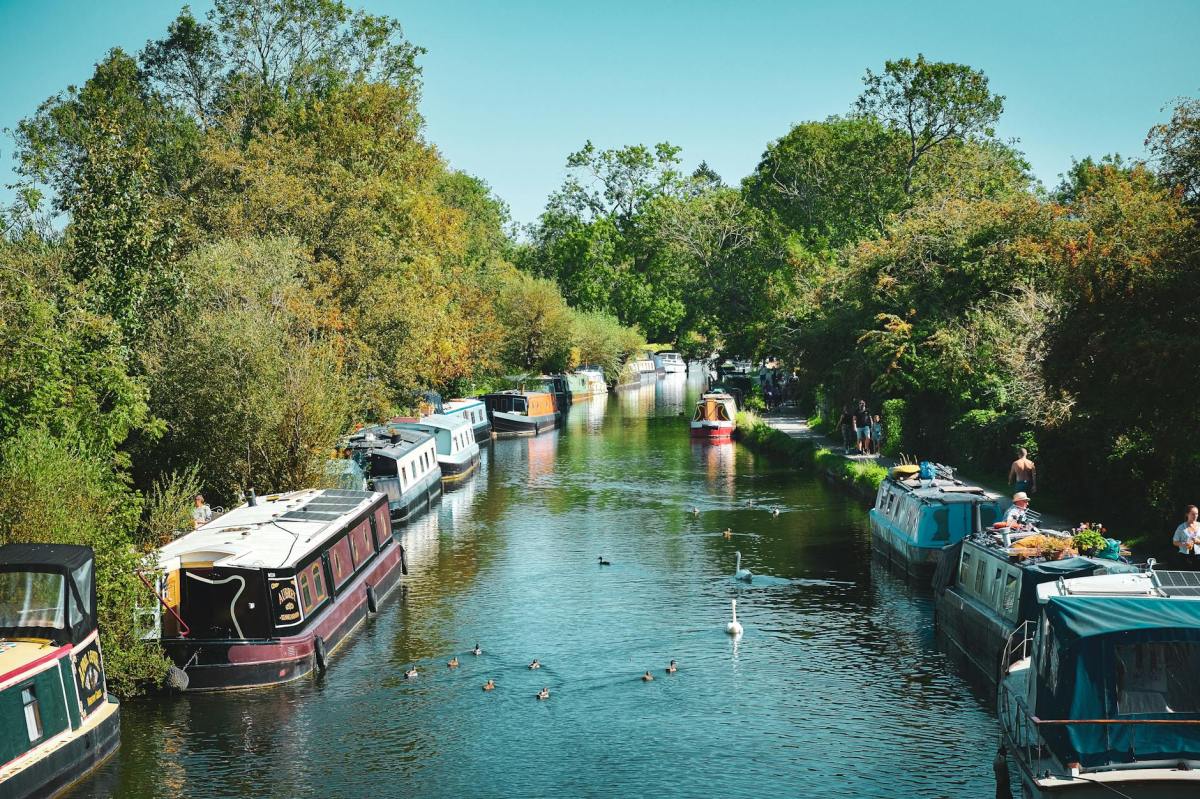
Riverside walks can be pleasant ways of spending a sunny spring evening. That’s what I did on Friday. Sun shining with a cool breeze sweeping through the trees. Underfoot even the unmade-up paths were dry, which is testament to the rainless weather of recent weeks. Even so, the riverbank showed signs of the flooding of the winter.

Reading is a town[1]. It’s England’s largest town. Now, I didn’t know that until I looked it up. The largest English town that I’ve been familiar with over the years is Crawley in Sussex. I think of that as a large town but it’s less than half the size of Reading. It’s the railway that makes Reading. Reading railway station was the last stop on the Great Western Railway (GWR)[2] when it was first opened in 1840. After that the railway forged west to be what we know now as the main thoroughfare across southern England.

Reading town has a long history. That’s no surprise given its position on the river Thames. It’s where the river Kennet, the canal and the river Thames meet. An obvious place for trading since Roman times. It’s a commercial town. Glass sided office blocks and Victorian brick work. For all that it doesn’t stand out as an architectural masterpiece.

Another surprise for me was leaning that town twinning is alive and well. That Reading in twined with Düsseldorf in Germany. A city more than twice the size of Reading. In fact, until this last year, I’ve been more familiar with Düsseldorf.

Our walk ended at The Fishermans Cottage[3]. I’m happy to recommend this small riverside pub.

From there, on the walk back to the railway station I did see the one of the more notable sites in Reading. That’s the Banksy’s Great Escape artwork[4] on Reading prison wall. Oscar Wilde spent time in that jail. The artwork has got a Perspex cover to keep the pigeons off. And anyone else who might think of spraying it.

That reminds me. It’s not unusual to have a phobia about dogs. Although dog owners mostly have a difficulty in getting their heads around the fact. On my riverside walk dogs were not the problem. Amongst our small group of walkers had a different phobia.

As we got to the confluence of the Thames and the Kennet, we discovered the phobia of one of our walkers. Alfred Hitchcock would approve. The Kennet’s tow path attracts Swans. These Swans are attracted by people with food. With no inclination to get out of the gently flowing river these lazy Swans wait for passers-by to pay attention to their needs. That’s no problem.

It’s called Ornithophobia. A fear of birds. Birds flock when free food is on offer. The worst of these can be thought of as flying rats. I talk of pigeons. That how I think of pigeons. Tom Lehrer[5] had the right idea about these annoying birdies. Frightening them away, at least for a moment, cleared our pathway. Like a flash they returned as we strolled into the pub.


[1] https://www.reading.gov.uk/

[2] https://www.gwr.com/stations-and-destinations/travel-inspiration/blogs/history-of-the-railways

[3] https://www.tripadvisor.co.uk/Restaurant_Review-g186363-d7363678-Reviews-The_Fishermans_Cottage-Reading_Berkshire_England.html

[4] https://banksyexplained.com/create-escape-march-2021/

[5] https://youtu.be/yhuMLpdnOjY

Europe Day Highlights the Need for Unity

Keeping the peace is never easy. There’s an irrational propensity to conflict in human nature. Keeping the peace is not a passive task. First, it requires communication and engagement. When those two go, trouble is not far behind. It’s by expressing concerns that each side knows where the other stands. Escalation can come when ignorance and propaganda take over.

After the second world war, institutions were established to ensure that communication and engagement became a non-stop affair. With only a small number of exceptions, the countries of the regions of the world engaged in these institutions. Those measure have contributed to making a more prosperous world.

“Never again” are two words that refer to the atrocities of war. The moto is to remind everyone that the worst can and does happen, and that perpetual effort is needed to ensure that history does not repeat itself. The concept of “lessons learned” is essential for safety and security. This is as much true for micro day to day activities as it is for the macro events that shape the path global ahead. Taking teaching not from narcissistic demigods and snake oil salesman but from the pages of history. Appeasing tyranny is not an option.

This week has been a reminder of the lessons learned from the world wars. For most people it’s been a continuing commitment to ensure such events never happen again in Europe. Sadly, let’s not be coy. Despite an overwhelming desire for peace, conflict in still Europe is a reality. But the lesson is there in black and white, appeasing tyranny never works.

Today, Friday 9th May is Europe Day. That’s because a speech by Robert Schuman[1] changed the course of European history on this day. Five years after the war in Europe had come to an end, he put forward a proposal that would make a future similar conflict impossible. The idea was to create an interdependence that would secure peace, unity and solidarity.

It worked. His proposal led to the creation of a European Coal and Steel Community. That measure lay solid foundation for what would later become the European Union (EU). Behind this is move is the echo of “Never again”. Europe has seen centuries of war. This was a moment in time to bring that to an end.

For now, 75-years on, this has been a success. It’s not a regional project with a defined end, even if it has a defined beginning. Where the EU chooses to go next is in the hands of its Member States and its citizens. Changing the course of European history doesn’t stop because the EU exists. Without the cooperation and dialogue, it provides there’s always a chance that ancient rivalries will be reignited. In fact, unscrupulous right-wing politicians[2] are trying to do that just now.

Sadly, in the UK, we stand on the sidelines, looking across the water at continental Europe. Brexit has done a great deal of damage. But as I have said, nothing is static, the world is entering an ever-uncertain phase. The opportunity for the UK to restore EU relations is open. I see the wisdom in the words of the Governor of the Bank of England. He has said the UK now needs to “rebuild” Britain’s relationship with the EU. Amen to that.


[1] www.europa.eu/!9JbCd9

[2] https://www.politico.eu/article/germany-spy-agency-walk-back-extremist-label-afd/

Cities Shaped by War

War is failure. Humans being quick to aggression, possessive and slow to reconciliation, it’s plagued every corner of history. Reason to go to war can be imperial, territorial, moral or ethical. In a democratic society, defeating an evil becomes an overwhelming imperative. That was certainly the case in the six years of the second world war. This week, it’s time to look back. To recollect the impact of the world war. To remember the sacrifice and suffering. To be thankful for the last 80-years years of relative peace in Europe.

For me these recollections take me to the experience of living in two cities. Cities on different sides of past conflicts. Severely damaged by the conflict. Targets because of their civic and industrial strength. Both cathedral cities with an ancient heritage.

My student life was spent in Coventry[1]. A decade of my working life was spent in Cologne[2].

Arriving as a fresh-faced student in the heart of the industrial Midlands, the architecture of Coventry city centre was so striking. It was that post-war vision of rebirth at a time when economic decline had set in. With an inner ring-road that was like a go-cart track, 50s style concrete avenues, windblown and neglected, there was little of the Medieval splendour of the pre-war city remaining. Standing proud in the middle of it was, and is, the skeleton of the old cathedral and the new one that ascended like a phoenix from the flames of war. Well worth a visit, the cathedral built in the 60s is a wonderful modern design. It plays with light and space to elevate emotions. A sign that we have a great capacity for reconciliation and regeneration.

Moving on just over 20-years, my encounter with Germany’s fourth largest city was full of hope and optimism. Based in Cologne, I experienced a city with even deeper roots than Coventry. Ironically, it was the destruction of the war that uncovered much of the Roman remains on display. At Cologne’s heart is a magnificent gothic cathedral that is more dominating of the landscape than perhaps ever it has been. Here the citizens of the city took a different approach to post-war rebuilding. Not so much embracing everything that was new, although there’s quite a bit of that approach, but reconstructing the old city in its original style. The culture of the city survives in the traditions of the annual carnival.

These two European cities have taken different paths. All the same, there are threads of common experience. Both have seen industrial decline and a search for a better future to thrive and grow. Both are distinctive and culturally colourful. Both carry the baggage of a brutalist architecture that was fashionable on the drawing boards of the late 1950s.

Visting the past in museums and walking the streets the marks of the last war are there to be seen by everyone. Passed by every day. Yet, mostly ignored in the humdrum of commuting and the busy obsession we have of staring at a “mobile” or call it a “handy”. Now and then it’s as well to look up. To look and see the bullet marks on stone structures, the nicely arranged medieval or Roman stones and cobbles, or the conserved streets that contain the ghosts of past generations. For good or ill, war has shaped the world we inhabit.

Peace is a far far better condition. I think of the “Coventry Cross of Nails[3]” as a symbol of reconciliation and peace. Let’s not forget.


[1] https://www.coventry.ac.uk/

[2] https://www.koelner-dom.de/en

[3] https://www.coventrycathedral.org.uk/reconciliation/community-of-the-cross-of-nails

The Value of Public Service

In praise of public life[1]. That sound like such a strange sentence to utter about this last week. It’s been local election week. First Thursday in May is traditionally the day of elections in the UK.

It’s good to say that a political life is a positive. I’d say most councillors elected in this crop are motivated by the simple idea of public service. Yes, a lot of them will have completely different understanding as to what that means but there’s a general desire to make life better.

Naturally, there are the exceptions. That is those people who are ideologues, intent on imposing their views on people regardless of rational belief or any basic understanding of how the world works. Yes, I am talking about the blip that is the current results for the Reform Party. Blip it is. Like it or not, the turnout for local elections is sadly unimpressive.

Party politics is in jeopardy. I’ve nothing to object to politicians who take an independent line. It’s often those individuals who cross boundaries and unravel roadblocks to stop a stasis descending over a political assembly. A council chamber full of sheep helps no one.

To command popular support a practical political party must be a board church. We have a common expectation that decision-making forums be made up of our peer group. It’s embedded in the jury system. If decision-making in the public realm becomes so disconnected from everyday life, then respect is lost. However, if ever changing newspaper headlines drive governance – well, you get my point.

I say, conventional Party politics is in jeopardy because popularism is distorting the playing field. If a political Party becomes a rabble-rousing creature that sits on the backs of the electorate, then no good will come of it. That’s especially true when issues pursued are nothing much to do with the remit of a Council.

My prediction is that the new Reform councillors will soon get locked into lots of noisy arguments over issues that bypass the things that need to be done in each locality. No fixing potholes or planting trees when meaningless debates about “woke” can be had. No improving recycling achievements or properly funding care provisions. No building affordable housing or cleaning up waterways.

For political leaders and parties to regain respect and support there needs to be less communication about the possible ways and means and more about what’s been done. Populism takes over when people become fed-up with endless jam tomorrow arguments. The cycle of empty promises feeds the demigods.

My advice. Even if it’s just one pothole is fixed – tell people.


[1] Book Title – In Praise of Public Life : the Honor and Purpose of Political Science