
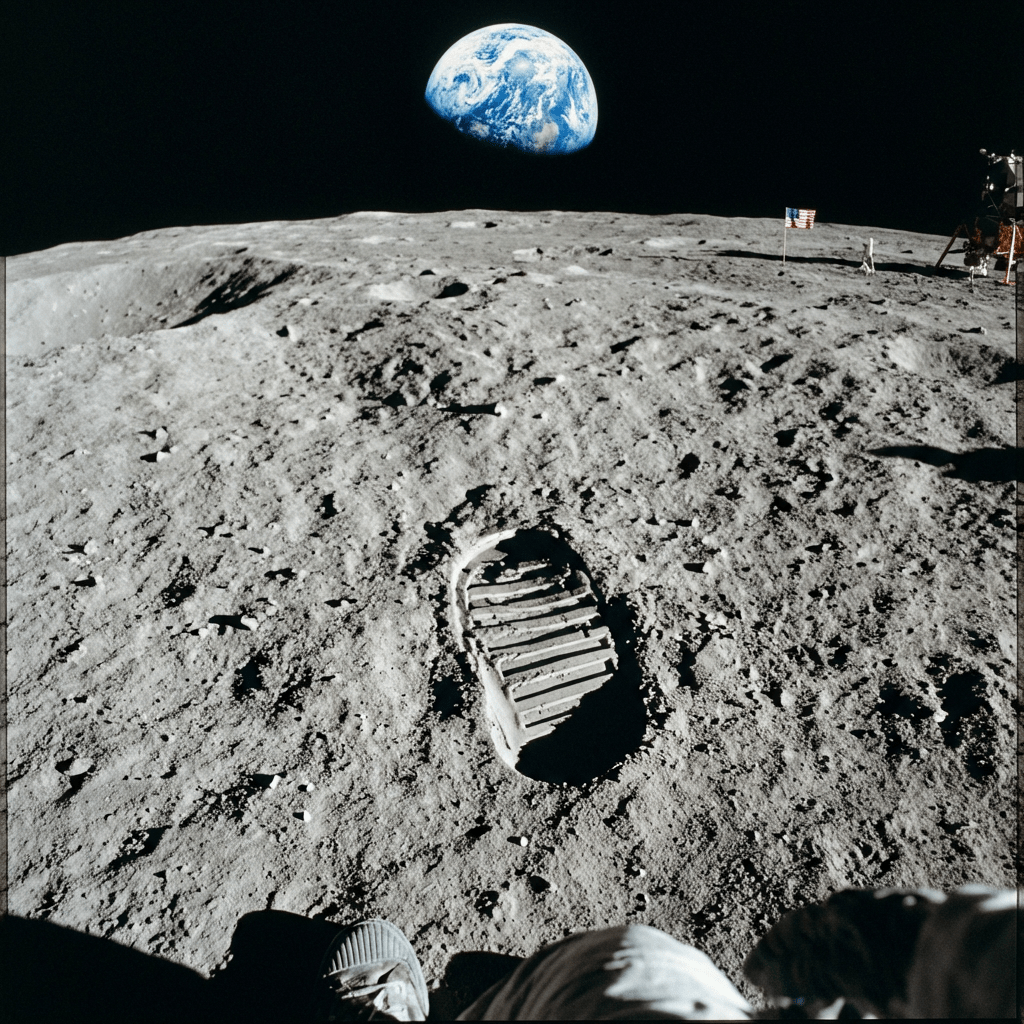
Return to the Moon is the aim of the latest American project to venture into space. It’s an ambitious attempt to get to the Moon and eventually to establish a base on its surface.
For fans of the British TV series Space 1999 it’s a possible realisation of Moon base Alpha. Although the reality is likely to be rather more modest in size. As far as we know there’s no aliens to repel or possibility of being spun into the empty void of space.
Setting up camp on a Moon, with no atmosphere and much less gravitational pull than Earth, is not for the faint hearted. Just the act of landing on it without crashing into it takes considerable skill. I remember early computer games based on a simple lunar lander. Block graphics written in BASIC floating across the screen.
Look as hard as you can, there are no signs of cows jumping this morning. That nursery rhyme is to be left on the shelf. If the Moon bound astronauts should see a cow on their mission, then I’m sure that it’s more a case of something they ate rather than a bovine space traveller.
This space mission should take humans further away from our home planet than any human has travelled. Hopefully this will happen as per the script. It seems strange that it has taken until 2026 to mark this great achievement.
Makes me think of the HHGTTG and the reference to humans being so lazy that they can’t be bothered to travel to their closest star. Afterall the plans for the demolition of the Earth have been sitting there for all to see for eons.
In fictional space travel terms this mission to the Moon is baby steps. A hop to our constant satellite. Both an opportunity to admire it close and look back at the Earth. To look back to see the whole Earth. Not a single boundary fence or line on a map. Not a palace or bunker.
Passing over the dark side of the Moon has been done before. Immortalised by Pink Floyd, the dark side is a unique place that few have seen with their own eyes. Yes, a spacecraft has landed there but there remains something spooky about the face that’s turned away from us.
One thing is for sure. Should they succeed, these 21st century astronauts can report back to US President Trump. They can finally confirm that the Moon is not made of green cheese. Rumours may persist amongst the flat earthers. Conspiracy theories do the rounds on a regular basis. Modern popular culture hasn’t embraced the green cheese theory – yet.
Return to the Moon is a grand ambition. Not a lot of practical benefits to be gained in the short-term. This is more a venture for the long-term. If we are to become a spacefaring race, then these are steps that must be taken.





 John Vincent